A Thousand Shall Fall

A Thousand Shall Fall

A Thousand Shall Fall

By Susi Hasel Mundy

This inspiring book recalls the story of a Seventh Day Adventist leader who was drafted in the German army during World War II. He refused to break the Sabbath and suffered because of it. His wife refused to give their children exams on the Sabbath and they resisted all pressure to join the Nazi party. He warned Jewish people to flee as the German army advanced. This book is not a Scriptural examination of the seventh-day Sabbath; it is a story of faith put into practice. Against all odds, he honored God’s Holy Day and survived the war.

To learn about this inspiring story, click the link below:

https://biblesabbath.org/shopping/pgm-more_information.php?id=22&=SID

Sabbath Evening (Erev Shabbat) Family Service

Sabbath Evening (Erev Shabbat) Family Service

(also Called “Erev Shabbat”, Hebrew for Evening of the Sabbath)


Throughout the week, we are all running to and fro. We are going to ballgames, work, school, and other events. The Erev Shabbat Service is a special service performed by the Jewish people for over 2,000 years. It would have been performed in the time of Jesus. It is a great way to welcome in the Sabbath as a family and make the dividing line between Holy Time of the Sabbath and the common time of the week we are leavening behind.

While it is mostly performed by Sabbath keepers with a Messianic background, it is a great learning tool for all Sabbath keepers. It is a way to speak life and blessing into your family. It is a great way to spend interactive time with your family.


Just click the link below to access this FREE resource!

https://kellymcdonaldjr.com/erev-shabbat-ceremony/

Sabbath Traditions

Sabbath Traditions

By Lois Lemley

“A family tradition passed down through my mother’s family (Andrew and Effie Dugger) was Friday night music. The family would gather around the pump organ. Grandma Effie would play the organ while the family sang. An added feature was that one of the lampstands on the organ was a kerosene lamp and on the other lampstand was Little Speck. Little Speck was a tiny bantam hen who heard the music, came in, hopped up on the lampstand and “sang” and danced as the family sang…”

(this article is an excerpt from the Sept-Oct 2016 edition of the Sabbath Sentinel)

To read the rest of this article, which starts on page 20, click this link:

http://biblesabbath.org/media/Sep-Oct_2016_small.pdf


Five Myths about Sabbath Keepers

hand.jpg

Five Myths about Sabbath Keepers

By Kelly McDonald, Jr.

Myth #1: Sabbath keepers belong to a cult

Unfortunately, this is often the first thing we hear when others find out that we honor the Sabbath from Friday sunset to Saturday sunset. I cannot fully identify where this misconception comes from – likely just because we are different. We have not been drugged or brain washed into following the Sabbath. We have studied the Bible and arrived at the conclusion to follow the example of Jesus.


Myth #2: Sabbath keepers only think God can answer prayer one day a week.

I am accused of this belief by non-Sabbatarians. I honestly have never met or heard of a Sabbath keeper who believes this – and I have connections to thousands of them. There might be a few radicals out there who think this way, but it is certainly not the majority belief of the Sabbath community. Many Sabbath churches host prayer meetings and even Bible studies on other days of the week. While we rest on the Sabbath and honor the example of Jesus, we also seek God daily in our lives.

Myth #3: Sabbath keeping started in the 1800s

Another myth we commonly hear is that no Christians honored the Sabbath until the 1800s AD. We know Jesus and the early Apostles actually honored the Sabbath (see Matthew 12:1-8, Acts 13:13-48 for a couple of examples). Historically speaking, most Christians honored the Sabbath into the 400s-500s AD (CLICK HERE to read more). On this site, we have posted a number of blogs discussing this. You can actually find Sabbatarians who believed in Jesus in every century from Christ to the present.

Now, where does the misconception come from?  The world’s largest Sabbatarian group is the Seventh-Day Adventist Church, which has millions of members today. This group has its origins in the mid-1800s. Due to this, many people think their group was the first group to practice the Sabbath. The Seventh-Day Adventists were influenced to keep the Sabbath by Seventh-Day Baptists, who can trace their origins to the 1500s. And there are other Sabbatarian groups that precede the Seventh Day Baptists.


Myth #4: We hate people who don’t keep the Sabbath.

This is another misconception. Most Sabbath keepers I know are very kind and function fine in the work place with others no matter their religious background or denominational affiliation. Just because we disagree with people about the Sabbath does not mean we hate them.

We believe very strongly about the Sabbath, but we are often treated differently because we keep the Sabbath. We are accustomed to mistreatment on jobs and exclusion from family and friends. Due to this, Sabbath keepers are discerning about their friends and can come across as being cautious or reserved. We certainly do not hate people who do not honor the Sabbath.

Myth #5: Sabbatarian children are socially and emotionally handicapped.

There are plenty of events in our society that take place on the Sabbath such as sports, non-Christian concerts, etc.  We abstain from many cultural activities that happen on the Sabbath. We raise our children to do the same.

There is a misconception that we are socially and emotionally handicapping our children because we do not participate in certain activities on Sabbath. The premise of this misconception is typically rooted in fear. How are we handicapping someone for teaching them to live like Jesus? Was Jesus socially and emotionally handicapped?

Instead of being afraid, think about the wonderful lesson being instilled. We are teaching our children that we will stop worldly activities to honor God as Jesus did. This reinforces the idea that God comes first. We learn that temporary gain is secondary to honoring God. Again, our focus is Jesus, not someone else. This lesson is reinforced throughout childhood.

The idea that Sabbatarian children are handicapped is also not rooted in fact. Our children still play sports and participate in extracurricular activities; we just abstain from most of them on Sabbath.  Sabbatarians have been successful in business and even served in many positions in society.

Ben Carson honors the seventh-day Sabbath; he is a brilliant neurosurgeon and has ran for President. In 2017, five men gave benedictions during the President’s inaugural address. One of them, Bishop Wayne T Jackson, honors the Sabbath.  There are millionaires and billionares that honor the Sabbath. Some are Christian and some are Jewish. They display that honoring the Sabbath does not hinder us financially, socially, or otherwise. Some famous companies were formed by Sabbath keepers (such as Kellogg’s). For a modern example, research Billionaire Adam Neumann.

There have been professional athletes that also honored the Sabbath.  Dmitriy Salita is an Ukrainian-born welterweight boxer is an orthodox Jew who will not fight on the Sabbath. Ed Correa, from Puerto Rico, is a Seventh Day Adventist.  He played 3 seasons in the major leagues and was a starting pitcher. The Texas Rangers adjusted their rotation to accommodate Correa’s religious beliefs.

At the same time, there have been some athletes who left professional sports to honor the Sabbath. Trevor Bullock was a tremendous pitching prospect for the Philadelphia Phillies. He was considered one of their top minor-league pitchers. However, he was convicted about the seventh-day Sabbath and decided to walk away from the game altogether. When asked about having any regrets for leaving baseball, he said, “No. Well at first I regretted that I didn’t do it sooner. But then I look at the journey; it has made me stronger and made me trust God more. I am healthy, happy, and I’m getting married.” (to see more of his story, read: http://archives.adventistreview.org/2002-1538/story1.html).

I sincerely hope that this article will help you have a better understanding of Sabbath keepers and how to interact with them.

Kelly McDonald, Jr. is President of the Bible Sabbath Association (BSA)

www.biblesabbath.org

Israel of the Alps (DVD set)

Prod-IsrealoftheAlps191x250

Israel of the Alps (DVD set)

The Waldenses were a group of Sabbath keepers who dwelt in the Swiss Alps for a period of just over 1,000 years. This stirring 3-part, 85 minute DVD, documents the History of these people. They were hunted down mercilessly by the Catholic Church. Despite intense sufferings they clung to the Word of God. Many lost their lives. This DVD was filmed live on location in the Alps.

To order this astounding documentary, click the link below!

https://biblesabbath.org/shopping/pgm-more_information.php?id=34&=SID


52 Sabbath Activities for Teen Groups

52 Sabbath Activities

52 Sabbath Activities for Teen Groups

By Don Pate

Here are 52 proven, surefire, guaranteed ─ fun activities to make Sabbath really special for teens! Each activity section gives you step-by-step instructions for making it happen and tells you what preparation and materials you’ll need and the minimum time required for the activity. Whether you’re a youth leader, teacher, or pastor, you’ll find this book a valuable resource for creating Sabbaths that bring teens exciting fellowship with God and Christian friends.

To order this book, just click the link below:

https://biblesabbath.org/shopping/pgm-more_information.php?id=104&=SID

Correcting a Commonly Shared Meme

Correcting a Commonly Shared Meme

By Kelly McDonald, Jr.

MEme

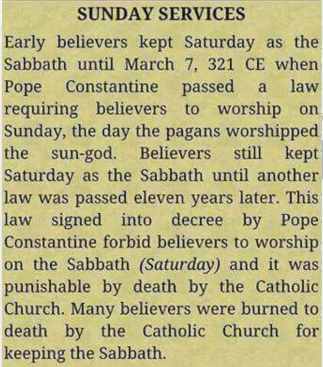
There is a specific meme (found above) that has been widely circulated by Sabbath keepers. The problem is it contains many historical inaccuracies. It is important to check our facts before sharing information to the public.  Let’s look at what is true and what is not about the meme.

First of all, Constantine was not a pope. Constantine was Emperor over the Western Roman Empire in 321 AD (and then over the entire Roman Empire in 324).

Secondly, it is TRUE that Constantine received a law on March 7, 321 AD regarding the observance of the day of the sun (what we call Sunday). The decree required people in cities to rest. People in the country, especially farmers, were exempted from this so they could work the fields. Here is a copy of the original decree:

“All judges, city dwellers, skill workers, and the offices of all should honor the venerable day of the sun and rest. However, those placed in the country freely serve the fields of culture, because it often happens that no other better on corn grains or vineyard transplant recommended that lost an important opportunity to benefit from the heavenly provision granted” (Codex Justinian: 3.12.2).

In the Latin, the phrase translated as “venerable day of the sun” is venerabilis dies solis. Constantine’s decision was based upon honoring and esteeming the celestial body we call the sun. There are no records of punishments for those who may have violated this law.

Third, this decree did not ban the True Sabbath. It simply added Sunday as a day of rest for most people.

Fourth, there was not another Sunday law passed eleven years later. Constantine passed two Sunday laws in 321; there are no records of Sunday laws being passed by Roman Emperors until 386 AD (CLICK HERE to learn more about other Sunday Laws in the Roman Empire).

Fifth, there is no evidence that Constantine put Christians to death for honoring the Sabbath. No such command is found in any of his decrees. At the end of his life, he was baptized by an Arian believer. The Arians had Sabbath-keeping tendencies. There is no evidence of anyone being put to death for the Sabbath at this time in European history. Constantine actually protected Sabbath observance (CLICK HERE to read more).

Lastly, the majority of Christians still honored the seventh-day Sabbath into the 400s/500s AD. Here are some primary sources that confirm these details: Chrysostom, Eight homilies against the Jews, 1.5 and Commentary on Galatians 1:7; Augustine, letters 36 and 82; Sozomen, Church History, 7:19; Socrates, Church History, 5:22, 6:8. To read these primary sources, just click the following link: Sabbath Keeping in the 300s/400s AD,

BREAK THROUGH DISCOVERY: Constantine protected Sabbath observance. To read more, click this link.

CLICK HERE to read a FREE book about Constantine and the Sabbath.

Thank you for reading and God bless!

Kelly McDonald, Jr.
BSA President http://www.biblesabbath.org

From Sabbath to Sunday

Prod-FromSabbathToSunday125x164

From Sabbath to Sunday

By Dr. Samuele Bacchiocchi


In this intriguing book, Dr. Bacchiocchi explores in detail historical events that surround the Catholic Church changing the day of worship from Sabbath (Saturday) to Sunday. He explores how paganism and Anti-Semitism played a large role in luring people away from Sabbath keeping.

Here is an excerpt from pages 185-185:

“The adoption and enhancement of Sunday as the exclusive new day of worship presupposes the abandonment and belittling of the Sabbath. We would presume therefore that the Church where Sunday worship was first introduced and enforced adopted some measures to discourage Sabbath observance. While it must be admitted that we have evidence for the observance of both days, particularly in the East, this must be viewed as a compromise solution on the part of those who wished to retain the old Sabbath while at the same time accepting the new Sunday worship. Their very concern to preserve some type of Sabbath observance disqualifies them as the pioneers of Sunday-keeping, since they could hardly have championed the new day while trying to retain the old. In the church of Rome, the situation was substantially different. Not only was Sunday worship urged there, but concrete measures were also taken to wean Christians away from any veneration of the Sabbath…”

To order this book, please click the link below:

https://biblesabbath.org/shopping/pgm-more_information.php?id=9&=SID

The Resurrection of Jesus Christ

The Resurrection of Jesus Christ

By Bryant Buck

“People often ask this question: “Aren’t all religions essentially the same?” In other words, if they all believe that there’s a deity, and that there’s a basic moral code, aren’t all religions essentially the same?

For example, people often point to the fact that Judaism, Christianity, and Islam all believe in one God and that this one God gave us a basic moral code. Then are Judaism, Christianity, and Islam essentially the same?

The answer to the question posed at the beginning of the above paragraph is a most emphatic “No.” All of the world’s major religions are not the same; in fact, Judaism, Christianity, and Islam are barely similar. These last three have some similarities as noted above, but they also have marked differences. Christianity, in particular, has one truth that sets it apart from all other religions – THE RESURRECTION OF JESUS CHRIST….”

(this article is an excerpt from the Summer 2015 edition of the Sabbath Sentinel)

To read the rest of this article, which starts on page 4, click this link:

http://biblesabbath.org/media/TSSSUMMER2015.pdf

Some Bible Translations Remove References to the Sabbath

Sabbath Bias
Some Bible Translations Remove References to the Sabbath

…a disturbing trend!

There are a variety of Bible translations. Some are older and some are newer. Among the newer translations, there are those that have removed some or many references to the Sabbath. This is a disturbing and dangerous trend.

Translations should be concerned with the original language of the text, not theology. If people are allowed to toy with the original text of the Bible, then where will such changes stop? We have identified some of these translations and provided some examples below.

Translation #1: God’s Word Translation (printed 1995). In the Old Testament, we find the Hebrew word Shabbat translated as “seventh day.” However, in the New Testament, the Greek term sabbaton and other related words are rendered “day of rest.”

Example: Matthew 12:1-8 “12 Then on a day of rest—a holy day, Jesus walked through the grainfields. His disciples were hungry and began to pick the heads of grain to eat. 2 When the Pharisees saw this, they said to him, “Look! Your disciples are doing something that is not right to do on the day of rest—a holy day.” 3 Jesus asked them, “Haven’t you read what David did when he and his men were hungry? 4 Haven’t you read how he went into the house of God and ate the bread of the presence? He and his men had no right to eat those loaves. Only the priests have that right. 5 Or haven’t you read in Moses’ Teachings that on the day of rest—a holy day, the priests in the temple do things they shouldn’t on the day of rest yet remain innocent? 6 I can guarantee that something greater than the temple is here. 7 If you had known what ‘I want mercy, not sacrifices’ means, you would not have condemned innocent people. 8 “The Son of Man has authority over the day of rest—a holy day.”

Translation #2: Names of God Bible (printed 2011) – This translation renders the Hebrew word Shabbat in the Old Testament as “seventh day.” This is in the same manner as the previous translation as we discussed. However, in the New Testament, the Greek term sabbaton and other related words are rendered “day of worship.”

Example: Matthew 12:1-8: “1Then on a day of worship Yeshua walked through the grainfields. His disciples were hungry and began to pick the heads of grain to eat. 2 When the Pharisees saw this, they said to him, “Look! Your disciples are doing something that is not right to do on the day of worship.” 3 Yeshua asked them, “Haven’t you read what David did when he and his men were hungry? 4 Haven’t you read how he went into the house of God and ate the bread of the presence? He and his men had no right to eat those loaves. Only the priests have that right. 5 Or haven’t you read in Moses’ Teachings that on the day of worship the priests in the temple do things they shouldn’t on the day of worship yet remain innocent? 6 I can guarantee that something greater than the temple is here. 7 If you had known what ‘I want mercy, not sacrifices’ means, you would not have condemned innocent people. 8 “The Son of Man has authority over the day of worship.”

In this translation, even the title for Psalm 92 has been edited: “A psalm; a song; for the day of worship.” It should actually be rendered: “A Psalm: a Song for the Sabbath.”

In these first two translations, the rendering of the Greek word for Sabbath as “day of rest” or “day of worship” are totally contrary to the original language. Such translations cheapen and diminish the seventh-day Sabbath, which Christ and the earliest believers obeyed. It is mentioned in about 140 Bible verses.

There are three others we will look at:

Translation #3 – The Passion Translation, published in 2017, puts the following title above Psalm 92:1: “A Sunday Morning Song of Praise.” The introduction to Psalm 92 is translated as “a poetic praise song for the day of worship.” Once again, the original Hebrew is “A Song of Praise for the Sabbath.” The Hebrew word Shabbat never means Sunday morning or just simply “the day of worship.”

Translation #4 – The Message Bible, published in 2002, adds the phrase “Sunday morning best” to a passage that has nothing to do with the first day of the week. Isaiah 52:1-2 “Wake up, wake up! Pull on your boots, Zion! Dress up in your Sunday best, Jerusalem, holy city! Those who want no part of God have been culled out. They won’t be coming along. Brush off the dust and get to your feet, captive Jerusalem! Throw off your chains, captive daughter of Zion!” It would never be in the mind of a Jewish prophet to “dress up in your Sunday best.” I am well aware that in many Western countries this is a common saying, but it is not what the original text says.

Translation #5 – The Living Bible (published in 1971) renders the introduction to Psalm 92:1 “A song to sing on the Lord’s Day.” Again, this introduction should be translated as “A song for the Sabbath day.” The phrase “Lord’s Day” is not found in the text.

According to the prophecy of Daniel 7:25, we learn that the “times and the laws” would be changed by the little horn. The Aramaic word translated as times is zeman, and it is the equivalent of the Hebrew word moed. The Hebrew word moed refers to the festivals of Leviticus 23, the first of which is the Sabbath. The Sabbath will be attacked in all times, but especially in a time of mass media where large amounts of information can travel quickly. These attacks began in the second century and continue to the present day.

I definitely encourage you to share the faults of these translations with others so they can be avoided and confusion would not be caused.

Kelly McDonald, Jr.

BSA President – www.biblesabbath.org