March 7, 321 AD – Constantine’s Sunday Law
by Kelly McDonald, Jr.
On March 7 321 AD, Constantine approved the “day of the sun” as a day of rest for the Western Roman Empire. It was a law enacted to honor the sun god by requiring rest for those who lived in the city. Those in the country were exempt from it. Below I have provided an English translation of this law:
“All judges and city people and the craftsmen shall rest upon the venerable day of the sun. Country people, however, may freely attend to the cultivation of the fields, because it frequently happens that no other days are better adapted for planting the grain in the furrows or the vines in trenches. So that the advantage given by heavenly providence may not for the occasion of a short time perish.” (Codex Justinian 3.12.2 [some list as 3.12.3]; English: Ayers, pp 284-285; Latin: Krueger, p 127)
As we look at this first law, there are no references to the God of the Bible or Jesus. It did not force anyone to worship anything. Moreover, it contains no references to the seventh-day Sabbath of the Bible. At that time, the Roman Church emphasized the use of the phrase “Lord’s Day” to refer to Sunday; it is missing from the law because the Roman Church did not emphasize Sunday rest yet.
Notice in Constantine’s decree that farmers were not allowed this day off of work. It applied to those in the cities, not the country. The Biblical Sabbath (Friday sunset to Saturday sunset) was a day of freedom for all people, regardless of their occupation. This extends even to farmers in their busiest seasons (Ex. 34:21).
In Latin, the phrase translated as “venerable day of the sun” is venerabili die solis. Constantine’s law was based upon honoring and esteeming the celestial body we call the sun. The Mithras cult was a favorite for Roman Emperors, especially Constantine. He minted coins as late as the 320s AD honoring Sol Invictus, the invincible sun god (Encyclopedia Britannica “Mithras”, Cath. Encycl. “Constantine the Great”). On some of these coins, he was crowned by Sol (see Sear, pp 363-491). We have an example of a coin below:
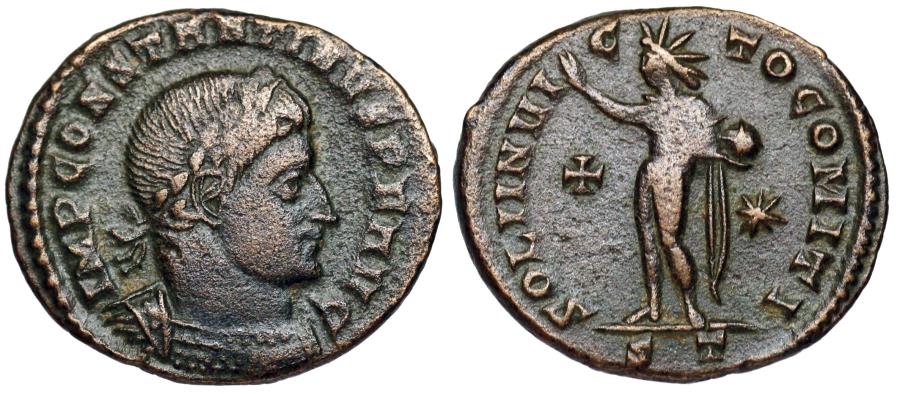
On one side of the coin, you see Constantine’s face. The inscription reads IMP (short for Imperator) Constatantius PF (short for Pius and Felix, or Pious and Happy) AVG or Augustus. On the other side is the sun deity, Sol Invictus, with the inscription: SOL INVICTO COMITI, which means “Sol Invictus, my companion.” There is also a cross symbol beside the sun deity. This coin was minted in 316, which was several years before his famous Sunday law. He struck coins with Jupiter’s likeness on them as late as the mid-320s.
While Constantine’s decree did not change the Sabbath, it created a civil day of rest beside it. CLICK HERE to learn more about how Constantine protected Sabbath observance. His first Sunday law also did not force any sort of worship on his subjects, though the law itself was dedicated to the sun.
The Catholic Encyclopedia states: “…many of the emperors yielded to the delusion that they could unite all their subjects in the adoration of the one sun-god who combined in himself the Father-God of the Christians and the much-worshipped Mithras; thus the empire could be founded anew on unity of religion. Even Constantine, as will be shown farther on, for a time cherished this mistaken belief…. Many other actions of his also have the appearance of half-measures, as if he-himself had wavered and had always held in reality to some form of syncretistic religion…” (Article: Constantine the Great).
Long Term Outlook
While this law did not affect the Sabbath, it did set a precedent with long-term implications. About 50 years after his death, Theodosius I and later emperors enacted Sunday rest laws with added Christian meaning. As the Roman Catholic Church gained political influence in the Dark Ages and Middle Ages, their leaders pressured temporal rulers to force Sunday rest. In modern times, some regions and countries still have Sunday rest laws that exist in some form or fashion.
One could argue that his Sunday rest laws were among the most impactful rulings made by emperors in ancient times – as the effects are seen even today.
For more commentary on Constantine and the effects of this March 7, 321 law, please click HERE – Did Constantine Change the Sabbath?
To read Constantine’s second Sunday law, click HERE – Constantine’s Second Sunday Law
Kelly McDonald, Jr.
Bible Sabbath Association (BSA) www.biblesabbath.org
Bibliography
Ayer, Joseph Cullen. A Source Book For Ancient Church History. New York: Charles Scribner’s Sons, 1913. pp 284-285.
Catholic Encyclopedia: Constantine the Great; Mithras
Codex Justinian, Latin. Edited by Paulus Krueger. Corpus Iuris Civilis. Codex Iustinianus. Vol 2. Berlin, 1892. p 127.
Sear, David. Roman Coins and their Values, Volume IV. Spink, London, 2011. Pp 233-264, 363-491.

 The Sabbath Sentinel
You must be logged in to post a comment.