Leadership in the 21st Century

Leadership  for the 21st Century

by Kelly McDonald, Jr.

In the 21st century, we find ourselves in a unique situation. The world is interconnected in a way in which it likely has never been before. We have emails, text messages, social media, etc. While we have these conveniences, we also are becoming alienated from what it means to be human. Said another way, our own interconnectedness with each other seems to be replacing the need to have a genuine understanding of one’s own identity as a human.

Because this paradigm seems to be sweeping the world, Church leaders must guard themselves from behaviors detrimental to others. This is especially true in America because Christianity has been so commercialized. What do I mean by this?

Too often leaders can treat people like they are a means to an end rather than individuals with God-given intrinsic value. Ministers who do not consider the needs of others can fall into the trap of seeing people as instruments to reach goals.

This can create what I call the “fill in” attitude. Church leaders can be guilty of just trying to find anyone to “fill in” positions at church without regard to their personal/spiritual needs or even their spiritual maturity. This opens the way for people who are unprepared or who have a lack of character to be assigned roles in Church. This means the people are serving in a capacity they either should not be in or are not ready for. This can lead to abuse, immorality, and/or cause burn out.

As leaders, we must recognize the gifts of others and employ them in a way that brings God the glory. However, we must also connect with people and treat them in a way so that we do not forget that they are human.

Some questions to consider as a Church Leader when you seek to delegate tasks:

  • How well do you know the person? Have you taken the time to get to know them?
  • What gifts does a person have? Are you asking them to perform a task that they can actually carry out?
  • Are they actually ready to use that gift or do they need nurturing?
  • If they need nurturing, is there a way that you can gently and lovingly nurture them over time to use that gift?
  • Does the individual have the character and spiritual maturity to serve in the position that you are asking them to serve in? (The individual needs to display consistent character over a period of time before they can be trusted with any of God’s work. Keep in mind – some tasks require more spiritual maturity than others.)
  • What are the personal needs of that individual? Are they overwhelmed or going through a difficult time? They may not be able to handle the rigors of certain tasks (or any at all). Be aware of this and sensitive to their situation.

We cannot request something from someone that they are not able to produce. Nor can we expect someone to produce something that they do not have the character to properly represent. Moreover, we cannot push tasks on people that they are too overwhelmed to properly carry out.

Verses that can help us with this process: Leviticus 19:11-18 – Do not defraud others; Love your neighbor as yourself; Luke 22:24-30 – leaders are called to serve; Galatians 6:1-5 – Bear one another’s burdens; Romans 12:3 – Let us not think more highly of ourselves than we should; Romans 13:8-10 – Love one another. Phil. 2:3 – Do nothing out of selfish ambition and esteem others higher than yourself; I Timothy 3:1-13 – Standards for certain offices in the church and instruction that new believers should not serve in these positions.

There are certainly other verses on this subject, but these are some very important ones to guide us in this process. As we lead in the 21st century, let us not be found guilty of allowing attitudes of this world – such as the tides of commercialism and collectivism – to drown out individuality and the image of God.

Kelly McDonald, Jr.

BSA President (www.biblesabbath.org)

The People of God Must Preserve the Blessings of God

The People of God Must Preserve the Blessings of God

by Kenneth Ryland

“[T]he right to freedom being the gift of God Almighty, it is not in the power of Man to alienate this gift, and voluntarily become a slave.” —John Adams

A friend and I were talking at church about the great blessing for the people of God that is the United States of America. We have the freedom to assemble as we wish with whomever we wish. We can study the Bible without interference. We have the freedom to travel from place to place to preach the gospel, and we have the incredible blessing of wealth to carry the message

of Christ beyond our borders to the farthest reaches of this earth. What more could any Christian ask in this world? I truly believe that if the USA did not exist, God would find a nation to bless with freedom and wealth in order to carry his message of salvation to the entire world.

Given that the Great Creator of the universe has laid in our laps all of these blessings, why do we insist on placing the care of these blessings in the hands of godless men? We are loathe to take up the challenge to govern, so we elect leaders who constantly seek to raise our taxes, restrict our movements, and limit our God given freedoms…”

(this article is an excerpt from the May-June 2006 edition of the Sabbath Sentinel)

To read the rest of this article, which starts on page 7, click this link: http://biblesabbath.org/tss/519/tss_519.pdf


Sabbath Meditation #14 – Drawn Into His Presence

Sabbath Meditation #14 – Drawn Into His Presence
by Kelly McDonald, Jr.

“So he drove out the man; and he placed cherubim at the east of the garden of Eden, and a flaming sword which turned every way, to guard the way to the tree of life.” (Genesis 3:24)

“Cain left The LORD’s presence, and lived in the land of Nod, east of Eden.” (Genesis 4:16)

“1 Afterward he brought me to the gate, even the gate that looks toward the east. 2 Behold, the glory of the God of Israel came from the way of the east… 4 The LORD’s glory came into the house by the way of the gate which faces toward the east. (Ezekiel 43:1-2, 4)

46 “‘The Lord The LORD says: “The gate of the inner court that looks toward the east shall be shut the six working days; but on the Sabbath day it shall be opened, and on the day of the new moon it shall be opened…The people of the land shall worship at the door of that gate before [paniym] The LORD on the Sabbaths and on the new moons”.  (Ezekiel 46:1, 3)

When Adam and Eve dwelt in the Garden of Eden, where the first Sabbath was honored, the presence of God was with them. God would come down in the cool of the day and fellowship with them. After they transgressed in the Garden, they were driven to the East. In the very next chapter, Cain killed his brother. He also went out from the presence of the Lord to the East.

The Hebrew word translated as presence is paniym. It means to be in the face of someone and by extension their presence. It does not refer to general location, but instead to a person’s face being directed towards you. All of the pleasantness (or lack thereof) that comes from that person’s presence is implied when paniym is used.

For instance, God had a good purpose for Cain – and it could have been fulfilled. God directed His attention or presence towards him and even spoke to him. Unfortunately, Cain turned away from that purpose. He subsequently left God’s presence – His face, attention, and purposes.

When we read the prophetic books of the Bible, we learn about events that will take place in the future. Among these is the building of a Temple to honor God that has never been constructed; it is described in the book of Ezekiel. It will be gigantic in size!

God explained that this Temple will have an inner court gate that faces to the East! This gate will be open every Sabbath and the glory of the Lord will enter into it! The people will also come and worship in the presence the Lord through that same gate.

When we read the Bible, God declares the end from the beginning (Is. 46:10). Let us connect the verses we have reviewed.

Since the beginning, mankind has gone astray to the east, away from God’s presence or face. The Sabbath exists in part as a reminder that God desires us to be in His glorious presence. He desires to see you directly in His presence so you can receive all of the benefits of being near Him.

“Seek The LORD and his strength. Seek his face [paniym] forever more.” (I Chronicles 16:11)

While we should always seek the face of God, there is a special time when God’s face can always be found: the Sabbath. While we have all strayed away from His presence, to the east, His Sabbath is open every week to receive us back.

Throughout the week, God is beckoning us to dwell in His presence on Sabbath. His face will be fully turned towards us. Honoring the Sabbath involves setting aside those things that keep our face from being turned towards Him.

Will we accept His invitation?

Selah.

Kelly McDonald, Jr

BSA President, www.biblesabbath.org

What Does the Azazel Goat Represent?

What Does the Azazel Goat Represent?

By Kelly McDonald, Jr.
The Feast of Atonement involves an intricate ceremony described in Leviticus chapter 16. Through this process, atonement was brought to the nation of Israel; they were reconciled back to God. It foreshadows our Atonement through Jesus Christ. While Christ has already atoned for our sins in His first coming, there is one aspect of this ceremony that has not prophetically been fulfilled.

The high priest began this special ritual by washing with water and putting on sacred garments. He then sacrificed a bull for his own sin and that of his household. The blood of this bull was taken into the Tabernacle and sprinkled on the Ark of the Covenant and the Altar of Incense.

The next step involved two goats. Lots were cast for them: the first goat was for the Lord and the second goat was called the scapegoat or azazel. The goat chosen for the Lord was taken to the door of the Tabernacle. The high priest would confess over it all the sins of the people. It was then slaughtered as a sin offering to make atonement for them. Its blood was applied in the same way as the bull.

The second goat was brought to the threshold of the Temple. The high priest would confess over it all the sins of the people. A man was chosen to chase this goat outside the camp and far away – to a place not inhabited by anyone else. This made the chosen man unclean. Once this was completed, he would return to the camp, wash with water, and be clean again.

Christ is our High Priest (Hebrews 3:1). He came to earth and laid down His life for our sins. Unlike the earthly high priests of the Old Covenant, He did not have to sacrifice an animal for His own sins. He is perfect. “…who doesn’t need, like those high priests, to offer up sacrifices daily, first for his own sins, and then for the sins of the people. For he did this once for all, when he offered up himself.” (Hebrews 7:27). After His resurrection, He took his own blood into Heaven to atone for the sins of the world (Hebrews 9:11-14).

Christ’s first coming fulfilled both the functions of the high priest and the sacrificial first goat. It logically follows that the fulfillment of the second goat happens after that event. There are some who propose that the second goat, called the azazel, represents another aspect of Christ’s atoning work. To further understand this second goat, we must delve into the deeper theological conceptions with animals in God’s Temple system.

In the sacrificial system, animals died in the place of the person who brought it; this is called a substitution. Leviticus 17:11 reads: “…the life of the flesh is in the blood; and I have given it to you on the altar to make atonement for your souls: for it is the blood that makes atonement by reason of the life.”

In the New Covenant, Christ is our substitutionary sacrifice. We each deserve death because we have sinned (Rom. 3:23, Rom. 6:23). Christ took on Himself the sins of the world and died in our place (Romans 5:6-21). Any animal that had its blood shed was a foreshadowing of the ultimate blood to be shed – the perfect Son of God (see Hebrews 10:1-8). This would include the first goat from Atonement.

After reviewing the concept of sacrifice, we can better consider details of the second goat and any possible connection with Christ.

The first two details of the azazel goat are very important. First, this goat was dealt with after the Lord’s goat. Secondly, though sin was placed on the azazel, it did not pay the penalty for sins, which is death. These details present problems when trying to compare azazel to Christ.

We have to ask ourselves this question: when in history did Christ take on the sins of the world a second time and remain alive? Christ is not returning a second time to bear sin; He did that in His first coming. “…but now he has appeared once for all at the end of the ages to do away with sin by the sacrifice of himself. 27 Just as man is destined to die once, and after that to face judgment, so Christ was sacrificed once to take away the sins of many people; and he will appear a second time, not to bear sin but to bring salvation to those who are waiting for him” (Hebrews 9:26b-28, NIV, emphasis mine).

Third, consider that the second goat was chased into an uninhabited place by someone who was NOT the high priest. While Christ died outside of the camp (Hebrews 13:12), he only did so in fulfilling an aspect of the first goat (Lev. 16:27). Since then, he has not been driven to an uninhabitable place. He currently dwells in Heaven, where God and a host of angels dwell (Heb. 12:22-24).

Fourth, the azazel goat caused uncleanness to the one who chased it into the wilderness. If Christ still had the sins of the world on Him (which He does not), then he would defile everything around Him in the Heavenly Temple. He would be disqualified from serving as our high priest. No such implication is made in the Bible.

Because Christ took upon Himself our sins and paid the price of death, it is impossible that He could in any way represent the second goat. Christ does not live forever in a state of sin–He lives forever in glorified perfection (Hebrews 7:28).

Who does this second goat represent? Consider the qualifications for it. 1) It takes on sin (permanently); 2) It does not die; 3) It is handled by someone who is not a high priest; 4) It is placed in an uninhabited place; and 5) It causes uncleanness to others while alive.

The very next chapter in Leviticus brings more clarity to this subject. In Leviticus 17:7, we learn that the Israelites were sacrificing to goat idols: “They shall no more sacrifice their sacrifices to the goat idols, after which they play the prostitute.” Some translations say “goat demons”. There is an obvious connection between the azazel and the goat idols (or goat demons). The worship of idols and satan are mentioned together in the Bible (Rev. 9:20; 13:1-18).

While Christ took on the sins of the world, we must remember that the first sin by Adam and Eve was influenced by the serpent or satan. He is called the deceiver of all mankind (Rev. 12:9). Satan or the devil is called the father of all lies (John 8:44). The devil has sinned since the beginning (I John 3:8). This means every lie originates with his being.

While every human has chosen to sin and disobey God, satan has participated in that sin through deception. In other words, satan is a partaker in the sins of other people. This means he also bears guilt for our transgressions. Since his sins cannot be atoned for or be taken away, they remain upon him forever. No atoning sacrifice was made for angels.

In fact, satan and his angels are eventually cast into the Lake of Fire where they will be tormented (Rev. 20:11-15). They are not allowed to die. They also impart uncleanness while they are alive. The term ‘unclean spirit’ is used as another name for satan and his minions (see Mark 5:1-13 as an example). At Christ’s return the land of Israel will be cleansed by removing the idols and unclean spirits (Zechariah 13:2).

In Matthew 12:43, Jesus described unclean spirits as walking through wilderness places. Additionally, satan will be cast into an uninhabited place called the bottomless pit by an angel, who is not our high priest, just before the Millennium (Rev. 20:1-3). As long as he is bound, the nations are not deceived.

In conclusion, satan is the only being that can meet all of the five qualifications for the azazel goat. This interpretation fits perfectly into the fulfillment of Bible prophecy as outline in the book of Revelation.

The fulfillment of Trumpets is revealed in Christ’s public return (Rev. 19:1-21). Satan is then placed in the uninhabitable bottomless pit (Rev. 20:1-3), representing the fulfillment of the Atonement azazel. The Millennium is described, which relates to Tabernacles (Rev. 20:4-6). The Great White Throne Judgment is then described, which relates to the Eighth Day (Rev. 20:11-15).

Christ laying down His life as the first goat ensured that the second goat would be condemned.

All verses, unless otherwise noted, come from the Kingdom Life Version.

Kelly McDonald, Jr.

BSA President – www.biblesabbath.org

Why Jesus Is “Lord” of the Sabbaths

Why Jesus Is “Lord” of the Sabbaths

by Ian Hufton

(Note: The four-digit numbers in the text of this article are references to Strong’s Concordance.)

“If Jesus is your Lord and Jesus is the Lord of the Sabbaths, what is your relationship to the Sabbaths? Mark 2:27-28: “Therefore the Son of Man is also Lord of the Sabbath [4521].”

“Sabbath” (the English word from Greek word [4521] sabbaton (sab’-bat-on) of Hebrew origin (7676); the Sabbath (i.e. Shabbath), or day of weekly repose from secular avocations (also the observance or institution itself).

Christ Is the Focal Point of All the Sabbaths

Few people grasp that the focal point or “person” of every Sabbath is Jesus—our Lord—whom the Father has chosen to be the “Way” we come to our Heavenly Father. The weekly Sabbath and the annual Sabbaths all exemplify aspects of Christ’s interaction with those who follow Him and plan to spend eternity in His presence. Jesus came down from the Father in heaven to enlarge man’s understanding of what God is doing for mankind….”

(this article is an excerpt from the January-February 2005 edition of the Sabbath Sentinel)

To read the rest of this article, which starts on page 14, click this link: http://biblesabbath.org/tss/511/tss_511.pdf


Keeping the Sabbath Holy (Part 2 of 2)

Keeping the Sabbath Holy (Part 2 of 2)

By Ronald L Dart

The Preparation Day

We will not be called on to discipline someone for gathering firewood on the Sabbath, but the judgment is still important.  It underlines a fundamental concept of Sabbath observance:  the preparation day.  If you are going to need firewood on the Sabbath, collect it the day before.  After all, the Sabbath does not come as a total surprise each week.

When God decided to “rain bread from heaven” for the Israelites (Exodus 16:4-30), He did it in such a way as to drive home two important lessons about the Sabbath.  Bear in mind that this is not a commandment, but an administrative statement as to how the Sabbath should be observed in this situation.  It is a judgment.  We will derive lessons from it, but we may apply those lessons a little differently under Christ’s administration.

Lesson one: The proper observance of the Sabbath requires forethought and preparation.  “Behold, I will rain bread from heaven for you; and the people shall go out and gather a certain rate every day, that I may prove them [it was a test commandment], whether they will walk in my law, or no.  And it shall come to pass, that on the sixth day they shall prepare that which they bring in; and it shall be twice as much as they gather daily” (verses 4, 5).

God gave them a very simple procedure.  Gather just enough for your family each day and eat it all.  If you gather too much and try to hold it over, it will breed worms and stink.  It was to be their “daily bread.”  Then, on the sixth day, they were allowed twice as much and told to prepare extra for the Sabbath day.  This time being carefully taught to prepare for the Sabbath day.

Lesson two: The Sabbath could not be any one day in seven.  It was established on a specific day.  Some people tried to do otherwise and were left with smelly, worm-eaten bread.  Those who went out on the Sabbath to collect manna found none and were rebuked for their efforts: “How long refuse ye to keep my commandments and my laws?  See, for that the Lord hath given you the Sabbath, therefore He giveth you on the sixth day the bread of two days; abide ye every man in his place [stay put], let no man go out of his place on the seventh day.  So the people rested on the seventh day” (verses 28, 29).

What we learn from these judgments is that the Sabbath is on a specific day, and that proper observance of the Sabbath requires preparation.  There is nothing in Christ’s teaching to change that.

What we have read so far are God’s judgments for a people fresh out of slavery.  They had to be taught, and that teaching required discipline.  There were questions to be asked about the observance of the Sabbath in that time and place, and those questions had to be answered.

When preparations were being made for building the Tabernacle, Moses’ opening instructions clarified a matter regarding the Sabbath.  Even the work on the Tabernacle would cease on the Sabbath.  In fact, they were not even to kindle a fire on the Sabbath (Exodus 35:3).  Did this mean that they could not start a fire to keep warm in case of a sudden change in the weather?  Not likely.  They were not even to build a fire on the Sabbath preparatory to resuming work after the Sabbath was over, even if the work was on the Tabernacle.  Remember, this is a judgement of Moses given on a specific occasion.  It has not been abolished.  It remains in the law as a precedent, but judgments may be interpreted differently when we face different circumstances.  Kindling a fire in our own age is hardly work.  It may only involve the flipping of a switch.  And there is no prohibition in any age to kindling a fire to get warm.  It is a matter of judgment.

Nevertheless, the concept of the preparation day calls for us to get our firewood ready the day before so we can truly rest on the Sabbath.

Much later, after the captivity when the leaders of Israel were anxious to restore obedience to God, a governor named Nehemiah rendered some judgments about the Sabbath (Nehemiah 13:15-22).  In those days some of the Jews were carrying on all their normal activities on the Sabbath day including setting up farmers’ markets in Jerusalem.  By means of a “city ordinance” he forbade the marketing of produce in Jerusalem on the Sabbath day.  There was little he could do about work done elsewhere, but in Jerusalem, he was governor.  Even when they tried to set up markets outside of Jerusalem, he drove them away.  If you have ever been to that kind of market, you will realize how it can shatter the peace of a Sabbath morning.

Some have taken this as proof that it is wrong to buy, sell, or even for money to change hands on the Sabbath.  There are five things to be considered about this passage.  First, there is nothing in the fourth commandment to prohibit money or goods changing hands on the Sabbath.  The commandment is that you are not to do any work.  Second, although it is a small point, Nehemiah was the governor, and was establishing a Sabbath keeping society.  Third, different judgments may be called for in a non-Sabbath keeping society where you have no authority.  Fourth, this is a judgment of a governor to meet a specific situation.  While it is a precedent, it is a narrow precedent.  Fifth, we have yet to consider Christ’s judgments relative to the Sabbath.

Jesus’ administration of the Sabbath was a common sense approach.  By the time He came on the scene, the Jews had rendered the Sabbath almost unrecognizable.  Following what they thought was Nehemiah’s example, they had decided how far a person could walk on the Sabbath, how much he could carry, whether one could take things out of his house if it were on fire, and even whether one could heal on the Sabbath.

Jesus and His disciples for the most part ignored the traditions of the Jews regarding Sabbath observance.  On a day when they were passing through grain fields, they were plucking ears of grain as they went (Mark 2:23).  To the Pharisees, this was unlawful and they challenged Jesus on the question.  They saw no real difference between the act of plucking one head of grain, and harvesting fifty or five thousand.  The difference was only a matter of numbers.

Now common sense tells you that isn’t so.  Obviously there is a difference between plucking a few heads of grain to eat right then and there, and harvesting your entire crop.  What is the difference?  The difference is in your intent.  One man might have gone out to collect sticks on the Sabbath to build a fire to keep warm after a sudden cold snap. This man might have gone unpunished while another man who performed exactly the same act might have been stoned.  One was reluctantly working to meet a human need, and the other was arrogantly flouting God’s law.  It was purely a matter of intent.

Jesus replied to the critics, “Have ye never read what David did, when he had need, and was an hungred, he, and they that were with him?  How he went into the house of God in the days of Abiathar the high priest, and did eat the shewbread, which is not lawful to eat but for the priests, and gave also to them which were with him?” (Mark 2:25-26).

What did this reply have to do with the Sabbath?  Merely that a simple human need like hunger could, on a rare occasion, take precedence over the law–even the fourth commandment.  Such an occasion in no way invalidates or sets aside the commandment–it is an exception to the rule.

Jesus even acknowledged that there could arise a conflict between two laws.  In Matthew’s account of this incident, Jesus continues by asking, “Or have you not read in the law, how that on the Sabbath days the priests in the temple profane the Sabbath, and are blameless?”  (Matthew 12:5).  In truth we would expect that the greater law would take precedence over the lesser, and who would argue that the sacrificial law is greater that the Sabbath?  The priests were commanded to do the work of sacrificing animals.  The Sabbath forbade work.  Which commandment took precedence?  The sacrificial law took precedence.

This deserves some consideration.  The Sabbath, Jesus continued, was made for man, and not man for the Sabbath.  Man was not expected to worship the Sabbath, but to worship God on the Sabbath.  The offerings were a part of the worship of God and so were offered every day.  They were also a presentation of the Gospel since every sacrifice pointed to Christ.

Having made this point, Jesus continued “But I say unto you that in this place is one greater than the temple” (Matthew 12:6).  If the service of the Temple could continue on the Sabbath, then so could the service of Christ.  “But if you had known what this meaneth, I will have mercy and not sacrifice, ye would not have condemned the guiltless.”  The rigid, ritualistic observance of law was not as important as mercy, according to Christ.

He concluded, “For the Son of man is Lord even of the Sabbath day” (verse 8).  Jesus is the final judge of proper conduct on the Sabbath day.  He took us beyond the ministration of death to the ministration of the spirit and defined this day at a level no Pharisee would ever have seen.

They asked Him, “Is it lawful to heal on the Sabbath days?”  They were only setting a trap–trying to find some accusation against Him.  When they asked this, there was a man standing near who had a withered hand.  Jesus asked, “What man shall there be among you, that shall have one sheep, and if it fall into a pit on the Sabbath day, will he not lay hold on it, and lift it out?”  Plainly, all of them would have rescued the dumb animal.  If not, then His question would have been meaningless.  Elsewhere, He asks a similar question regarding an ox in a ditch, plainly expecting that even the strictest Pharisee would save the animal even though it involved back breaking work.  After all, it was an emergency.  Jesus taught that work is permissible in an emergency, even to save an animal.

Then He hit them with the clincher: “How much then is a man better than a sheep?  Wherefore, it is lawful to do well on the Sabbath days.  Then saith He to the man, Stretch forth thine hand.  And he stretched it forth; and it was restored whole, like as the other” (Matthew 12:13).

You would think the dramatic healing would have been all the authority Jesus needed to pass judgment on how to observe the Sabbath, but the men went out and conspired how they might destroy Him.

It was almost as though Jesus sought out opportunities to correct the errors of the Jews.  On another occasion, He found an impotent man lying on a pallet.  He could easily have said, “rise up and walk,” but that would have left an issue unresolved.  He went on to say, “Rise, take up thy bed and walk.”  This was on the Sabbath, and the Jews had precisely defined the size of the burden a man could carry on the Sabbath.

When the Jews saw the man carrying his pallet, they said, “It is not lawful for thee to carry thy bed.”  The man’s answer is instructive: “He that made me whole, the same said unto me, take up thy bed and walk.”  He had no question about Jesus’ credentials in interpreting the Sabbath.  Any man who could heal him could certainly explain the nuances of Sabbath observance.

Did Jesus intend to completely invalidate the Sabbath?  Hardly.  What concerned Him was the trivializing of the Sabbath.

The Jews can hardly be blamed for being careful.  They knew it was carelessness on the Sabbath that had resulted in the Babylonian captivity.  They recalled vividly Jeremiah’s admonition to “bear no burden on the Sabbath day” (Jeremiah 17:22).  God had warned through Jeremiah that if they would not listen, and routinely carried a burden through the gates of Jerusalem on the Sabbath, that He would kindle a fire in the gates of the city (verse 27).  They recalled Nehemiah’s admonition that God had brought captivity upon their fathers for profaning the Sabbath (Nehemiah 13:18).

What they could not see was the difference between carrying a heavy burden of firewood, and carrying a rolled up blanket under the arm.  There is a difference, but it cannot be measured in kilograms.  Once again, it is a matter of intent.

When Jesus was challenged on the matter, He responded, “I can of mine own self do nothing: as I hear, I judge: and my judgment is just; because I seek not mine own will, but the will of my Father which hath sent me” (John 5:30).  It was not God’s intent to prevent a man from carrying even a light burden on the Sabbath, or from doing good on the Sabbath.  It was His intent to set a man free from his work on the Sabbath.

Jesus’ judgment about the Sabbath was the Father’s judgment, the Father’s intent.  It was the true interpretation of the original intent of the Sabbath law.

But Jesus also realized that there was no way He could answer all questions for all generations.  What about the questions that would arise as technology radically changed man’s lifestyle?  Would there be a continuing need for interpretation?

Jesus told, not only Peter, but all the Apostles, “And I will give unto thee the keys of the kingdom of heaven; and whatsoever thou shalt bind on earth shall be bound in heaven: and whatsoever thou shalt loose on earth shall be loosed in heaven” (Matthew 16:19, 18:18).  This does not include the power to change laws, but simply to pass judgment on doubtful matters.  Jesus’ statement does include the support of these decisions at the highest level of God’s Kingdom.

This is not to say that the ministry decide for the people what they can decide for themselves.  As it was in Old Testament times, the decision-making process was only for those things, “Too hard for you in judgment . . . being matters of controversy within your gates.”  The body of ministerial judgments, given to resolve questions and controversy, become a part of the tradition of the church.  This is a major factor in maintaining the unity of the church.

Using Jesus’ principle that the Sabbath was made for man and not man for the Sabbath, the ministry have long since determined, that while it is wrong to work at your job on the Sabbath, it’s not wrong for you to benefit directly or indirectly from the work of others.  The extreme opposite view would argue that proper observance of the Sabbath requires that we use

no electricity on that day.  We must turn off our air conditioners and use candles to light our home.  Even the candles should be lit before sundown as we are to kindle no fire on the Sabbath.

But in following that approach, we are going far beyond the requirements of the law, and we may well defeat the very purpose of the Sabbath.

The keeping of the Sabbath is very much a matter of intent.  God revealed through Isaiah the right attitude toward the Sabbath: “If thou turn away thy foot from the Sabbath, from doing thy pleasure on my holy day; and call the Sabbath a delight, the holy of the Lord, honorable; and shalt honour Him, not doing thine own ways, not finding thine own pleasure, nor speaking thine own words: Then shalt thou delight thyself in the Lord; and I will cause thee to ride upon high places of the earth, and feed thee with the heritage of Jacob thy father: for the mouth of the Lord hath spoken it” (Isaiah 58:13,14).

The purpose of the Sabbath is to get man to pause–to step out of the rat race for a moment and to find a little time for God, for family, for friends, for brothers.  It is not a time to sit in the dark because you don’t want to turn on a light on the Sabbath.  It is not a day to be cold because you don’t want to light a fire in the fireplace.  It is not a day to be alone because you won’t go to a restaurant with brethren for fellowship.

But it is God’s day.  It is a day when you have all the time in the world.  You have time for reading the Bible, time for prayer, time for fellowship, time for your children, time for thought, time for yourself, and, above all, time for God.

Don’t you feel sorry for those poor souls who have no Sabbath?

For further information feel free to contact us at the following address:

Christian Educational Ministries

P.O. Box 560

Whitehouse, TX 75791

Office: (903)-509-2999

Fax: (903)-509-1139

Keeping the Sabbath Holy (Part 1 of 2)

Keeping the Sabbath Holy (Part 1 of 2)

by Ronald L. Dart

Just what does it mean to “keep the Sabbath?”  What should a person do on that day?  Or, as some would prefer to ask, what should a person NOT do?  Can you work at your normal job?  What about emergencies?  Can you buy groceries on the Sabbath?  What if you have unexpected guests?  The Sabbath is indeed a holy day, and to worship God properly requires a right view of His day.

When I was fresh out of high school and looking for work, I took a job working twelve hours a day, seven days a week.  At $1.25 an hour, I was making pretty good money, or so I thought.  The way I figured it, I could earn 455 dollars a month, live with my folks, and buy a new car.

And so I went to work.  I started at six in the evening and worked until six in the morning.  I had a ten minute break very two hours, and a short break for “lunch” at midnight.  I was working on a drill press helping fulfill a military sub-contract.  The lathe operators would cut the cast iron stock to shape and then I would place the finished stock into a jig on my drill press and put a hole in the middle of it, shaping a flange at the same stroke.  The job required absolutely no thought.  There were three simple movements required on each piece–on to the press, down with the tool, off to the stack of completed material.  This went on for twelve hours.

When we got off at six in the morning, there was the bus ride home, a shower, a bite to eat, and a few minutes to unwind before getting to bed about eight o’clock to dream about the drill presses.  I got up about four in the afternoon, showered and shaved, had a bite to eat, puttered about for a short while, and then caught the bus back to work.

When I started on that job, I had no idea how depressing it would be.  Remember, I was eighteen, single, and just out of high school.  I didn’t last long–I quit.  But I have often thought of the other men who were working that same job.  They didn’t have the same option I had.  They had children to clothe, mouths to feed, and rent to pay.  Jobs were not that easy to come by in those days.  In truth, those men were not far removed from being slaves.

It is looking back on this experience that helps me truly appreciate the Sabbath day.  Too often we think of God’s law as restrictive, prohibitive, taking away from us things we want.  If you happen to be a person of leisure, you may feel the Sabbath interferes with your recreation.  But if you are a working stiff, you are more likely to think of the Sabbath as a day of liberty, of freedom, of rest.  You are more likely to welcome the Sabbath as the great gift it is.

The Fourth Commandment

If we are to understand Sabbath observance, the obvious place to start is with the commandment itself, “Remember the Sabbath day to keep it holy.”

Most of us make a peculiar omission when we talk about “keeping the Sabbath.”  For merely saying we keep the Sabbath stops one word short.  God said, “Remember the Sabbath day to keep it holy.”  Simply put, that which is holy belongs to God.  The Temple and all its accouterments, for example, were holy because they belonged to God.

In this case, the Sabbath is declared to be holy, and we are commanded to keep it that way.  The law goes on to explain: “Six days shalt thou labour, and do all thy work: But the seventh day is the Sabbath of the Lord thy God; in it thou shalt not do any work . . .” (Exodus 20:10).  Six days of the week belong to us, but the seventh day belongs to God. 

            Not only are we to keep in mind that the Sabbath day does not belong to us, and to avoid any work on that day, we are not to require work of others: “. . . thou shalt not do any work, thou, nor thy son, nor thy daughter, thy manservant, nor thy maidservant, nor thy cattle, nor thy stranger that is within thy gates.”

Does this mean you stop the boy from delivering your paper on the Sabbath day?  No, he doesn’t work for you.  In most cases he is self-employed and makes his own decisions about when to work and when to take off.  The commandment forbids you to require work of anyone who is under your control.  Notice the use of the possessive: thy servant, thy daughter, even thy stranger.  The commandment is to you and has to do with what you do and what you require.  It does not call on you to prevent work by others, nor does it prevent you from benefiting from the labors of those who decide to work.  Otherwise, you would have to avoid even the use of electricity on the Sabbath.

Why are we to do this?  “For in six days the Lord made heaven and earth, the sea, and all that in them is, and rested the seventh day; wherefore the Lord blessed the Sabbath day, and hallowed it” (Exodus 20:11).  Some funny arguments have grown up around the Sabbath.  There are those, for example, who believe the Sabbath originated with Moses.  And yet it is plain that in resting on the seventh day, God set it apart and hallowed it from creation.  To hallow something is to make it holy.  The Sabbath day was made holy right from the start.

As Jesus put it, the Sabbath was made for man.  It was created when man was created.  The fourth commandment itself points to creation as the origin of the Sabbath.

The account in Deuteronomy adds another element to the Sabbath: “And remember that thou wast a servant in the land of Egypt, and that the Lord thy God brought thee out thence through a mighty hand and by a stretched out arm: therefore the Lord thy God commanded thee to keep the Sabbath day” (Deuteronomy 5:15).

To people born in slavery, the Sabbath was without a doubt the greatest expression of liberty these people had ever known.  No longer did they have to work seven days out of seven.  No longer were they left without time to think about God, to worship, to pray, to rest as God Himself rested.

Judgments

The commandment was pretty simple.  “Keep the seventh day apart as belonging to God.  Do not work on that day.  Rest on that day.  Do not require work on that day.  Remember that God your creator rested on the seventh day, and remember that He liberated you from slavery.”  That was all the fourth commandment had to say about the Sabbath.

Even though that is all there is to the commandment, it doesn’t take a great theologian to realize that there are a lot of unanswered questions raised here.  For example, does it really matter which day is the Sabbath, or can we keep any one day in seven?  Just what constitutes work?  What if my house catches fire–would it be work to remove some of my belongings?

These two versions of the Ten Commandments are not all the Bible tells us about Sabbath observance, but there is an important difference between this commandment and all the other Scriptures about the Sabbath–all the other references are judgments.  What difference does that make?  Judgments are administrative statements applying the law to specific situations.  The principle remains in force, but it may not always have the same force when applied to different circumstances in different times.

There has never been a law given which does not require interpretation.  And if there is to be official interpretation, then sort of official administration is called for.

Someone must have decision making powers in any governmental structure.  Israel was no exception, and the procedure for handling questions and disputes was described in Deuteronomy 17:8.  If there arose a matter too hard for them in judgment–especially a matter creating controversy–then they were to get up to the seat of government and inquire of the priests, Levites, and judges.  These officials were charged with the responsibility of rendering judgments in doubtful matters.  Their decisions took on all the force of law for those who had so inquired (verse 10), even to the extent of the death penalty (verse 12).

These judges could not decide arbitrarily.  They were constrained to derive their decisions from the law and to support them by exposition of the law (verse 11).  This was, in effect, the supreme court of the day.  Like our Supreme Court, their decisions actually became a part of the body of law, and we find biblical writers referring to the law in terms of commandments, statutes, and judgments.  Like our Supreme Court, they made narrow decisions that applied only to the case in point or they made broad decisions that could find application in many similar cases.

Whatever the decision, it became the law of the land, and was just as binding on applicable cases as if it were written with the finger of God.

Sometimes the judgment came from God Himself.  Take for example the young man who went out to gather sticks on the Sabbath day.  Numbers 15 draws a distinction between sinning through ignorance, and sinning presumptuously: “But the soul that doeth ought presumptuously [margin: with a high hand], whether he be born in the land, or a stranger, the same reproacheth the Lord; and that soul shall be cut off from among his people” (Numbers 15:30).

In this context, a case study is included of a man who gathered sticks on the Sabbath (verses 32-36).  He was arrested and held “because it was not declared what should be done to him.”  In other words, the law did not specify this particular violation–after all, no law can cover every contingency.

God’s judgment was that he should be put death, but in terms of the courts, this was a “narrow” decision.  Not every man who ever gathered sticks on the Sabbath would be stoned.  This man had not acted out of ignorance, weakness, necessity or even stupidity.  He had acted defiantly–with a high hand.  His attitude and intent had figured in the decision.  Jesus would later make it clear that human and even animal necessity could create exceptions in the Sabbath Law.  This man had reproached God by sinning “with a high hand.”

We will continue this thought next time.

For further information feel free to contact us at the following address:

Christian Educational Ministries

P.O. Box 560

Whitehouse, TX 75791

Office: (903)-509-2999

Fax: (903)-509-1139

The Amazing 7-Day Cycle (Part 2)

The Amazing 7-Day Cycle (Part 2)

by Kenneth Westby

“Last time we looked at what science has uncovered concerning the innate seven-day (circaseptan) rhythms of living things and how these new discoveries are forcing us to reconsider the reigning theories on the origin of the seven-day week. We learned that this mysterious seven-day beat is entirely independent from environmental cycles of sun, moon and stars— the only major rhythm of human activity that is totally oblivious to external nature, resting on mathematical regularity alone.

We saw that history credits ancient Israel as the culture that bequeathed the seven-day week to the rest of the world. In his book The Seven-Day Circle, Eviatar Zerubavel plainly states the “continuous seven-day cycle that runs throughout history paying no attention whatsoever to the moon and its phases is a distinctively Jewish invention.” Modern attempts by the French and Soviets to erase the seven-day week— with its imbedded religious ties—ended in complete failure…”

(this article is an excerpt from the September-October 2004 edition of the Sabbath Sentinel)

To read the rest of this article, which starts on page 13, click this link: http://biblesabbath.org/tss/509/tss_509.pdf

Sabbath Meditation #13 – Are We Making the Most of It?

Sabbath Meditation #13 – Are We Making the Most of It?

by Kelly McDonald, Jr.

“15 Therefore watch carefully how you walk, not as unwise, but as wise, 16 redeeming the time, because the days are evil” (Ephesians 5:15-16, KLV).

“If you turn away your foot from the Sabbath, from doing your pleasure on my holy day; and call the Sabbath a delight, and the holy of The LORD honorable; and honor it, not doing your own ways, nor finding your own pleasure, nor speaking your own words, then you will delight yourself in The LORD, and I will make you to ride on the high places of the earth, and I will feed you with the heritage of Jacob your father;”  for The LORD’s mouth has spoken it” (Isaiah 58:13-14, KLV).

When we go to work the first six days of the week, we try to make the most of our time. We focus on being honest, hard-working employees. The Sabbath is 14.2% of our week and it last 24 hours. Are we really making the most of the opportunity set before us?

We were made by God to engage Him in a dedicated, focused relationship. While we should do this every day, the Sabbath has a special, intimate connection to God that no other day of the week has available. The Sabbath rest is an innate part of the image of God built into our very being. We are connected to God in a special way that no other day of the week provides for us.

One question to ask ourselves is this: Are we making the most of this powerful, special time given to us by God? The Sabbath is a once in a week opportunity to satisfy one of the deepest longings within us.

Isaiah 58:13-14 are great verses for us to consider as we gauge the focus of our Sabbath observance. When it comes to our Sabbath behavior, ask yourself some basic questions: Am I about to engage in an activity that I could do the other six days of the week? Am I doing this solely because I desire to do it (without consideration to God)? Am I just passing the time? Am I just seeking to be entertained?

We only have so many days to live on this earth and only so many Sabbaths. Considering these things my dear friends, let us consider if we are making the most of our Sabbath observance. While we must certainly rest, let us not pass the time by in idleness or mere passivity. Let us make the most out of every Sabbath, for it may be our last.

Consider that our God redeems the time among the evil days we live in.

I encourage you to meditate on ways that you can focus more on engaging God rather than letting the time pass by. Consider ways to make the most of it.

Selah.

Kelly McDonald, Jr, BSA President www.biblesabbath.org


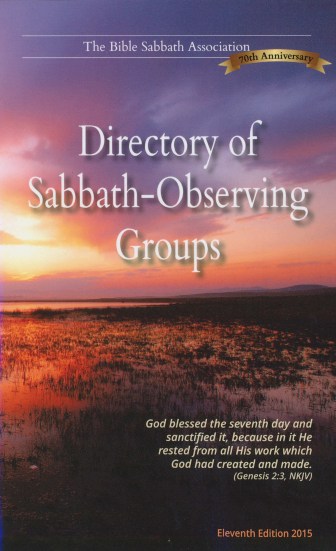
Directory of Sabbath-Observing Groups

directory-11
Directory of Sabbath-Observing Groups

by the BSA 

The directory of Sabbath-Observing Groups is now available for FREE online!

Just click the link below!

https://biblesabbath.org/find-a-church/

This directory lists hundreds of Sabbath Keeping churches all over North America and even the rest of the world! There are seven categories of churches in this directory:

  • Seventh-Day Baptists
  • Seventh-Day Adventists
  • Church of God (Seventh Day)
  • World Wide Church of God Successor Movements
  • The Sacred Names Movement
  • The Messianic Movement
  • Non-Aligned Groups (Independent)

We no longer offer this in print form. We apologize for this inconvenience, but we were no longer able to do this as an organization. The link to the online directory is more up to date and is constantly adjusted for new churches or changes in addresses for old churches.

God Bless!
– BSA board directors