Hope in the Face of Loss

Hope in the Face of Loss

by Brian Knowles


“Recently a couple we knew many years ago lost their daughter to illness. She was only 47. The loss was devastating to the parents. The father’s health was affected. Stress of such an enormous magnitude can directly affect the immune system, making one susceptible to illness.

Another friend has already lost two brothers and a parent to cancer. Others have lost children to disease, accidents and even warfare. Thousands of American and Iraqi parents are living with the loss of sons and daughters due to warfare in the region. Countless millions have been slaughtered by their own governments in the last century and the beginning of this one. In much of the world, life is cheap indeed. They call it “democide” – death by government.

Governments kill. Armies kill. Disease, accidents and old age kill. None of us gets through this life alive. As the writer of Hebrews says, “It is appointed unto men once to die…” (Hebrews 9:27). How we will die is known only to God…”


(This article is an excerpt from the July August 2007 edition of The Sabbath Sentinel)


To read the rest of this article, which starts on page 10, click the link below:


http://biblesabbath.org/tss/526/tss_526.pdf

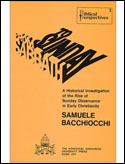
From Sabbath to Sunday

Prod-FromSabbathToSunday125x164

From Sabbath to Sunday

By Dr. Samuele Bacchiocchi


In this intriguing book, Dr. Bacchiocchi explores in detail historical events that surround the Catholic Church changing the day of worship from Sabbath (Saturday) to Sunday. He explores how paganism and Anti-Semitism played a large role in luring people away from Sabbath keeping.

Here is an excerpt from pages 185-185:

“The adoption and enhancement of Sunday as the exclusive new day of worship presupposes the abandonment and belittling of the Sabbath. We would presume therefore that the Church where Sunday worship was first introduced and enforced adopted some measures to discourage Sabbath observance. While it must be admitted that we have evidence for the observance of both days, particularly in the East, this must be viewed as a compromise solution on the part of those who wished to retain the old Sabbath while at the same time accepting the new Sunday worship. Their very concern to preserve some type of Sabbath observance disqualifies them as the pioneers of Sunday-keeping, since they could hardly have championed the new day while trying to retain the old. In the church of Rome, the situation was substantially different. Not only was Sunday worship urged there, but concrete measures were also taken to wean Christians away from any veneration of the Sabbath…”

To order this book, please click the link below:

https://biblesabbath.org/shopping/pgm-more_information.php?id=9&=SID


What does “Under the Law” Mean?

What does “Under the Law” Mean?

By Kelly McDonald, Jr.

In Romans 6:14, Paul wrote: “For sin shall not have dominion over you: for ye are not under the law, but under grace.” This verse is used by many to say that the requirements of God’s Law, especially the Ten Commandments, are no longer necessary. The key with this verse, as with all verses, is the context.

In the following two verses, Paul wrote, “What then? shall we sin, because we are not under the law, but under grace? God forbid. Know ye not, that to whom ye yield yourselves servants to obey, his servants ye are to whom ye obey; whether of sin unto death, or of obedience unto righteousness?” One definition of sin in the Bible is transgression of God’s Law (I John 3:4). To clarify the phrase “under the law” in Romans 6:14, we must go to the other letters of Paul.

In Galatians 4:4-5, Paul wrote: “But when the fulness of the time was come, God sent forth his Son, made of a woman, made under the law, To redeem them that were under the law, that we might receive the adoption of sons” (KJV). If the phrase “under the law” in Romans 6:14 means obeying the Law, then Paul said in Galatians 4:4-5 that Christ only came to redeem those that were obeying the Law. We know that is not true! Christ came to redeem all mankind (John 1:29, 3:16).

The phrase “under the law” refers to being in an inferior position to the law. It must be something that is applicable to all humans who are not converted. All have sinned and fallen short of the glory of God (Romans 3:23).  “Cursed is anyone who does not uphold the words of this law by carrying them out” (Deuteronomy 27:26).

In Galatians 3:13-14, Paul also wrote: 13 Christ redeemed us from the curse of the law by becoming a curse for us, for it is written: “Cursed is everyone who is hung on a pole.” 14 He redeemed us in order that the blessing given to Abraham might come to the Gentiles through Christ Jesus, so that by faith we might receive the promise of the Spirit.”

When Paul said that we are not under the law, he is obviously referring to the curse of the law. Christ died so that we would not be slaves to sin and lawlessness.

In Romans 6:18, he wrote: “Just as you used to offer yourselves as slaves to impurity and to ever-increasing wickedness, so now offer yourselves as slaves to righteousness leading to holiness” (NIV). The Greek word translated as “ever-increasing wickedness” is anomia, and it means lawlessness. After salvation, lawlessness is supposed to be apart of our past, not our future. 

What does being under grace mean? Being under grace means that when we make a mistake, God is not going to stone us or strike us dead. We have a grace period to learn right from wrong. We are not under the law’s penalty, but we are not free from its requirements because grace is not a license to sin or transgress God’s Law.

Later in Romans, Paul wrote that the Law is holy, righteous and good (Romans 7:12-14). In Romans 8:7, Paul explains that the sinful mind is hostile to God’s Law and refuses to submit to it. Our goal and aim is to let the Holy Spirit guide us in obedience to the commandments of God. Since we are under grace, we are alive in Christ and enabled to obey the Law of Life (see also Deut. 30:11-15, I John 5:1-5).

Kelly McDonald, Jr. is the BSA President. You can visit his website here: kellymcdonaldjr.com

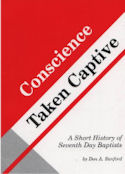
Conscience Taken Captive: A Short History of the Seventh Day Baptists

ConscienceTakenCaptive

Conscience Taken Captive: A Short History of the Seventh Day Baptists

By Don Sanford

This book is a tremendous piece of history showing how Sabbath keepers took a foothold and extended the Kingdom of God into America. Here is an excerpt from page 8:

“The First Seventh-day Baptist Church in America was organized in December 1671 from members of a Baptist Church who had come to the conviction of the Sabbath of the Bible. Stephen and Anne Mumford were Sabbath keeping members of the Tewksbury Baptist Church in England when they migrated to American in 1664 during a period of dissenter persecution. About the same time, according to Samuel Hubbard’s journal, his wife Tracy, “took up keeping the Lord’s holy 7th day Sabbath the 10th day of March 1665…”

“Within 20 years about 76 names were added to the covenant relationship which spread out to places such as Westerly, Rhode Island, and New London, Connecticut. The membership included American Indians as well as English colonists…”

“In 1709 it was constituted as the First Hoplinton Seventh Day Baptist Church, now located at Ashaway, Rhode Island. This is the oldest existing Seventh Day Baptist Church in America”.

To learn more from this powerful book of history, click here: https://biblesabbath.org/shopping/pgm-more_information.php?id=86

Do Sabbatarians Have a Documented History in the U.S before 1800?

Do Sabbatarians Have a Documented History in the U.S before 1800?

 by Joe Bellefeuille


“Yes, Sabbatarians have a long and rich history in the United States. There are written records of sabbatarians in Rhode Island going back to the 1670’s. In my brief survey of early American sabbatarians, I have found evidence of sabbatarians in ten of the thirteen colonies and references to 31 sabbatarian congregations/groups in nine of the colonies. In order to share some of this surprising information in an organized format, this article is divided into the following categories: 1. Questions & Answers 2. A list of 31 known pre-1800 congregations/groups 3. A list of some family surnames of early Sabbatarians 4. Bibliography of sources consulted 1. Questions & Answers Who was the earliest known American sabbatarian? • Stephen Mumford. He came from England to Newport, Rhode Island in 1664. (Gaustad’s New Historical Atlas of Religion in America on page 3 mentions colonial records of Connecticut that state there were “four or five seventh day men” there in 1670….”

(This article is an excerpt from the March-April 2006 edition of The Sabbath Sentinel)

To read the rest of this article, which starts on page 14, click the link below:


http://biblesabbath.org/tss/518/tss_518.pdf

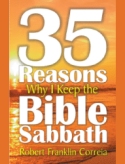
35 Reasons Why I Keep the Bible Sabbath

 Products-35ReasonsWhy125

35 Reasons Why I Keep the Bible Sabbath

By Robert Franklin Correia

This book will give you 35 reasons why it is important for us to keep the Sabbath. This book will build your faith and give you confidence in your walk with God. Here is Reason #8, taken from page 17:

  1. Because the Sabbath is God’s flag.

God has a flag:

  • “I [God] will set up my ensign”
  • A flag is a sign:
  • They set up their ensigns for sins (Ps. 74:4)
  • God’s sign is His Sabbath:
    • “I have them my Sabbaths, to be a sign” (Eze. 20:12; see also verse 20).
    • “It [my Sabbath] is a sign (Ex. 31:13).
    • “It [my Sabbath] is a sign… forever” (Ex. 31:17)   https://biblesabbath.org/shopping/pgm-more_information.php?id=94&=SID
    • To learn all 35 great reasons to honor the Sabbath, order this book at the following link:
    • God took of the fabric of time and made Himself an ensign for eternity. He made a unit of time by rolling of a globe, and He called that unit day. He took a handful of days – seven-and made them a week. And of that week He took the last day, the seventh, and made it the Sabbath. That Sabbath is His sign, His emblem, His flag.
    • Since God has a flag (Isa. 49:22, RV), and a flag is a sign (Ps. 74:4), and God’s sign is His Sabbath (Eze. 20:12, 20), therefore, God’s flag is His Sabbath, because things equal to the same things are equal to each other.

Sabbath Evening (Erev Shabbat) Family Service

(also Called “Erev Shabbat”, Hebrew for Evening of the Sabbath)


Throughout the week, we are all running to and fro. We are going to ballgames, work, school, and other events. The Erev Shabbat Service is a special service performed by the Jewish people for over 2,000 years. It would have been performed in the time of Jesus. It is a great way to welcome in the Sabbath as a family and make the dividing line between Holy Time of the Sabbath and the common time of the week we are leavening behind.

While it is mostly performed by Sabbath keepers with a Messianic background, it is a great learning tool for all Sabbath keepers. It is a way to speak life and blessing into your family. It is a great way to spend interactive time with your family.


Just click the link below to access this FREE resource!

https://kellymcdonaldjr.com/erev-shabbat-ceremony/

What is the meaning of Acts 20:7?

What is the meaning of Acts 20:7?

by Kelly McDonald, Jr.

“6 But we sailed from Philippi after the Festival of Unleavened Bread, and five days later joined the others at Troas, where we stayed seven days.7 On the first day of the week we came together to break bread. Paul spoke to the people and, because he intended to leave the next day, kept on talking until midnight.” (Acts 20:6-7, NIV emphasis mine throughout)

Some have said that these verses are an indication that Paul was making a shift away from Sabbath and towards weekly observance of the first day of the week, which we call Sunday today. Notice that there was no recurring or weekly first-day service mentioned before or after this event. No rest or worship is mentioned at all for the day. Paul only taught on the day; he only did this once.

As I often tell people, the text determines context. This one-time teaching episode by Paul on the first day of the week happened because he was leaving the next day. He had to get the message delivered before he left. There are zero references to an ongoing practice of this nature by any of the first disciples before or after this event.

To give further depth to Paul’s actions in these verses, let us start with his example. In the book of Acts, the Apostle Paul kept the Sabbath with Jews and Greeks.

Acts 13:14 “14 From Perga they went on to Pisidian Antioch. On the Sabbath they entered the synagogue and sat down….”

Acts 14:1 “At Iconium Paul and Barnabas went as usual into the Jewish synagogue. There they spoke so effectively that a great number of Jews and Greeks believed”

Acts 16:12 “From there we traveled to Philippi, a Roman colony and the leading city of that district of Macedonia. And we stayed there several days. 13 On the Sabbath we went outside the city gate to the river, where we expected to find a place of prayer.”

Acts 17:1-2: “When Paul and his companions had passed through Amphipolis and Apollonia, they came to Thessalonica, where there was a Jewish synagogue. 2 As was his custom, Paul went into the synagogue, and on three Sabbath days he reasoned with them from the Scriptures…”
Acts 18:1-4:After this, Paul left Athens and went to Corinth. There he met a Jew named Aquila, a native of Pontus, who had recently come from Italy with his wife Priscilla, because Claudius had ordered all Jews to leave Rome. Paul went to see them, and because he was a tentmaker as they were, he stayed and worked with them. Every Sabbath he reasoned in the synagogue, trying to persuade Jews and Greeks.”

Before we arrive at Acts 20, there is an established pattern by Paul. It was his custom to attend gatherings on the Sabbath with both Jewish and Greek people.

Too often we use a Roman mindset to understand the Bible. Days do not end or begin at midnight. They end/begin at sunset.

It is important to remember that the Sabbath is from Friday sunset until Saturday sunset. All of us know that at certain times of the year, sunset can be earlier or later. Those of us who honor the Sabbath know that after service is over we typically sit around and fellowship. We pray with each other and talk about the Word of God. This often will go past sunset on Saturday, especially when the sun sets sooner. Potluck meals are often involved.

This is the case with Acts 20:7. At sunset, the Sabbath ended and they had a meal. Why did Paul continue to teach after sunset? The verse tells us plainly, “….because he intended to leave the next day, kept on talking until midnight…” Paul had an urgent message for the brethren. He preached until midnight to finish sharing his final instructions with the brethren.

The fact that he was already with the brethren before the first day of the week began demonstrates that he was with them during the Sabbath. For someone who might be trying to establish a custom to be practiced every week, one instance does not suffice. The Acts 20:7 meeting is clearly a one-time exception tied to his soon departure. To learn more about Paul’s Sabbath observance, CLICK HERE to read more.

Moreover, look at Acts 20:6. In this verse, we learn that Paul was in Philippi for the Feast of Unleavened Bread. The Feast of Unleavened Bread has two annual Sabbaths in it (See Leviticus 23:4-9)! Paul wanted to make sure he honored this feast before he left Philippi.

Paul’s example shows that he continued to honor the Sabbath even with Gentiles for his entire ministry.

Kelly McDonald, Jr.
BSA President – www.biblesabbath.org

Directory of Sabbath-Observing Groups

directory-11

Directory of Sabbath-Observing Groups

The directory of Sabbath-Observing Groups is now available for FREE online!

Just click the link below!

https://biblesabbath.org/find-a-church/

This directory lists hundreds of Sabbath Keeping churches all over North America and even the rest of the world! There are seven categories of churches in this directory:

  • Seventh-Day Baptists
  • Seventh-Day Adventists
  • Church of God (Seventh Day)
  • World Wide Church of God Successor Movements
  • The Sacred Names Movement
  • The Messianic Movement
  • Non-Aligned Groups (Independent)

We no longer offer this in print form. We apologize for this inconvenience, but we were no longer able to do this as an organization. The link to the online directory is more up to date and is constantly adjusted for new churches or changes in addresses for old churches.

God Bless!
– BSA board directors

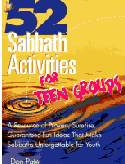
52 Sabbath Activities for Teen Groups

52 Sabbath Activities

52 Sabbath Activities for Teen Groups

By Don Pate

Here are 52 proven, surefire, guaranteed ─ fun activities to make Sabbath really special for teens! Each activity section gives you step-by-step instructions for making it happen and tells you what preparation and materials you’ll need and the minimum time required for the activity. Whether you’re a youth leader, teacher, or pastor, you’ll find this book a valuable resource for creating Sabbaths that bring teens exciting fellowship with God and Christian friends.

To order this book, just click the link below:

https://biblesabbath.org/shopping/pgm-more_information.php?id=104&=SID