Make Peace With God

Make Peace With God

By: Tommy Willis

Make as much peace with God as you can; we don’t have much time left.

Over the years, I have heard a few ministers say things like, “Get right with God,” or “Make peace with God.” They were concerned that the churches to which they were speaking were caught up in the ways of the world, and not seeking God as they should. I remember one saying that he was afraid time was going to run out on them. It made me think of the scripture that says: “Seek the Lord while he may be found; call on him while he is near.” (Isa 55:6) niv.

We have limited time on this planet. As the scripture tells us, we are soon gone: “Why, you do not even know what will happen tomorrow. What is your life? You are a mist that appears for a little while and then vanishes.” (James 4:14) niv.

The messages to the churches had a time period also. If we study Revelation chapters two and three, we will see most those seven churches were told to repent—a space of time was given—and if no repentance, there were consequences.

Brethren, those letters are for us today—to help us examine our lives. I share this with you as one who was brought back from drifting from God. God used Rev 3:18 -20, that tells us about a lukewarm attitude. I could not see I was lukewarm; God led me to examine myself, and I had to repent and be restored to proper fellowship.

Jesus says: “Those whom I love I rebuke and discipline. So be earnest and repent. Here I am! I stand at the door and knock. If anyone hears my voice and opens the door, I will come in and eat with that person, and they with me.” (v19-20) NIV.

Those messages in the Bible are for us today also. We would do well to examine our lives with these messages to the churches. Some had left their first love; and some grew lukewarm.

We need to do as David did: “Search me, O God, and know my heart; Try me, and know my anxieties; And see if there is any wicked way in me, And lead me in the way everlasting.” (Ps 139:23-24) nkjv. We need to do this because our hearts are very deceitful (Jer 17:9), and will let too many things go.

Time could be running out for many of us. We would be on much safer ground if we took the time to examine our lives this way. Most of us have drifted from God at times; but keep in mind that each time we allow ourselves to drift, we will find it harder to find our way back.

Therefore, I dread not praying as I should now. I may not find my way back next time. I found it harder to find my way back each time I drifted. Therefore, I now have a healthy fear of not praying as I should. It was a long time in coming; God had to bring me to a place where he showed me I was lukewarm. And I’m not trying to suggest that I still don’t struggle and sin, because I do still sin. It seems to be a constant battle, no matter what level of growth we have.

But things are so much better now that I have been resorted to proper fellowship with the Prince of Peace, who gives me peace in my struggles and agony of this life. And now, each time I fall, God picks me back up and I walk towards him and don’t drift from Him as before. I thank God for his mercy.

Many are caught up in the rat race, too busy with the cares of this life and this consumer society. Many things can become an idol. It can be the TV, money, politics, fame, the list can be long– Whatever is distracting you from spending time with God needs to be put away.

Brethren, get out of the rat race, and learn to live as simple a life as possible—it will help your prayer life. Many Christians are caught up in the consumer society. I share the simple life because I know it works through experience. I learned years ago the best way around the hurdle is not making more money, but spending less.

Anxiety, panic, and torment increased across the land with the plague, and the stress left in its wake. People have had a difficult time trying to “get back to normal,” the past three years. And many Christians have had increased fear and worry.

I once saw on the news where a tornado ripped off an old man’s roof, and threw him around the house. The newsman asked him if he thought he was going to die. And he said, “I’m ready, for I’m right with God,” he seemed to be at peace. The man seemed aware of how the Bible tells us we don’t know what tomorrow will bring, for we are like a mist soon gone. The thief on the cross made peace with God before he died. I doubt he knew much doctrine; but his heart was right before God. God looks on the heart.

With the peace of God, we can live without the fear of death. It reminds me of what Paul said: “For to me, living means opportunities for Christ, and dying—well, that’s better yet! But if living will give me more opportunities to win people to Christ, then I really don’t know which is better, to live or die! Sometimes I want to live, and at other times I don’t, for I long to go and be with Christ. How much happier for me than being here!” (Phil 1:21- 23) NLT. This does not mean we should seek death, for
life is a blessing, and God has a work for us to finish. Paul loved life; but he realized to depart this life would be “far better” because we get to go be with Christ!

Psalms 23 has sometimes been the last words people uttered on their deathbed. “Even when walking through the dark valley of death I will not be afraid, for you are close beside me, guarding, guiding all the way.” (v4). TLB.

God does not promise us tomorrow. I’ve have known brethren that I’ve talked with about end time prophecy and they died with cancer at a young age; others in car wrecks. Therefore, even if it’s not the End Time, still, the Bible tells us we don’t have much time. We are comfortable talking about prophecy; but in our death-denying culture, we avoid talking about death. But the Bible reminds us:

“Seventy years are given to us! Some even live to eighty. But even the best years are filled with pain and trouble; soon they disappear, and we fly away…Teach us to realize the brevity of life, so that we may grow in wisdom.” (Ps 90:10, 12) NLT. The psalmist asks to be reminded of the brevity of life. When we are, we will be helped to focus on what’s most important, because we don’t have much time left.

Now, with all the chaos increasing, many feel the prophecies and birth pains are near…will many die in the near future. Are you ready like the old man above whom almost died in the tornado who said he was “right with God?” And like the above scripture tells us, we will soon be gone one way or another, for our life is just a mist soon gone. Therefore, we need to make as much peace with God as we can; we don’t have much time left. Don’t procrastinate.

Jesus said it will be like the days of Noah and come suddenly; Noah was a preacher of righteousness, but they did not listen to his warnings. God shut the door of the Ark— the time had run out.

In like manner, Matthew 25 tells about the spiritual preparation to get more oil in our lamp; and those who didn’t prepare found the door closed also: “The virgins who were ready went in with him to the wedding banquet. And like the days of Noah, the door was shut. “Later the others also came. ‘Lord, Lord,’ they said, ‘open the door for us!’ “But he replied, ‘Truly I tell you, I don’t know you.’ “Therefore keep watch, because you do not know the day or the hour.” (v10-13) niv.

Certainly, these are clear biblical admonishments of time running out in both Noah’s day and in Jesus return. We know how to get more oil in our lamp; but we can make a thousand excuses for not getting in our prayer and Bible study.

He stands at the door and knocks; but we have to open the door (Rev 3:20) for a deeper relationship with Him. Think and pray about these matters. Because he loves us so much. He longs for a closer relationship with us. Don’t let the distractions of the world hinder you from spending time with God.

God loves us and cares so very much. We often fail to see how much he cares; the Bible specifically tells us to go to Him in prayer because he cares:

“Give all your worries and cares to God, for he cares about you.” (1 Pet 5:7) NLT.

We will need God’s peace to endure the difficult days ahead. As we learn to do as the scriptures tell us, we can have the peace of God in our daily walk; “For he is our peace.” (Eph 2:14) KJV. And God will keep us at peace amidst the chaos of the world. This is true success. Nothing will comfort you more than the peace of God, for it passes human understanding (Phil 4:6-7).

This article appeared in the Sep/Oct 2024 edition of The Sabbath Sentinel and can be viewed at https://biblesabbath.org/wordpress/wp-content/uploads/2024/08/SabbSent0924_Proof.pdf

To learn more about The Bible Sabbath Association visit https://biblesabbath.org/

That’s a mistranslation!

That’s a mistranslation

By: Daniel Botkin

(this article appeared in the Sep/Oct 2024 The Sabbath Sentinel edition)

One of my pet peeves is people trying to dismiss a Bible truth by repeating the trite, worn out excuse
“That’s a mistranslation.”

No Bible translation is 100% perfect, because the full meaning of any Hebrew or Greek or Aramaic word, and all the nuances of that particular word and its connection to other words, cannot be fully conveyed with a single English word. That is a linguistic fact that exists in the translation of any document from one language to another. But this does not mean that every translation that you do not like is a mistranslation. It only means that every translation has limitations. A translation can convey only a limited amount of all the meaning that is embedded in the text in its original language. Limitation and mistranslation are two entirely different things.

When people say “That’s a mistranslation,” oftentimes what they really mean is: “That translation
contradicts what I want to believe. That translation does not match up with my personal theological
preferences and wishes.”

They think they can dismiss Bible truth by simply saying “That’s a mistranslation.” But God is not
fooled, and neither am I.

The next time I hear someone say “That’s a mistranslation,” I want to ask three questions.

QUESTION #1. Do you know Hebrew (or Greek or Aramaic) well enough to explain to me WHY that is
a mistranslation? And don’t just give me a vocabulary number from the lexicon of Strong’s Exhaustive Concordance. Explain to me why that verse is a mistranslation by using your knowledge of Hebrew (or Greek or Aramaic) grammar, morphology, syntax, orthography, semantics, phonology, verb conjugation, case, etc. Use your knowledge of the original language to explain to me in your own words why that particular verse is a mistranslation. Can you do this?

Check one: Yes No

QUESTION #2. Do you know Hebrew (or Greek or Aramaic) well enough to actually read and understand the text in its original language? And I don’t mean just being able to pronounce the words. I mean are you able to understand the words and the reasons those words appear in whatever particular form they appear in this particular verse? Can you do this?

Check one: _ Yes _ No

QUESTION #3. Have you read through the entire Bible in its original languages at least one time?
This is an important question, because if you have not done this, then you have never truly read
through the entire inspired text of the Bible. You have only read through translations of the inspired
text. And if you have only read through translations of the inspired text, and not the inspired text
itself, then what business do you have claiming “That’s a mistranslation”? Have you ever read the
entire Bible in its original languages?

Check one: _ Yes _ No

If you answered “No” to one or more of those three questions, then please do not tell me “That’s a mistranslation.” That claim is being made by too many people who know little or nothing about translating the text from the original languages.

If you insist on telling me that something is a mistranslation, at least find someone else who can use
their knowledge of the original languages to explain to me why the verse is a mistranslation.

See Daniel Botkin’s website at gatesofeden.online.

This article appeared in the Sep/Oct 2024 edition of The Sabbath Sentinel and can be viewed at https://biblesabbath.org/wordpress/wp-content/uploads/2024/08/SabbSent0924_Proof.pdf

To learn more about The Bible Sabbath Association visit https://biblesabbath.org/

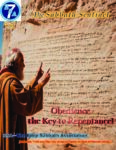
Obedience- the key to Repentence

Obedience- the key to Repentence By Dr. Royce Mitchell

What is the standard that God put into place for mankind to be saved? That seems a very important question since without that salvation we are all walking dead men. If you turn on your television on Sunday mornings you will hear that all you have to do is to accept Jesus as your savior and live a good life to be saved. Their idea of being saved is that when you die you go to heaven. Satan has indeed, as it says in Rev. 12:9, deceived the whole world.

To begin with, bible scholars know that heaven is promised to nobody. Jesus Himself is quoted as saying in John 3:13 that NO man has ascended to heaven. This includes the man after God’s own heart, David King of Israel.

But, misunderstanding the gift and rewards of God does not influence our salvation. The ideas that one can just say that Jesus is one’s Savior, and the vague notion of being good, are far more insidious, and dangerous to anyone who accepts this satanic “salvational” dogma.

Lip service is often given to the idea of repentance but is usually defined to be generating some “sorrow” for having not done good in our lives. But, is that what God says to us through His Word?

A young man approached Jesus when He walked the earth in human form. He asked Jesus what he had to do to receive eternal life. Jesus did not correct him to remind him that he had an immortal soul, yet another deception found promoted from the Sunday morning pulpits. Instead, Jesus pointed him back to the Commandments of God. We find His answer in Mar 10:19: You know the
commandments: Do not commit adultery, do not kill, do not steal, do not bear false witness, do not defraud, honor your father and your mother.
Those commandments are found in Exodus 20

Jesus also did NOT tell the young man that He was going to nail those commandments to the cross of His sacrifice. Yet, when we discuss the test commandment, keeping God’s Sabbaths, the answer is always that those commandments were nailed to the cross, citing Col 2:13-14: And you, being dead in your sins and the uncircumcision of your flesh, hath he quickened together with him, having forgiven you all trespasses; Blotting out the handwriting of ordinances that was against us, which was contrary to us, and took it out of the way, nailing it to his cross.

It is astounding to me that people can read those scriptures and not see the contradiction between what Jesus told the young man and what Paul wrote to the Corianthians, and the dogma that proclaims that God’s Commandments were nailed to the Cross by Jesus.

Moreover, it stakes that claim on the idea that the commandments were ordinances that are against us. However, Paul puts that statement to the lie also. We read this in Rom 7:7: What shall we say then? Is the law sin? Let it not be said! But I did not know sin except through the law. For also I did not know lust except the law said, You shall not lust.

Anyone who actually reads their bible knows that Paul is referring to the commandment against lust in Exo 20:17 Thou shalt not covet thy neighbour’s house, thou shalt not covet thy neighbour’s wife, nor his manservant, nor his maidservant, nor his ox, nor his ass, nor any thing that is thy neighbour’s.

Coveting is defined in Webster’s dictionary as “To desire or wish for, with eagerness; to desire earnestly to obtain or possess.” Lust is defined in Webster’s as “Longing desire; eagerness to possess or enjoy.” Lust and covet mean the same thing. When Paul talks about lust he is talking about the command found in Exo 20:17! He is pointing back to God’s Commandments!

Returning to Rom 7:7, Paul is saying that the Law is not sin. Instead, he explains that he would not have known what sin was except by the law. Then gives the example that points us back to God’s Commandments!

Some seeking to excuse their failure to follow the Commandments of God will state that they keep the Royal Law, claiming that they need merely to love God and their fellow man. But, does that excuse their failure? James, the brother of Jesus, proclaims otherwise. We find in Jas 2:8-12 the following: If you fulfill the royal Law according to the Scripture, “You shall love your neighbor
as yourself,” you do well. But if you have respect to persons, you commit sin and are convicted by the Law as transgressors. For whoever shall keep the whole Law and yet offend in one point, he is guilty of all. For He who said, “Do not commit adultery,” also said, “Do not murder.” But if you do not commit adultery, yet if you murder, you have become a transgressor of the Law. So speak and do as those who shall be judged by the Law of liberty.

James is telling us that the Royal Law of love pertains to keeping the Commandments of God as found in Exo 20! James cites the commandments related to adultery and murder as part of that Royal Law. It is clear that those who claim the Royal Law as exempting them from God’s Commandments are not reading their bibles except to justify their sin. Let’s make no mistake about it, they are justifying sin!

The Apostle who leaned on Jesus at His last supper had this to say about sin in 1Jn 3:4 Whosoever committeth sin transgresseth also the law: for sin is the transgression of the law. John also refers us all back to God’s Commandments! He tells us that breaking or transgressing that Law IS sin. If we are going to repent, then we had better know of what we are repenting, shouldn’t we?

We will return to this idea of repentance shortly. First, though, the thinking bible student might ask him or herself why anyone would be making the false claims that the law is done away, nailed to the cross or for some reason no longer applicable. None them would claim that dishonoring one’s parents, murder, theft, lying or improper lust are acceptable to God. Likewise, none of them would claim that having idols or taking God’s Name in vain are acceptable. What element of those Commandments leads others to claim the demise of the requirement to keep them?

There is only one of the Commandments that people specifically object to; it is the Commandment to keep the Sabbath Day holy. And, yet, we find it is that very Commandment that indicates who are God’s people. Notice what we find in Exo 31:13: Tell the Israelites, ‘Surely you must keep My Sabbaths, for this will be a sign between Me and you for the generations to come, so that you may know that I am the LORD who sanctifies you. Keep the Sabbath, for it is holy to you. Anyone who profanes it must surely be put to death. Whoever does any work on that day must be cut off from among his people.

The Sabbath is a sign that we know who God is. I’ve heard the response to that in that past. It goes like this, “That only pertained to the Israelites.” That’s true! But, also notice this. Paul wrote something of vast importance to the Gentiles in Rome that we would do well to understand.

In Rom 11:1, Paul asks whether Israel has been cast away. He goes on to state that he is trying to stir up the Gentile brethren to emulate Israel in vs 14. However, to really drive home the point, Paul goes on to state that the casting away of the Israelites was for the purpose of including the Gentiles in God’s plan, vs 15. He compares Israel to an olive plant whose roots are in Christ, who alone, of all the humans who have ever lived, can be called holy. Paul states that the firstfruits are holy, and in another place that Christ IS the firstfruit.

However, notice what Paul goes on to tell the brethren in Rome. Rom 11:17-21 And if some of the branches (Israel) be broken off, and thou (Gentiles), being a wild olive tree, wert graffed in among them, and with them partakest of the root and fatness of the olive tree; Boast not against the branches. But if thou boast, thou bearest not the root, but the root thee. Thou wilt say then, The branches were broken off, that I might be graffed in. Well; because of unbelief they were broken off, and thou standest by faith. Be not highminded, but fear: For if God spared not the natural branches, take heed lest he also spare not thee.

We should not overlook the importance of what Paul is saying. He is saying that Gentiles MUST become part of Israel to be a part of Christ. Becoming part of Israel, and Christ’s, necessarily means doing what He commanded. As we have already seen, Christ’s command was to keep the Commandments—and those commandments include keeping the Sabbath holy! It is clear then that those who follow Christ must keep God’s Commandments. Those refusing to keep God’s Commandments are not following Jesus, at least not the Jesus sent by God to be our Savior. They are following a false Jesus promulgated by Satan whose sole desire is to kill the potential children of God.

We return to repentance now that we understand of what we are to repent, that is to say, sin—the breaking of the Commandments of God. As previously mentioned, repentance is not some emotion generated without knowledge of what constitutes sin. John the Baptist gives us a glimpse into what repentance actually is. We read in Mat 3:7-8, But when he saw many of the Pharisees and Sadducees come to his baptism, he said unto them, O generation of vipers, who hath warned you to flee from the wrath to come? Bring forth therefore fruits meet for repentance…

Repentance requires fruit. The fruit of repentance is a changed mind! Indeed, the word repent is from a Greek word that means to have a change of mind or direction. While personal sorrow for sinning against God who has given us life is certainly a part of repentance, standing alone it is worthless. Repentance must be accompanied by a change of mind toward obeying God, and a change of direction toward keeping God’s Commandments. As John ordered the Pharisees, to show God our repentant attitude we must DO something! That thing we must do to show repentance is to quit sinning.

The conclusion is clear. God’s Commandments are still in force today. Those Commandments define sin for us. Breaking even one Commandment is sin against God and brings with it the death penalty God warned Adam and Eve about in the Garden. But, God sent us His only begotten Son who would present Himself as the Lamb to be sacrificed once and for all time for our sins. He commands all men to repent, and that means to seek the redeeming sacrifice, and to stop sinning. It means to obey
the simple Commandments God gave us and stay on His path toward God’s Kingdom.

The next step is up to us. God will not force us to repent and obey. He will allow us to choose the death penalty that we have earned. It is past time to make our choice and claim the incredible blessings God has for us.

This article appeared in the Sep/Oct 2024 edition of The Sabbath Sentinel and can be viewed at https://biblesabbath.org/wordpress/wp-content/uploads/2024/08/SabbSent0924_Proof.pdf

To learn more about The Bible Sabbath Association visit https://biblesabbath.org/

Continuing the Worthy Goals Set by Christ!

Continuing the Worthy Goals Set by Christ!

By Dr. Royce Mitchell

(This article appeared in the Mar-April 2024 Sabbath Sentinel Magazine Edition)

The Bible Sabbath Association (BSA) Board of Directors election is over and a new Board has been selected by the BSA members. The new Board has met and selected its officers for the coming 4 years. Anyone interested in who will be those officers can find that list inside the front cover. Perhaps YOU could join as a member also!

Although it was not within my desire to hold any office on the Board, being content to serve merely as your Editor, the Board members nominated and elected me to the office of President to replace retiring Kelly McDonald. Having served with Kelly for the past 8 years, I can tell you that his shoes will be big ones to fill, requiring several of us to coordinate our efforts just to maintain the marvelous efforts that Kelly produced in promoting the goals of the BSA. It is a task that humbles me and for which I am not sure that I am adequately prepared. But, with your patience and loving guidance as BSA members and readers, I hope that we can propel the BSA to even bigger and better promotion of its great goals over the next few years.

As one can see from the last edition of this magazine, elected to the board were some excellent examples of the variety of Sabbath keepers who are part of this Association. They come from a variety of Sabbath keeping backgrounds and will provide fantastic insight into methods whereby we can continue to improve upon the wonderful actions taken by the previous Board. Hopefully, we can
be even better at reaching across Sabbatarian corporate lines to foster fellowship where there has been distrust and animosity in the past. I truly believe that this is what Jesus had in mind when He said that His followers would be known by their love for one another (John 13:35).

All too frequently we in the Church have filtered out other brethren by using differences in doctrine as the standard. What this has caused is an ever-widening gulf between the different groups who claim to be following Christ’s teaching. Some groups are less strident about this, of course. But, too many groups remain insular in nature and avoid getting to know, much less accept, those of differing understandings from them.

But, Jesus, or Yahshua if you prefer, did not teach us that His disciples would be known by their perfect understanding of the scriptures, did He? No, of course not. What is Jesus’ focus for His disciples? The focus is LOVE!

The question then becomes, “Can I love my brethren who think or understand differently from what I believe?” This is a hard question because it requires an honest look at how we approach those who have slightly different understandings of the nuances of scripture.

To get past these divisive matters, we need a new approach. It is an approach that reorients our mind in love and away from the politics of division in which so many engage for the purpose of protecting their “understanding.”

As a beginning, let’s consider what Jesus said shortly before He was nailed to a stake for us. He advised His disciples of this often overlooked, and sometimes misunderstood, truth. He said, “Howbeit when he, the Spirit of truth, is come, he will guide you into all truth…” (John
16:13).

Most fail to recognize an important point implied by a word that is NOT in that scripture. That word is the word “immediately!” You see, Jesus was not saying that He would open our minds to understand everything at once. In fact, if you look at such stalwarts as Peter, John and Paul, reviewing their actions and writings, it is easy to see that none of them had complete understanding from the beginning. In fact, we can even see that toward the end they recognized that they still had not quite discerned even the most important of things—when the Christ would return!

Why is this important? It is important because understanding our brethren in different groups requires us to accept that each one of us is at our own point in being led to ALL truth. I find myself wondering as I have gotten older whether or not Christ’s words were even intended to convey that we would receive ALL truth in this lifetime!

Now, if I accept that I did not have all the truth over 40 years ago when the Father had called me to His Church, then I have to also understand that even now I may not have all of the truth firmly fixed in my mind. What we all need to understand is that none of us are any different in
that respect! By this I mean that it is highly likely that none of us has ALL truth clearly understood as if the Father had directly spoken those truths to us.

For instance, I recognize that 40 years ago I had certain understandings of the scripture. 30 years ago, I had different understandings of the scripture. Likewise, I do not have the same understanding today that I did 20 years ago. We are told to GROW in grace and knowledge! (2 Pet 3:18). If the Spirit leads us to all truth immediately or quickly, or even ALL truth in our lifetimes, Peter would not have admonished us to grow in knowledge. Or, he might have reasoned with us that we need to grow in
grace and knowledge until we have everything right. How many of us would fail that test? Or, even worse, how many of us think that we already know it all and don’t need to continue to grow in knowledge?

How would we feel if a brother turned his back on us because we have not yet come to the same understanding as our brother? I suspect that we would not like that in the slightest. I know that I would not like it. But, that is exactly what has happened by our dividing ourselves over minor differences in doctrinal understanding.

Shouldn’t we recognize that we are not all at the same understanding of scripture and afford one another the grace of giving God’s Spirit the time needed to lead our brethren into those truths? Should we not recognize that if we were wrong in our understanding 20, 30 or 40 years ago, that would still be wrong in our understanding even today? And, if we could be wrong, should we display a lack of love and tolerance for those whose understandings are not in complete accord with our own?

Can we recognize the warnings of Christ related to children apply to those who are still spiritual children? Jesus told us that “But whoso shall offend one of these little ones which believe in me, it were better for him that a millstone were hanged about his neck, and that he were drowned in the depth of the sea.” (Matt 18:6). Of course, He was talking about physical children at the time. But, can we see that implication is also addressed to spiritual children? And, if we can see that, can we not reorient our mindset to allow others to be mistaken because God has not yet open their eyes to a truth that we see. Can we allow them to be mistaken without feeling the need to erect a wall between us pending their coming to the “correct” understanding? I hope that we can!

Coming to the realization that we could STILL be wrong should also have the effect of putting us back into God’s Word to prove all things and to hold onto those things which are good! (1 Thess 5:21). I’m scared for my brethren who have come to the point where they believe that they have perfect understanding of all things and use that to erect walls between them and others of those who will
inherit eternity!

What is important to our fellowship? As stated before, we need to love one another. It is true that we need a common point from which to work, on which we can all agree. One of those points is that Jesus said that man should live by EVERY word that God has spoken. (Matt 4:4). He did NOT say that we should live by what men have said about what God has said!

When we boil down what it is that we are to live by, we find that this amounts to keeping all of His commandments and accepting Christ, our Messiah, as our Savior and soon-coming King. I can safely say that all of the groups who keep the Sabbath have these two understandings in common! We all preach Jesus as our Lord and Savior, don’t we? We all preach adherence to the commandments of God, including the keeping of His Sabbaths, don’t we? Therein is the common ground from which we can build fellowship and love for one another! AND, this is exactly what Jesus taught us we should be doing!

The Sabbath Sentinel will continue to have writers from the various flavors of Sabbath keeping groups. This is not because the BSA wants to convert brethren from one group to another. We do not and we take no position on those differences in understanding. But, what we want to
do is to foster understanding between the groups. The first understanding is that we have important truths in common. The second understanding is that the rest of our differences pale into insignificance compared to those great truths—and we ought to act like it!

Loving one another and being tolerant of our differences is important as we see this present evil time approaching its climactic end. We are going to need one another as the evil escalates. Let’s use this relative peace to come closer to one another in love!


View the Mar-April 2024 Edition of The Sabbath Sentinel at https://biblesabbath.org/wordpress/wp-content/uploads/2024/04/SabbSent0324_Proof.pdf

To learn more about the Bible Sabbath Association (BSA) visit https://biblesabbath.org/

A Worthy Mission- the BSA

By Dr. Royce Mitchell

(This article appeared in the Jan-Feb 2024 edition)

As everyone undoubtedly knows who is familiar with the Bible Sabbath Association (BSA), we have just finished the Association’s quadrennial election process for its governing Board. The new Board of Directors as well as the outgoing Directors have all been notified. Soon, we will begin the process of moving the BSA forward for another 4 years of service to the people of God.

As the new board prepares to take up the reins of governance, it might be fitting to rehearse the purpose and goals of the BSA for all of the members and readers. To do so, a rehearsal of the mission given to us by our Savior would seem to also be in order, providing us with a framework for our BSA mission.

Before ascending to heaven to take up His rightful place at the right hand of the Father, Jesus gave a commission to His disciples. Many people use the following scriptures to form the basis of a “Great Commission.”

In Mat 28:18-20 we read the following: “And Jesus came and spoke to them, saying, All authority is given to Me in Heaven and in earth. Therefore go and teach all nations, baptizing them in the name of the Father and of the Son and of the Holy Spirit, teaching them to observe all things, whatever I commanded you. And, behold, I am with you all the days until the end of the world.”

Much mischief has been done through the misapplication of that scripture. However, I’ll leave that for another time. What should be focused on is another scripture which is truly the mission Christ gave to His disciples when He walked the earth. That commission can be found in Joh 13:34-35: “I give you a new commandment, that you love one another. As I have loved you, you should also love one another. By this all shall know that you are My disciples, if you have love toward one another.”

Jesus expanded on the idea through another statement that He made to His disciples in Joh 15:12-14 “This is My commandment, that you love one another as I have loved you. No one has greater love than this, that a man lay down his life for his friends. You are My friends if you do whatever I command you.”

The command then is that to show our love for God and our fellow man, we ought to be willing to lay our lives down for one another. Too often that idea is taken to the extreme that Christ had to take it so that we had access to salvation, and to the Father, through Him. And, if the truth is to be told, there have been times in the past where that ultimate sacrifice was required of some of the brethren.

But—and this is your author’s opinion—Jesus was not indicating that unless our love was so strong such that we submitted to martyrdom then we don’t love Him and are not His disciples. If we take the rest of scriptures into consideration, including the Decalogue, it becomes easy to see that any way we set aside part of our lives to help others, especially the brethren, we are in effect laying that
part of our lives down for them.

Your new Board of Directors for the BSA have generously decided to lay down a part of their lives for the purpose of causing the BSA to be a tool of unity in the Spirit. They are sacrificing a part of their lives to reach across corporate barriers in an effort to have all of God’s Children see the many ways that we see things alike, just as past boards have done for the brethren.

The outgoing Board, under the leadership of Kelly McDonald, made great strides in this effort to bring fellowship to the many differing groups of brethren who have in common the keeping of God’s Sabbaths and the desire to promote Jesus as the Messiah. We who will serve on the incoming board ask that everyone pray that we are able to build on the great foundation laid by our past leadership on the Board.

To accomplish one part of our commission, we at the BSA have been, and will continue to be, promoting the keeping of God’s Sabbaths. The world at large claims it worships Jesus but refuses to accept what He said to us all. He told us, “… It is written, ‘Man shall not live by bread alone, but by every word that proceeds out of the mouth of God.’” Mat 4:4.

The churches of the majority teach that we don’t need to keep God’s Sabbaths, but those words are God breathed! While not having repeated every commandment specifically in the New Covenant, Jesus did have this to say about them. When the rich young man came to Him and asked what good thing He could do to enter into life, Jesus responded thusly, “And He said to him, Why do you
call Me good? There is none good but one, that is, God. But if you want to enter into life, keep the commandments. He said to Him, Which? Jesus said, You shall not
murder, you shall not commit adultery, you shall not steal, you shall not bear false witness, honor your father and mother, and, you shall love your neighbor as yourself.”
Mat 19:17-19.

Jesus repeated those parts of the Commandments that related to how to love our neighbors as ourselves, one of the two Great Commandments. In another place Jesus explained that loving our neighbors as ourselves would not just be refraining from killing another, but to even refrain from hating them. Shouldn’t that include ALL Sabbath keepers as well?

He also tied the Commandments all together when He dealt with the young expert in the Mosaic Law who tested Jesus with a question. In Mat 22:36 we read: “Master, which is the great commandment in the Law?

“ Jesus said to him, You shall love the Lord your God with all your heart, and with all your soul, and with all your mind. This is the first and great commandment.

“And the second is like it, You shall love your neighbor as yourself. On these two commandments hang all the Law and the Prophets.”

If the final six commandments apply to loving our neighbors as ourselves, then the first four must apply to loving the Lord our God with our hearts, souls and minds!

Therefore, since in no place have we ever seen God-breathed words stating that we need no longer obey ALL of God’s Commandments, then we must default to Christ’s admonition to live by every God-breathed word. We can’t rationalize around those words of God like so many do who want to keep their own traditions rather than doing what God has asked us to do.

If we do try to rationalize around God’s spoken words then we will be among those Christ described here: “Not everyone who says to Me, Lord! Lord! shall enter the kingdom of Heaven, but he who does the will of My Father in Heaven. Many will say to Me in that day, Lord! Lord! Did we not prophesy in Your name, and through Your name throw out demons, and through Your name do many wonderful works? And then I will say to them I never knew you! Depart from Me, those working lawlessness!” Mat 7:21-23.

These blind-leading-the-blind preachers of the world are teaching people to rebel against God, to hate His Sabbaths, and to continue in sin in the name of Jesus. That is not the message that Christ brought to the world and it is likewise the antithesis of the message that the BSA is promoting.

Moreover, they ignore the plain words of Jesus wherein He says that all of those who claim to have been doing great works in His Name will be turned away as strangers who are unknown to Him. One would think that such an admonition would be enough for those “teachers” to stop teaching the lie and instead to teach what God has to say!

Jesus told us all to love. That is the great commission given to us. He explained to us that loving God and our fellow man so much that we would never consider trespassing against either should be the goal for every minute of our lives.

Summing up, preaching and teaching Jesus as our Savior necessarily means speaking the words that He spoke, teaching the concepts that He taught. That has been one of the goals of the BSA—part of its Mission Statement if you will—for over 75 years. Jesus wants us to have unity in the Spirit—unity with Him and with the Father. We can’t have unity if we are always focusing on what makes
us different from one another. Indeed, that focus is a divisive one and we know who the author of division is; it certainly did not come from the mouth of God.

Instead, as we have been teaching at the BSA for many decades, we need to focus on loving one another. When we love one another we are to do so as Christ loves us. When we love we overlook things that bring discord between us; it becomes much easier to see each other as God sees us. And, after all, should that not be part of our goals individually, also?

To do this great work, however, we need many hands. This small team can be your hands and the hands of God to accomplish this ministry, but hands need a body to direct them to accomplish the will of God. We need writers, donations and prayers! Won’t you join with us in this
worthy goal?


View the Jan-Feb 2024 edition at https://biblesabbath.org/wordpress/wp-content/uploads/2024/04/SabbSent0124_Proof.pdf

To learn more about the BSA, visit http://biblesabbath.org

Our Walk in the Sand

By Darl Arbogast, Minister

The tracks we make on our journey on this earth are still in the sand so look behind you!

Our legacy is what we bequeath or pass on to those who come along after we have passed away; whether it is passed on voluntarily or otherwise by osmosis. Our family legacy is who we are or the person we may become. Our family legacy starts with those before us and it filters down through us toward those coming after us. Our legacy is an inescapable concept that follows us like a shadow, it is like the first cousin to our reputation. Our reputation lives with us now and in our community we are recognized either ‘for the good or not for the good’ among our acquaintances.

All of this goes back to 1 Corinthians 12 known as the gift chapter. God has given all of us gifts the question is are we willing to use them? Our gifts should be used with zeal giving God the credit for our success, even when trials come.

A factor we may want to consider is our home, our family structure, our way of life, our education, our children’s education, even our choice of religious education or persuasion.

Outside of the home are we involved in such things as: community work, volunteer for charitable causes or in community projects, teachers’ aids etc.? Visiting nursing homes, hospitals or taking time to visit the elderly and watching out for our neighbors. What are our hobbies and how do we spend our spare time: sporting events, fishing, hunting, ball games, etc.? We can all be an asset to our community by lending a hand and being a value to society on our walk on this earth.

Social media is destroying our flesh and blood relationships and wars are popping up everywhere, food shortage and famine are on the rise in several countries and coming here. It is known that war causes famine and disease.

Our country is in a terrible curse; we have an aging population on one hand and a low birth rate on the other. While abortion is rampant, so are drugs killing our people young and old; the gap is being filled by illegal immigration.

If we were to ask those we meet on the street daily ‘What
or who is God’? What would be their answer?

Isaiah 43:10-12 NKJ – “You are My witnesses,” says the LORD, “And My servant whom I have chosen, that you may know and believe Me, and understand that I am He. Before Me there was no God formed, nor shall there be after Me. I, even I, am the LORD, and besides Me there is no savior. I have declared and saved, I have proclaimed, and there was no foreign god among you; therefore you are My witnesses,” says the LORD, “that I am God”.

Matthew 7:21-23 NKJ (Jesus said) – “Not everyone who says to Me, ‘Lord, Lord,’ shall enter the kingdom of heaven, but he who does the will of My Father in heaven. Many will say to Me in that day, ‘Lord, Lord, have we not prophesied in Your name, cast out demons in Your name, and done many wonders in Your name?’ And then I will declare to them, ‘I never knew you; depart from Me, you who practice lawlessness!”


The parable of the wicked and lazy servant Matthew 25:14-29 NKJ – (Jesus said), “For the kingdom of heaven is like a man traveling to a far country, who called his own servants and delivered his goods to them. And to one he gave five talents, to another two, and to another one, to each according to his own ability; and immediately he went on a journey. Then he who had received the five talents went and traded with them, and made another five talents. And likewise he who had received two gained two
more also. But he who had received one went and dug in the ground, and hid his lord’s money. After a long time the lord of those servants came and settled accounts with them. So he who had received five talents came and brought five other talents, saying, ‘Lord, you delivered to me five talents; look, I have gained five more talents besides them.’ His lord said to him, ‘Well done, good and faithful servant; you were faithful over a few things, I will make you ruler over many things. Enter into the joy of your lord.’ He also who had received two talents came and said, ‘Lord, you delivered to me two talents; look, I have gained two more talents besides them.’ His lord said to him, ‘Well done, good and faithful servant; you have been faithful over a few things, I will make you ruler over many things. Enter into the joy of your lord.’ Then he who had received the one talent came and said, ‘Lord, I knew you to be a hard man, reaping where you have not sown, and gathering where you have not scattered seed. And I
was afraid, and went and hid your talent in the ground. Look, there you have what is yours.’ But his lord answered and said to him, ‘You wicked and lazy servant, you knew that I reap where I have not sown, and gather where I have not scattered seed. So you ought to have deposited my money with the bankers, and at my coming I would have received back my own with interest. Therefore take the talent from him, and give it to him who has ten talents. For to everyone who has, more will be given, and he will have abundance; but from him who does not have, even what he has will be taken away.

In all of our doings do for His glory!

The greatest honor of all is to leave a legacy of faith and a legacy of self-sacrifice on behalf of others in the name of our Lord, Jesus the Christ.

God haste the day for His righteousness upon the earth.

God bless you in your efforts as you progress.


This article appeared in the May-June 2024 edition of The Sabbath Sentinel and can be viewed at https://biblesabbath.org/wordpress/wp-content/uploads/2024/05/SabbathSent0524_Proof.pdf

To learn more about The Bible Sabbath Association, visit https://biblesabbath.org/

It’s About Love

It’s About Love

by Terrell Perkins

“I just love my wife so much I’d kill her if she ever left me.” We’ve all heard statements like that. Love is the most popular subject in our music and our poetry but it’s also the most misunderstood concept in the world. Even with as much as we obsess over the subject, as a society, I believe we are somewhat uncomfortable with the subject of love. We’re not quite sure how or when to express it. It is often mistaken for weakness and we don’t want to appear weak.

In a Sabbatarian church I once attended, it was “politically incorrect” to talk about love. That was a subject that Protestants, and other “touchy-feely” types talked about. Love was too often used to dismiss God’s law and what mattered was the law. Never mind the fact that God revealed His law to us as an act of love like when a parent tells their young child to stay away from a busy street. It is out of love that they do so. The law of God glows with love for His children. Love flows through every line of His word. That’s something it would do well for all us to remember…”

(this article is an excerpt from the May-June 2012 edition of the Sabbath Sentinel)

To read the rest of this article, which starts on page 15, click this link: https://biblesabbath.org/media/TSSMayJune2012.pdf

The Seventh Day Sabbath Movement in China

The Seventh Day Sabbath Movement in China

 by Paul Wong

The Chang-An Monument

“It was in the year 1625; the Jesuits had infiltrated the fabric of the Chinese cultured classes, when a sensational discovery was made. A large monument stone inscribed with nineteen hundred Chinese characters, and fifty Syrian words, was unearthed just outside the walls of Chang-An, the ancient capital of the Tang Dynasty. The news of this discovery caused a bustle of excitement in the ancient metropolitan city, and thousands were anxious to know what information about their cultural heritage was hidden in the writing.

The Jesuits, who were regarded as the teachers and scholars, were immediately summoned to decipher the inscriptions. To the astonishment of these haughty priests, there before their eyes, was a description of the prestigious position, and vast extent of the seventh-day Sabbath-keeping Christian Church of the East of a millennia before!

The ancient Chinese characters were inscribed in 781 AD, at the command of Emperor Tae-Tsung, to honor the arrival of an Assyrian missionary and his companions to the capitol in the year 635 AD from Ta Tsin, or Judea…”

(this article is an excerpt from the Sept-Oct 2000 edition of the Sabbath Sentinel)

To read the rest of this article, which starts on page 7, click this link: https://biblesabbath.org/tss/485/tss_485.pdf

Dutch Sabbath-keepers to Cooperate with BSA

Dutch Sabbath-keepers to Cooperate with BSA

By Mike Gassenaar

“We started the De Sabbat Stichting (The Sabbath Foundation) in 1996. At that time we offered a price of 10,000 guilders to anyone who could prove from the Bible that Sunday is the seventh day, or Sunday is the day of worship. Only 17 persons tried to get the prize. Nobody could. So in 1998, we offered 100,000 guilders, that is approximately $50,000, U.S. dollars. They had to write their thesis in a maximum of 750 words. Now we have 35 persons who are trying to give such a proof. An independent jury is reading the scripts and most of the contributors wrote more than a 1,000 words. As you well know, nobody can prove this thesis.

The Sabbath Foundation is an independent organization from all kinds of Sabbath-keepers. In Holland we have more than 12,000 Sabbath-keepers, but only 6,000 are organized in a church, such as the Seventh-day Adventists or Baptists.

We try to reach the people with our brochure, “Busy, busy, busy.” [See translation, on page 9.] Until now 1,500 Sabbath-keepers are members of our foundation, which means every three months they get our magazine, “Sabbat Nieuws,” which means “News About the Sabbath.” We…”

(this article is an excerpt from the August-Sept 1999 edition of the Sabbath Sentinel)

To read the rest of this article, which starts on page 8, click this link: https://biblesabbath.org/tss/478/tss_478.pdf

10 Biblical Reasons to Keep the Sabbath

10 Biblical Reasons to Keep the Sabbath

by Kelly McDonald, Jr.

If you keep the Sabbath for any length of time, you will be asked the question: Why Do You Keep the Sabbath? In this article, we will review 10 Biblical reasons for keeping the Sabbath.

Reason #1: We are made in the image of God. In Genesis 1:27, we learn: “So God created man in his own image in the image of God created he him; male and female created he them.” All humans were made in the image of God. In other words, God left an imprint of Himself in us. This important truth has an interesting relationship to the Sabbath. After God made mankind, He rested on the Sabbath. This makes humans inseparably connected to this special day. In Genesis 2:2-3, we learn that God rested on the Sabbath. Since we are made in His image, every human is made with the innate need to rest on the seventh day.

Reason #2: Jesus Christ kept the Sabbath. The gospel accounts of Christ’s life make it clear that Jesus also kept the Sabbath. In Luke 4:16 we read, “…as His custom was, He went into the synagogue on the Sabbath day, and stood up to read.”

Reason #3: Jesus said that He was Lord of the Sabbath. This is the only day of the week that He declared Himself Lord over. In Mark 2:28, He said: “Therefore the Son of man is Lord also of the Sabbath.”

Reason #4: The human body was designed for rest. Jesus said that the Sabbath was made for man. Mark 2:27: “The Sabbath was made for man, and not man for the Sabbath.” God rested on the seventh day and was refreshed (Gen. 2:1-3; Ex. 31:17). Since we are made in His image and are infinitely more fragile than Him, it shows just that much more that we were designed for the Sabbath rest. It contributes to our physical, mental, and emotional health (Ex. 20:8-11, Ex. 23:12; 34:21).

Reason #5: The earliest disciples kept the Sabbath even after the resurrection. New Testament believers kept the Sabbath years after the resurrection (see Acts 13:13-48, Acts 17:1-4, Acts 18:1-4 for some example).

Reason #6: Paul said to let no one judge us for keeping the Sabbath (Colossians 2:16-17).

Reason #7: The writer of Hebrews said that the Sabbath rest remained. “9 There remains, then, a Sabbath-rest for the people of God; 10 for anyone who enters God’s rest also rests from their works, just as God did from his.” (Hebrews 4:9-10, NIV).

Reason #8: Most Christians continued to observe the Sabbath for hundreds of years after Christ. We have a free booklet available on our website titled A Brief History of the Sabbath in Early Christianity (CLICK HERE TO READ). These resources totally refute the idea that the early church instantly ‘flipped’ to Sunday.

Reason #9: The Sabbath has prophetic implications. When speaking about the days before His return (Matthew 24:1-3), Jesus said, “But pray ye that your flight be not in the winter, neither on the Sabbath day” (Matthew 24:20). This shows that Jesus intended for the Sabbath to be observed even when He returns.

Reason #10: In Isaiah 56:1-7 and 58:13-14 God promised special blessings to all humans who keep the Sabbath whether they were Jew or Gentile. He connects keeping the Sabbath with being bound in covenant with Him.

God bless!

Kelly McDonald, Jr.
BSA President – www.biblesabbath.org