The Amazing 7-Day Cycle (Part 2)

The Amazing 7-Day Cycle (Part 2)

by Kenneth Westby

“Last time we looked at what science has uncovered concerning the innate seven-day (circaseptan) rhythms of living things and how these new discoveries are forcing us to reconsider the reigning theories on the origin of the seven-day week. We learned that this mysterious seven-day beat is entirely independent from environmental cycles of sun, moon and stars— the only major rhythm of human activity that is totally oblivious to external nature, resting on mathematical regularity alone.

We saw that history credits ancient Israel as the culture that bequeathed the seven-day week to the rest of the world. In his book The Seven-Day Circle, Eviatar Zerubavel plainly states the “continuous seven-day cycle that runs throughout history paying no attention whatsoever to the moon and its phases is a distinctively Jewish invention.” Modern attempts by the French and Soviets to erase the seven-day week— with its imbedded religious ties—ended in complete failure…”

(this article is an excerpt from the September-October 2004 edition of the Sabbath Sentinel)

To read the rest of this article, which starts on page 13, click this link: http://biblesabbath.org/tss/509/tss_509.pdf

Sabbath Meditation #13 – Are We Making the Most of It?

Sabbath Meditation #13 – Are We Making the Most of It?

by Kelly McDonald, Jr.

“15 Therefore watch carefully how you walk, not as unwise, but as wise, 16 redeeming the time, because the days are evil” (Ephesians 5:15-16, KLV).

“If you turn away your foot from the Sabbath, from doing your pleasure on my holy day; and call the Sabbath a delight, and the holy of The LORD honorable; and honor it, not doing your own ways, nor finding your own pleasure, nor speaking your own words, then you will delight yourself in The LORD, and I will make you to ride on the high places of the earth, and I will feed you with the heritage of Jacob your father;”  for The LORD’s mouth has spoken it” (Isaiah 58:13-14, KLV).

When we go to work the first six days of the week, we try to make the most of our time. We focus on being honest, hard-working employees. The Sabbath is 14.2% of our week and it last 24 hours. Are we really making the most of the opportunity set before us?

We were made by God to engage Him in a dedicated, focused relationship. While we should do this every day, the Sabbath has a special, intimate connection to God that no other day of the week has available. The Sabbath rest is an innate part of the image of God built into our very being. We are connected to God in a special way that no other day of the week provides for us.

One question to ask ourselves is this: Are we making the most of this powerful, special time given to us by God? The Sabbath is a once in a week opportunity to satisfy one of the deepest longings within us.

Isaiah 58:13-14 are great verses for us to consider as we gauge the focus of our Sabbath observance. When it comes to our Sabbath behavior, ask yourself some basic questions: Am I about to engage in an activity that I could do the other six days of the week? Am I doing this solely because I desire to do it (without consideration to God)? Am I just passing the time? Am I just seeking to be entertained?

We only have so many days to live on this earth and only so many Sabbaths. Considering these things my dear friends, let us consider if we are making the most of our Sabbath observance. While we must certainly rest, let us not pass the time by in idleness or mere passivity. Let us make the most out of every Sabbath, for it may be our last.

Consider that our God redeems the time among the evil days we live in.

I encourage you to meditate on ways that you can focus more on engaging God rather than letting the time pass by. Consider ways to make the most of it.

Selah.

Kelly McDonald, Jr, BSA President www.biblesabbath.org


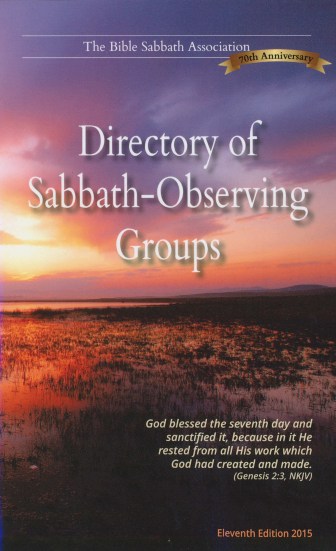
Directory of Sabbath-Observing Groups

directory-11
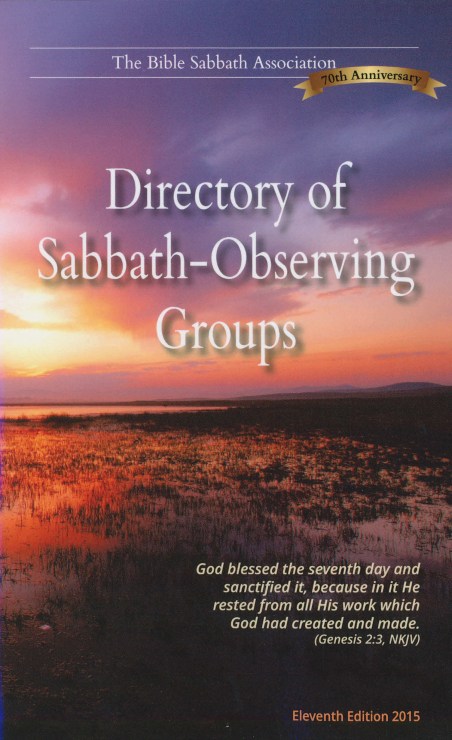
Directory of Sabbath-Observing Groups

by the BSA 

The directory of Sabbath-Observing Groups is now available for FREE online!

Just click the link below!

https://biblesabbath.org/find-a-church/

This directory lists hundreds of Sabbath Keeping churches all over North America and even the rest of the world! There are seven categories of churches in this directory:

  • Seventh-Day Baptists
  • Seventh-Day Adventists
  • Church of God (Seventh Day)
  • World Wide Church of God Successor Movements
  • The Sacred Names Movement
  • The Messianic Movement
  • Non-Aligned Groups (Independent)

We no longer offer this in print form. We apologize for this inconvenience, but we were no longer able to do this as an organization. The link to the online directory is more up to date and is constantly adjusted for new churches or changes in addresses for old churches.

God Bless!
– BSA board directors

Basic Principles of Christian Education

Basic Principles of Christian Education

By Kelly McDonald, Jr.

In the last article, we discussed the need for more Christian education. Colleges are far away and expensive. They are not always theologically sound. While I am not against the concept of Bible colleges, the local church is the best place for the average person to experience higher learning. How do we approach this?

At first, the task of establishing Christian education in the local church may seem intimidating. The first key is to START SOMEWHERE. In this article, we will review some ideas to help you jump start this process.

One of the first principles of Christian Education is macro learning. This method helps us understand the ‘big picture’ view on a subject. A great way to utilize this principle is by reviewing all the Bible verses on a specific subject.

A great place to start is to study the Sabbath all the way through the Scriptures. There are over 140 verses that mention the Sabbath or some aspect of it. Going through every verse allows your congregation to see the big picture of the Sabbath and its consistent mention across the Bible. These allow one to see Biblical patterns pertaining to the Sabbath.

As part of a comprehensive study on a subject such as the Sabbath you could always go faster or slower through certain places where the Sabbath is mentioned.

A second principle to apply is micro learning. Micro learning is focusing in on a specific aspect of what you are studying. So in the case of the Sabbath, you could take a specific passage where the Sabbath is mentioned and go over every word of those verses. This allows you to point out detailed characteristics of the Sabbath.

You could even incorporate both. A pastor could have a sermon series covering the macro view of the Sabbath. During Bible study time, a teacher could cover specific passages about the Sabbath in depth.

The macro and micro methods of learning actually go hand in hand. Based on our current understanding of the human brain, these methods will reinforce the memorization and comprehension of the subject matter. You can apply these principles with any subject – I just mentioned the Sabbath as a starting place.

As part of the micro type of study, the teacher could always use a concordance. The concordance lists the appropriate Hebrew or Greek word associated with each English word we read. A Strong’s Concordance is a good one to start using. You can usually find this kind of resource online for free!

As I said before, the key is to just start somewhere. The Sabbath is a great beginning point. As time goes on, you could choose other subjects such as a study of the other Ten Commandments throughout Scripture and expand the study to other doctrines. Once you start this process, God will lead you down the rest of the path.

Systematic studies conducted in this manner will teach each congregation member a process of learning that will last a lifetime. It gives them the recipe for learning rather than just the cooked meal.

Always remember that the entire Word of God matters – every word of it. This is true whether we understand it fully or not. We can always seek to understand it. Christ taught us to seek, ask and knock (Matthew 7:7-8).  The things we think are harder – such as prophecy – really are some of the most important things that help us view the Bible as a complete whole. Starting with basics will make other subjects easier to understand.

You can always check with other ministries to see if they have resources that will help you in specific areas (Bible Sabbath Association [www.biblesabbath.org], the Church of God International (https://www.cgi.org/), and Christian Education Ministries [https://www.borntowin.net] are great places to start). Additionally, there may be speakers you can invite from other churches from time to time to help teach a certain subject. Connecting to other congregations will help your church.

As a pastor or other church leader, it is up to you to set the pace and the agenda. The onus is on the individual to decide how much they want to learn and how much they want to grow.

Look for more resources on this subject in the future!

Kelly McDonald, Jr.

BSA President – www.biblesabbath.org

Directory of Sabbath-Observing Groups

directory-11
Directory of Sabbath-Observing Groups

by the BSA

The directory of Sabbath-Observing Groups is now available for FREE online!

Just click the link below!

https://biblesabbath.org/find-a-church/

This directory lists hundreds of Sabbath Keeping churches all over North America and even the rest of the world! There are seven categories of churches in this directory:

  • Seventh-Day Baptists
  • Seventh-Day Adventists
  • Church of God (Seventh Day)
  • World Wide Church of God Successor Movements
  • The Sacred Names Movement
  • The Messianic Movement
  • Non-Aligned Groups (Independent)

We no longer offer this in print form. We apologize for this inconvenience, but we were no longer able to do this as an organization. The link to the online directory is more up to date and is constantly adjusted for new churches or changes in addresses for old churches.

God Bless!
– BSA board directors

The Amazing 7-Day Cycle (Part 1)

The Amazing 7-Day Cycle (Part 1)

by Kenneth Westby

“By surprise, science has discovered amazing seven-day cycles in the very building blocks of plant and animal life. These newly found sevens, or “septans,” also lie buried in us humans — deep in our metabolic, hormonal, and neuronal networks. This startling discovery has wide-ranging effects that you will want to understand. The following article explores those effects by answering three questions. First, does the formerly unknown, automatic rhythm of sevens hold the secret to one of history’s most perplexing enigmas — the origin of the seven day week? Second, what could these innate, autonomous rhythms mean for us? And lastly, what will this new knowledge tell us about the biblical Sabbath and the Creator God?

Society’s seven-day calendar week is the only major rhythm of human activity that is totally oblivious to external nature. This so-called “social week” rests on mathematical regularity alone….”

(this article is an excerpt from the July-August 2004 edition of the Sabbath Sentinel)

To read the rest of this article, which starts on page 11, click this link: http://biblesabbath.org/tss/508/tss_508.pdf

We Need More Christian Education (Part 1)

We Need More Christian Education (Part 1)

By Kelly McDonald, Jr.

The typical thought pattern among Christianity for the last few hundred years is to have an educated clergy/pastoral group that can facilitate the spiritual growth of a church members. While the leadership of a church still serves this function, the traditional model has slowly diverged from its original intent as it relates to Christian education (in most churches, but not all). We should reconsider the way we approach Christian education.

Many theological and seminary schools have one or more of the following characteristics. They: 1) are too expensive for the average individual to afford; 2) are too far away for a person to uproot; 3) require too much time for the average person to work and still attend; 4) no longer teach sound doctrine.

These factors often discourage the average Christian from pursuing deeper studies. I am proposing a different strategy for the Body of Christ to adopt. Instead of looking to monolithic institutions of higher learning as the sole provider of Christian education – some institutions still have value – the local church should view itself as the first institution of higher learning. This means that every believer should take it upon himself/herself to study the Bible deeper than ever before.

In other words, I am calling for an educated priesthood composed of all believers.

Does this mean there are still Pastors – YES! Evangelists? YES! – Other church officers? – YES! This proposal simply means that the average church attendee is very educated about the Bible and does not simply leave deeper study to someone else to do for them. By focusing so much on monolithic institutions, we have essentially recreated a system which mirrors the Old Covenant system (a chosen priesthood and then ‘everyone else’). It also has allowed satan to infiltrate these institutions with false doctrine and compromise so that the clergy, who the individual believer looks toward, passes on poor teachings to the flock (Ezekiel 34 depicts this kind of issue). Church has thus become more like a business than a living organism.

One of the problems in modern Christianity is that we have allowed our culture to slowly redefine our approach to church gatherings. Too often, we treat church as a place to be entertained or a social club. The new thought process I propose requires that we view church gatherings as a time of fellowship with God and other like-minded believers (which are great things) – but also as a time to be trained to serve our God throughout the other days of the week.

We must view our study of the Word of God as one of the ways that our relationship with God grows – and not just something a select few seek out on their own. We must learn to view it as necessary, and not optional!

This requires that each of us – individual believers – come with spiritual hunger to learn. This also means that our church leadership – Pastors, Evangelists, etc. – cannot be afraid to delve into subjects that are considered ‘too deep’ or ‘controversial’ – such as Bible prophecy. We have become so afraid of touching subjects because of past abuse of those subjects or false doctrines.

We also cannot be afraid of going deep even in basic subjects such as the Sabbath or Holy Days. This will require longer sermons, multiple sermons, or extra Bible studies. Due to various difficulties involving distance or time constraints with the meeting facility, a church may need to offer online and/or paper correspondence courses (that can be picked up during routine Sabbath services). Have follow ups with those who choose correspondence courses.

God calls people according to His will – but many who have been called to ministry have been discouraged by various factors. When every believer is properly educated, then they have received a high degree of preparation when God calls them and whatever God calls them to do for His Kingdom!

The spiritual forefathers who went before us, such as the Paulicians, were known for their knowledge of the Bible and their ability to constantly quote it. While you may not measure up to that high standard right now – but by the grace of God YOU CAN!

In the next article, we will look at practical ways the local church can equip itself to become an institution of higher learning.

Kelly McDonald, Jr.

BSA President – www.biblesabbath.org

BSA Evangelism Tracts

BSA Pamphlets
BSA Evangelism Tracts

By the Bible Sabbath Association

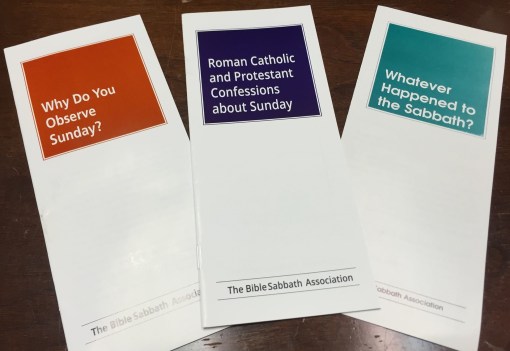
The BSA has a variety of short, easy to understand pamphlets available. These can help educate new believers, but also evangelize others. We give discounts for bulk orders. We have a brief list below:

  • Roman Catholic and Protestant Confessions about Sunday – This pamphlet is a series of quotes by Roman Catholic and Protestant ministers confessing that the true Sabbath is Friday sunset to Saturday sunset
  • Whatever Happened to the Sabbath? – This small pamphlet gives a brief overview of the Sabbath. It cites scripture and insightful questions to cause others to consider the importance of the Sabbath.
  • Why Do You Observe Sunday? – This pamphlet is an overview explaining that Sunday is just a common day; it then transitions to show the Apostle’s example of keeping the Sabbath.
  • Other small tracts available:
  • Why the Seventh-Day Sabbath?
  • Why the Protestant Reformation Failed!
  • 100 Facts on the Sabbath Question
  • What Would Jesus Do on the Weekend

To overview these tracts, click the link below!

http://biblesabbath.org/index.php?pr=Leaflets_and_Tracts


Fasting on the Sabbath in Early Christianity (Part 2)

Fasting on the Sabbath in Early Christianity (Part 2)

In the first part of this series (CLICK HERE to read part one), we reviewed the early history of fasting on the Sabbath. It was started by the heretic Marcion, but later adopted by the Roman Church as a routine discipline. This unfortunate practice was a way that the Roman Church attempted to demean or diminish the importance of God’s Sabbath.

Pope Innocent I (401-417 AD)

In the early fifth century, Pope Innocent I made a formal support of fasting on the Sabbath. In Epistle 25, section 4 he wrote: “Certainly, it is evident why we should fast on the Sabbath…” he went on to explain that we should fast on the Sabbath because Christ was in the tomb at that time – and that makes it a sad day. He taught that we fast on Sabbath out of sadness and then celebrate on Sunday to honor the resurrection. (JP Migne. Patrologiae, Cursus Completus. Series Prima. Vol 20. Latina. Paris, 1845. page 555. – Latin translation is mine).

To my knowledge, he is the first Bishop of Rome to issue a formal decretal regarding the Sabbath fast. Other well-known authors of the time discussed the issue.

Augustine (396-405)

We have two quotes from Augustine, who is considered a saint by the Roman Catholic Church. The first quote is from a letter written to Casulanus. The second quote is from a letter written to Jerome, who is also venerated by the Roman Church. In it, we learn that the vast majority of Christianity refused to fast on the Sabbath because they still revered the day to the Lord.

Augustine to Casulanus (396)

“This question I would wish to see him investigate, and resolve in such a manner as would not involve him in the guilt of openly speaking against the whole Church diffused throughout the world, with the exception of the Roman Christians, and hitherto a few of the Western communities. Is it, I ask, to be endured among the entire Eastern Christian communities, and many of those in the West, that this man should say of so many and so eminent servants of Christ, who on the seventh day of the week refresh themselves soberly and moderately with food, that they are in the flesh, and cannot please God; and that of them it is written, “Let the wicked depart from me, I will not know their way; and that they make their belly their god”, that they prefer Jewish rites to those of the Church, and are sons of the bondwoman…” (Letter 36, Chapter 2, Sec. 4)

Augustine to Jerome (405 AD)

“For if we say that it is wrong to fast on the seventh day, we shall condemn not only the Church of Rome, but also many other churches, both neighbouring and more remote, in which the same custom continues to be observed. If, on the other hand, we pronounce it wrong not to fast on the seventh day, how great is our presumption in censuring so many churches in the East, and by far the greater part of the Christian world!” (Letter 82, sec. 14)

John Cassian (420-429)

John Cassian was a writer of the fifth century who recorded practices and customs of Christianity at that time. He affirmed that fasting on the Sabbath was a non-Apostolic practice and simply a tradition without any authority. He also gave a further elaboration on the justification some gave for the Sabbath fast. Apparently, some thought that Peter fasted on the Sabbath before his encounter with Simon Magus in Acts chapter 8. There is no Scriptural evidence for this statement and it does not agree with Pope Innocent’s reasoning for doing so.

“And throughout the whole of the East it has been settled, ever since the time of the preaching of the Apostles, when the Christian faith and religion was founded, that these Vigils should be celebrated as the Sabbath dawns…And so, after the exertion of the Vigil, a dispensation from fasting, appointed in like manner for the Sabbath by apostolic men, is not without reason enjoined in all the churches of the East… For this dispensation from fasting must not be understood as a participation in the Jewish festival by those above all who are shown to be free from all Jewish superstition, but as contributing to that rest of the wearied body of which we have spoken…” (Institutes, chapter 9).

“But some people in some countries of the West, and especially in the city [Rome], not knowing the reason of this indulgence, think that a dispensation from fasting ought certainly not to be allowed on the Sabbath, because they say that on this day the Apostle Peter fasted before his encounter with Simon. But from this it is quite clear that he did this not in accordance with a canonical rule, but rather through the needs of his impending struggle….but no canonical rule of fasting would have been made general from this, because it was no general observance that led to it, but a matter of necessity, which forced it to be observed on a single occasion” (Institutes, 3:9,10).

Trullan Synod (692)

The Trullan Synod (also called Quinisext) was ordered by the Eastern Roman Emperor Justinian II towards the end of the seventh century; various representatives of the East were present. It challenged Rome on certain issues and was an attempt to place the city of Constantinople on the same authority as Rome. In the second canon of this council, all 85 canons from the work entitled Apostolic Canons were reinforced as ecclesiastical law (the Apostolic Canons are not Apostolic as they date from the third or fourth century at the earliest). This stance was contrary to Rome, who only recognized the first 50 canons. Further, the canons from Laodicea were upheld (which were very anti-Sabbatarian).

102 Canons were published at this synod. Canon 55 prohibited people from fasting on Saturday (citing the Apostolic Canons as the reason for this rule). While fasting on the Sabbath was routine at Rome, it was banned in the East. Canon 80 forced mandatory Sunday church attendance. After three weeks of missed church, a person was punished with excommunication.

The Trullan Synod was an attempt to correct fasting on the Sabbath. Sunday was also enforced, which is a testimony to the fact that it was not as strictly observed as one might think. The Sabbath was still an important day of worship (Hefele, vol 5, 221-242).

In conclusion, the practice of fasting on the Sabbath gradually entered Christianity in the second century, but became common place in the West by the sixth or seventh century AD. The Sabbath fast was discouraged and opposed by the Eastern Church. This issue was one the main reasons why the Western and Eastern churches split from each other in 867 and finally in 1054.

CLICK HERE To learn more about fasting in the Middle Ages.

God Bless!

Kelly McDonald, Jr

BSA President; www.biblesabbath.org

In the Beginning Creation According to Genesis

Genesis
In the Beginning Creation According to Genesis
by David Rives

The Holy Bible contains a historical record of the world from the time of creation. That record begins in the book of Genesis, which in the Greek language means “Origins.” In the original Hebrew it is known as “B’reshit” — Beginning — and in the very first sentence, the foundation of the whole Bible, we learn that “In the beginning, God created the heaven and the earth.” So let’s start at the VERY beginning.

To order this informative DVD, click the link below:

https://biblesabbath.org/shopping/pgm-more_information.php?id=97&=SID