A Thousand Shall Fall

A Thousand Shall Fall

This inspiring book recalls the story of a Seventh Day Adventist leader who was drafted in the German army during World War II. He refused to break the Sabbath and suffered because of it. His wife refused to give their children exams on the Sabbath and they resisted all pressure to join the Nazi party. He warned Jewish people to flee as the German army advanced. This book is not a Scriptural examination of the seventh-day Sabbath; it is a story of faith put into practice. Against all odds, he honored God’s Holy Day and survived the war.

To learn about this inspiring story, click the link below:

https://biblesabbath.org/shopping/pgm-more_information.php?id=22&=SID

Sabbath Meditation #6 – Timing is Everything

Sabbath Meditation #6 – Timing is Everything

by Kelly McDonald, Jr.

“And it came to pass at the end of the four hundred and thirty years, even the selfsame day it came to pass, that all the hosts of the Lord went out from the land of Egypt” (Exodus 12:41).

“My times are in thy hand: deliver me from the hand of mine enemies, and from them that persecute me” (Psalm 31:15).

“See, for that the Lord hath given you the sabbath, therefore he giveth you on the sixth day the bread of two days…” (Exodus 16:29a).

“…the feasts of the Lord, which ye shall proclaim to be holy convocations, even these are my feasts. Six days shall work be done; but the seventh day is the sabbath of rest, an holy convocation” (Lev. 23:2-3)

Have you ever heard the phrase, “Timing is everything?” Just imagine how things would be different in your life if certain events had not occurred at just the right time. For an example: What if our perceived delays prevented us from being in an accident? The point is this: Timing plays a huge part in our lives.

God is all about timing. He is never late. He is always on time to fulfill His promises, even if we question His timing. For instance, God brought the Israelites out of Egypt 430 years to the very day that they went into that land. They did not leave a day before or a day after. God had designed that they leave in His timing.

After the Israelites left Egypt, the theme of time continued. God sent one portion of manna on the first five days of the week, twice as much on the sixth day, and none on the seventh day. The goal was to teach them which day was the Sabbath. “See, for that the Lord hath given you the sabbath, therefore he giveth you on the sixth day the bread of two days…” (Exodus 16:29a). After leaving Egypt, God brought them into His weekly sacred rhythm.

When God told the Israelites to take the Promised Land, they refused due to unbelief (Numbers 13). As a result, God forbid them from entering into the Promised Land (Numbers 14:1-38). They defied God and still tried to take the Promised Land, but failed (Numbers 14:39-45).

In the same way, humans want to work and rest whenever we choose. This can’t be a good idea if God has already ordained that we work certain days and rest on one specific day. If the Israelites had tried to leave Egypt sooner or later than God’s intentional timing, they would have not succeeded.

During the week, we can feel overwhelmed with everything that can be or needs to be done. Moreover, there are certain events in our culture that might often occur on Sabbath (such as sporting events). The enemy, satan, wants you to think that because you abstain from these activities to honor the Sabbath that you are missing out on something. In these moments, we must trust in God’s timing, which is perfect. If God’s timing was so precise and perfect in bringing the Israelites out of Egypt, then why would this not also apply to the Sabbath? You cannot miss out on anything that God has for your life when you follow His timing.

His timing leads us towards the fulfillment of His plans and purposes. He knows best. David wrote, “My times are in thy hand…” (Psalm 31:15). Recall from Sabbath Meditation #1 that God did not give mankind dominion over time. That is left to God’s sovereignty. What is left in His hands cannot be taken away (John 10:29).

The Israelites cried out and wanted to leave Egypt as soon as possible, but God ordained it happen on a specific day. Similarly, God has planned the Sabbath on the seventh day, not a day of our choosing. He has established the pattern for our times.

If we find ourselves outside of His weekly rhythm by failing to observe Sabbath, we will miss out on something He wants us to have. In previous Sabbath Meditations, we have reviewed the spiritual strength and Joy we receive when we honor the seventh day of the week (see Sabbath Meditation 4[link] and  Meditation 5[link]).

In Leviticus 23:2-3, God said that the Sabbath was one of HIS feasts. The Hebrew word translated as ‘feasts’ is moed, and it means an appointed or set time.  For the natural mind, any time seems convenient. In John 7:6, Jesus said, “My time has not yet come, but your time is always ready.” For man, any time works – any time to work and any time to rest. God already has an appointment for you and I on the Sabbath – He will not fail to come through on this set time. Why would we want to miss it?

God is very intentional and He designed the seven-day week according to His purpose for our lives and our best interest. His ways are higher than our ways (Isaiah 55:8-9). When we simply follow His timing, the possibilities are endless.

Selah.

Kelly McDonald, Jr

BSA President

www.biblesabbath.org

Seven Factors that Influenced the Sabbath in the Early Church (Part 4 of 4)

Seven Factors that Influenced the Sabbath in the Early Church (Part 4 of 4)

by Kelly McDonald, Jr.

The last factor that influenced the Sabbath was the relationship between Roman Emperors and Roman Bishops. Beginning with the time of Constantine, the Roman Church became intertwined with the Roman Empire. Constantine de facto made the Roman Church an institution of the state. Roman Emperors starting with Constantine codified Roman Church practices as law and even tried to influence them.

In 321 AD, Constantine  ruled that people could leave property to the Roman Church upon death (CT: 16.2.4). In 326 AD, he passed a law that granted the Roman Church special privileges. All other Christian groups were not allowed these privileges and were bound to public service (CT: 16.5.1). He regulated the number of clergy in Christianity (CT: 16.2.6 [326 AD]). Secular judges were even required to enforce the decisions of Christian Bishops (CS: 1 [333 AD]).

In 379, Theodosius became the Eastern Roman Emperor. After hearing the perspectives of different Christian groups, he sided with the Roman Church. All houses of prayer were given over to the Roman Church. The next year he passed a law, which forced all peoples under his rule to follow the Roman Catholic religion. We have an excerpt from this decree below:

“To the residents of Constantinople: It is our will that all the peoples whom the government of our clemency rules shall follow that religion which a pious belief from Peter to the present declares the holy Peter delivered to the Romans, and which it is evident the Pontiff Damascus and Peter, bishop of Alexandria, a man of apostolic sanctity, follow; that is, that according to the apostolic discipline and evangelical doctrine we believe in the deity of the Father and the Son and the Holy Spirit of equal majesty in a holy trinity. Those who follow this law we command shall be comprised under the name of Catholic Christians; but others, indeed, we require, as insane and raving, to bear the infamy of heretical teaching; their gatherings shall not receive the name of churches; they are to be smitten first with the divine punishment and after that by the vengeance of our indignation, which has divine approval” (CT: 16.1.2).

His laws relating to religion were sometimes fanatical. People were not even allowed to discuss religious matters in public (CT: 16.4.1 [388 AD]). Non-Roman Catholic groups were forbidden from owning churches or meeting together to have services.

The Imperial relationship with the Roman Church would pave the way for celebrations of the Roman Church, including Sunday, to be enshrined as enforced law. The first Sunday law in history with any mention of the Lord was issued in 386 AD by Theodosius (CT: 2.8.18).

From 386 to 469, there were seven laws enacted that specifically regulated some aspect of Sunday rest or worship. Sunday became cemented as the day of rest in the Roman Empire. This would last for centuries into the future and even transfer to other European monarchies that used Roman law (such as the Frankish people under Charlemagne).

How did this last factor effect the Sabbath? The institution of Sunday as a government-mandated day of rest set up a false Sabbath beside the true one. People began to view Sunday as legitimized due to civil law. “If its good enough for everyone else, then its good enough for me.” This popularized Sun-day in a way not experienced before this time.

The bottom line: these laws distracted people from God’s agenda – for humans to rest on the seventh day of the week. Other Roman Catholic Celebrations such as the nativity of Jesus (later called Christmas) also became popularized (for Christmas, see: CT 15.5.5 [425 AD]) became established law.

In conclusion, the Sabbath was attacked and slandered for centuries through these seven factors: 1) Persecution of Christians, 2) Destruction of Jerusalem (twice), 3) Quartodeciman Controversy, 4) Anti-Semitism, 5) Syncretism, 6) Allegorizing Scripture, 7) The relationship between the Roman Empire and the Roman Catholic Church.

As you ponder these details, consider that some of these same factors are used in arguments today to denigrate the seventh-day Sabbath. But now you know their origin. We will give some examples.

Example #1 – The Quartodeciman Controversy still affects the Sabbath. People often use the argument that the resurrection occurred on Sunday morning to justify changing the Sabbath to Sunday. This argument was never used by the first Apostles. It wasn’t used by anyone until over 100 years after Christ was on earth.

Example #2 – Anti-Semitism still influences people’s view of the Sabbath. When you mention the seventh-day Sabbath, many will say “That’s just for the Jews”; “You mean the Jewish Sabbath?”; or “We do not live like Jewish people”. Yet not a single time in the Bible is the Sabbath ever called Jewish; it is called the Sabbath of the Lord our God (see Exodus 20:8-11 as an example). Jesus said the Sabbath was for man, not Jews. People who use these arguments may not be anti-Semitic; but they are using an anti-Semitic argument.

Example #3 – Allegorizing the Scriptures. Some today still allegorize when discussing the Sabbath. For instance, some people say “Jesus is my Sabbath” or “Rest is not a day, it is salvation in Christ” – yet none of these arguments are found in the Bible.

Consider this!

Despite these seven factors, most Christians still honored the Sabbath into the 400s AD. This completely negates the argument that the Sabbath was changed by the early Church!

We will look at one writer who lived in the late 300s/early 400s AD. His name is Socrates Scholasticus; He wrote a tremendous work on Christian history.

“For although almost all churches throughout the world celebrate the sacred mysteries on the Sabbath of every week, yet the Christians of Alexandria and at Rome, on account of some ancient tradition, have ceased to do this. The Egyptians in the neighborhood of Alexandria, and the inhabitants of Thebais, hold their religious assemblies on the Sabbath, but do not participate of the mysteries in the manner usual among Christians in general: for after having eaten and satisfied themselves with food of all kinds, in the evening making their offerings…” (ibid, bk 5, ch 22)

Pay close attention to the words of this historian. He recorded that Rome and Alexandria were the two cities that ceased to honor the Sabbath; this means at one time they did it! He also noted that they did not stop honoring the Sabbath because of any scripture, but because of a tradition. Jesus warned us about the traditions of man that contradict the commandments of God (Matthew 15:1-20).

Despite these seven factors, most Christians continued to honor the Sabbath. If you missed the first three parts of this series, I have included them below:

Click here for part 1

Click here for part 2

Click here for part 3

Kelly McDonald, Jr.

BSA President – www.biblesabbath.org

Directory of Sabbath-Observing Groups

directory-11

Directory of Sabbath-Observing Groups

by the BSA

The directory of Sabbath-Observing Groups is now available for FREE online!

Just click the link below!

https://biblesabbath.org/find-a-church/

This directory lists hundreds of Sabbath Keeping churches all over North America and even the rest of the world! There are seven categories of churches in this directory:

  • Seventh-Day Baptists
  • Seventh-Day Adventists
  • Church of God (Seventh Day)
  • World Wide Church of God Successor Movements
  • The Sacred Names Movement
  • The Messianic Movement
  • Non-Aligned Groups (Independent)

We no longer offer this in print form. We apologize for this inconvenience, but we were no longer able to do this as an organization. The link to the online directory is more up to date and is constantly adjusted for new churches or changes in addresses for old churches.

God Bless!
– BSA board directors

Seven Factors that Influenced the Sabbath in the Early Church (Part 3 of 4)

Seven Factors that Influenced the Sabbath in the Early Church (Part 3 of 4)

by Kelly McDonald, Jr.

In the midst of the previous four factors, a fifth significant development occurred: syncretism. Syncretism is the mixing of other religious practices with the pure practice of the Holy Bible.

As some early Christians sought to avoid practices that appeared Jewish and even avoid persecution, they embraced practices from other religions. The quote from Pliny the Younger in part 1 of this series confirmed the beginning of this trend. (CLICK HERE to read part 1 of this series.)

The veneration of the Sun and Sun-day were among the practices borrowed from other religions. The practice of praying towards the sun as it rose and set increased in popularity from the late second century onward. Sun-day was also adopted. Platonism, gnosticism, and other philosophies were melded with Christianity and formed the basis for these strange practices.

One of the writers of this period was Clement of Alexandria (180s AD). Among his other questionable statements, he believed that we should pray with our faces towards the east to face the rising sun (ibid, 7:7). Lastly, he believed that the sun was created as an object of worship. “And he gave the sun, and the moon, and the stars to be worshipped…” (ibid, 6:14).

He was an avowed gnostic and claimed that the true gnostic does not honor specific days (ibid, 6:15, 7:7). He proposed that philosophy was given to the Greeks to guide them towards righteousness (ibid, 1:5).

In his writings, we find the first legitimate reference to Sunday being called the Lord’s Day, which does not have scriptural evidence. His justification for this view comes from Plato and the number eight (Stromata, 5, 14). Plato was a heathen philosopher. Why would anyone use his writings to justify any Christian practice?

As the Old Testament was being devalued as the background source to the New Testament, these Gnostic writers found other sources that they could use as a derivative of Christian practice. Philosophy was one belief system syncretized with the New Testament to fill this void. An attraction to the sun, which was popular in the Roman Empire, was part of this trend.

Tertullian lived in Carthage in the late 190s/early 200s AD. He was an avowed enemy of Marcionites, but he still advocated Sunday.  We have some of his quotes below.

“Others with a greater show of reason take us for worshippers of the sun… This suspicion took its rise from hence, because it was observed that Christians prayed with their faces towards the east [towards the sun] but if we, like them[the pagans], celebrate Sunday as a festival and day of rejoicing, it is for a reason vastly distant from that of worshipping the sun; for we solemnize the day after Saturday in contradistinction to those who call this day their Sabbath, and devote it to ease and eating, deviating from the old Jewish customs, which they are now very ignorant of” (Apology, Chapter 16; emphasis mine throughout).

Tertullian admitted that the Sunday celebration was conducted “like them” – meaning like the pagans. He also acknowledged that there were Christians that still called Saturday the Sabbath.

“Others, with greater regard to good manners, it must be confessed, suppose that the sun is the god of the Christians, because it is a well-known fact that we pray towards the east or because we make Sunday a day of festivity. What then? Do you do less than this?…It is you [the pagans], at all events, who have even admitted the sun into the calendar of the week; and you have selected its day, in preference to the preceding day…For the Jewish feasts are the Sabbath and “the Purification”…all which institutions and practices are of course foreign from your [pagan] gods” (Against the Nations, 1:13).

In his work, Against the Nations (also called To the Nations), Tertullian addressed pagan worshipers. Once again, he admitted that some Christians made Sunday a festivity in the same way as the pagans. He then confessed that the practices of the Sabbath and festivals by the Jewish people are foreign to other gods. They are holy celebrations not shared by other religions. He had to defend the syncretism he practiced.

Tertullian was the first person (to my knowledge) who defended Christianity against accusations of sun worship. In the New Testament, Christians never had to shield themselves against such allegations. Syncretism caused this to change –the outside world was confused by the Sunday festivity.

Tertullian also confessed that Sunday worship was a tradition with no Scriptural authority. This is consistent with modern Catholic writers such as Cardinal James Gibbons and John Laux. CLICK HERE to read their quotes. 

“We count fasting or kneeling in worship on the Lord’s day to be unlawful…. If, for these and other such rules, you insist upon having positive Scripture injunction, you will find none. Tradition will be held forth to you as the originator of them” (De Corona, chapters 3 and 4).

As we read these primary source accounts, syncretism had a huge impact on the early Church. Some wanted to retain pagan practices, such as adoration of the sun and its rising, but still hold Christian principles. We are instructed in the Bible not to pray to the sun or adore its rising (see Deut. 4:19, Ezekiel 8:14-17). Also, the phrase “Lord’s Day” became gradually attached to the first day of the week.

This influenced the Sabbath in that an alternative day, without Scriptural support, found its way into the Christian community. This was yet another attempt to divert people from observance of the one and only True Sabbath.

The next factor that influenced the Sabbath was the allegorizing of Scripture. You may not be familiar with this concept, but allegorizing is a unique method of interpreting the Bible. It does not fully consider the literal meaning of verses. Instead, numbers and details in the Bible are treated as symbols. They are then reapplied in a way that is subjective to the interpreter. As a result, those who use this method usually come to conclusions that negate the literal meaning of the Bible.

Among the first writers to allegorize the Bible was Justin the Martyr. We discussed him in part 2 of this series (CLICK HERE TO read part 2). He especially used allegory as it related to the Sabbath and the resurrection. We have two excerpts below:

“For righteous Noah, along with the other mortals at the deluge, i.e., with his own wife, his three sons and their wives, being eight in number, were a symbol of the eighth day, wherein Christ appeared when He rose from the dead, forever the first in power” (Dialogue with Trypho, chapter 138).

“The Lord our God does not take pleasure in such observances: if there is any perjured person or a thief among you, let him cease to be so; if any adulterer, let him repent; then he has kept the sweet and true Sabbaths of God…” (ibid, chapter 12).

In the first quote, he allegorized the number eight from the story of Noah and used this number as a reason to transfer the Sabbath to the first day of the week (which he calls the eighth day of the week). In another chapter of the same work, he does the same thing with circumcision (see chapter 41).

His allegorical attack on the Sabbath has obvious problems with the literal meaning of the Scriptures. First, God never described the week as having eight days. Secondly, Jesus did not resurrect on Sunday. Third, no Bible writer ever connected circumcision or Noah to the Sabbath.

In the second quote above, Justin portrayed a sinless life as the true way to honor the Sabbath. Again, this is a problematic interpretation. The Sabbath is the weekly day of rest – keeping other commandments cannot replace its absolute requirements. If someone abstains from stealing, then they have done well and honored that specific commandment. However, if the same person works on Sabbath then he/she has violated the fourth commandment. If we use Justin’s logic, we could justify breaking any commandment we want.

Two other authors that contributed greatly to allegorizing the Scriptures were Clement of Alexandria and his pupil Origen. We mentioned Clement earlier in this article as a proponent of syncretism. He studied at the Alexandrian school of theology, which taught the allegorical method. At times, he and Origen decried honoring any specific day as special.

“Whence not in a specified place, or selected temple, or at certain festivals and on appointed days, but during his whole life, the Gnostic in every place, even if he be alone by himself, and wherever he has any of those who have exercised the like faith, honours God, that is, acknowledges his gratitude for the knowledge of the way to live” (Clement, Stromata, 7, 7).

“If it be objected to us on this subject that we ourselves are accustomed to observe certain days, as for example the Lord’s day, the Preparation, the Passover, or Pentecost, I have to answer, that to the perfect Christian, who is ever in his thoughts, words, and deeds serving his natural Lord, God the Word, all his days are the Lord’s, and he is always keeping the Lord’s day. He also who is unceasingly preparing himself for the true life, and abstaining from the pleasures of this life which lead astray so many — who is not indulging the lust of the flesh, but keeping under his body, and bringing it into subjection,— such a one is always keeping Preparation-day” (Origen, Against Celsus, 8:22)

Origen allegorized away any day with special significance and ranked them all the same. He thus contradicted the example of Christ and the early Apostles, who clearly made distinctions between days that were holy and those that were not.

Allegorizing Scriptures would contribute to misunderstanding the Sabbath for centuries to come. A substantial number of Christians were influenced by the Alexandrian school of Theology. This form of interpreting the Scriptures has existed in some form down to the present. People use similar explanations of the bible toda

We will finish this series next week!

Kelly McDonald, Jr.

BSA President – www.biblesabbath.org

BSA Evangelism Tracts

BSA Pamphlets

BSA Evangelism Tracts

By the Bible Sabbath Association

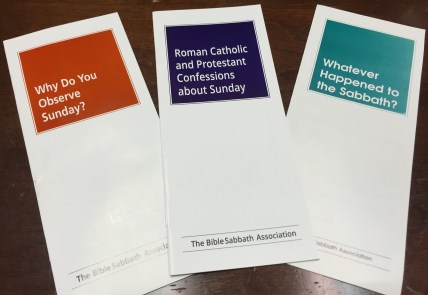
The BSA has a variety of short, easy to understand pamphlets available. These can help educate new believers, but also evangelize others. We give discounts for bulk orders. We have a brief list below:

  • Roman Catholic and Protestant Confessions about Sunday – This pamphlet is a series of quotes by Roman Catholic and Protestant ministers confessing that the true Sabbath is Friday sunset to Saturday sunset
  • Whatever Happened to the Sabbath? – This small pamphlet gives a brief overview of the Sabbath. It cites scripture and insightful questions to cause others to consider the importance of the Sabbath.
  • Why Do You Observe Sunday? – This pamphlet is an overview explaining that Sunday is just a common day; it then transitions to show the Apostle’s example of keeping the Sabbath.
  • Other small tracts available:
  • Why the Seventh-Day Sabbath?
  • Why the Protestant Reformation Failed!
  • 100 Facts on the Sabbath Question
  • What Would Jesus Do on the Weekend

To overview these tracts, click the link below!

http://biblesabbath.org/index.php?pr=Leaflets_and_Tracts

Seven Factors that Influenced the Sabbath in the Early Church (Part 2 of 4)

Seven Factors that Influenced the Sabbath in the Early Church (Part 2 of 4)

by Kelly McDonald, Jr.

The immediate consequence of the second destruction of Jerusalem was confusion as to when Passover should be celebrated. This is the third factor that had an influence on the Sabbath in the Early Church. It is also called the Quartodeciman Controversy.

In the 370s AD, Epiphanius wrote that that the quarrel about Passover started during the reign of Hadrian (Panarion, 70). Up to this time, there was no confusion about it. Most Christians celebrated Passover on the fourteenth of Nissan, as Jesus himself celebrated it in this manner.

In approximately 155 AD, a controversy about Passover caused a stir within the Christian world. Anicetus was the Bishop of Rome at that time; he refused to keep Passover. Polycarp, who was taught and trained by the first Apostles, was still alive. He celebrated Passover on the fourteenth of Nissan. He visited Rome to persuade Anicetus to stick with the Apostolic practice. The early church historian Eusebius wrote about this visit.

“At this time, while Anicetus was at the head of the church of Rome, Irenæus relates that Polycarp, who was still alive, was at Rome, and that he had a conference with Anicetus on a question concerning the day of the paschal feast…” (Eusebius, Church History, bk 4, 14:1- 7).

“For neither could Anicetus persuade Polycarp not to observe what he had always observed with John the disciple of our Lord, and the other apostles with whom he had associated; neither could Polycarp persuade Anicetus to observe it…” (ibid, bk 5, 24:16-17).

The meeting between the two leaders came to a standstill. Polycarp held to the practice of Passover as he received it from the early Apostles. Anicetus decided not to celebrate Passover. At that point in history, the Roman Church celebrated Passover on the Sunday after the 14th of Nissan. They claimed that this practice was necessary because they believed the resurrection of Jesus occurred on Sunday. This is the first time such a controversy arose; the issue would persist for hundreds of years.

How did the Quartodeciman controversy affect the Sabbath? From the position of an annual Sunday celebration to honor the resurrection, the Roman Church drifted towards the view that every Sunday should be celebrated by Christians in the place of the seventh-day Sabbath. The resurrection became their justification for this practice – even though such a justification is not found in the New Testament.

Sunday replacing Passover or the Sabbath cannot be an apostolic teaching because the earliest Apostles met on the Sabbath and still taught about the resurrection. The resurrection never influenced when the Sabbath was honored. Polycarp, who was taught by the first Apostles, was never persuaded to follow the practice of Rome.

The fourth factor that influenced the Sabbath in the early Church was anti-Semitism. It was tightly bound up with the previous factors we have reviewed.

By the reign of Hadrian, anti-Semitism was rooted in Roman culture. Some Roman writers called the Jewish people a cursed race. They were accused of following mere superstitions; sometimes attacks were made against them that specifically targeted the seventh-day Sabbath (For a few examples, see Jewish Encyclopedia 1905 article: Seneca, Lucius Annaeus; Tacitus, Histories, book 5:4-5; Quintilian Institutio Oratia, bk 3, sec 7:21).

Unfortunately, anti-Semitism infiltrated Christianity. During Hadrian’s reign, a man named Aristides made a defense of the Christian faith to the Emperor. His goal was to somehow curtail the regional persecutions of Christians still taking place. In his speech called The Apology, he claimed that there were four classes of men: barbarians, Greeks, Jews, and Christians. Moreover, he claimed that Christians were the highest of the four classes and had the most truth. He said that the Jewish people worshiped angels and derived their practices from them. Among the practices he derided was the Sabbath. We have a quote from his work below:

“Nevertheless they too erred from true knowledge. And in their imagination they conceive that it is God they serve; whereas by their mode of observance it is to the angels and not to God that their service is rendered:— as when they celebrate Sabbaths…” (The Apology, Section 14).

To my knowledge, this is the first historical reference of a Christian attempting to separate himself from the practices held in common with Jewish people. But it was the beginning of others who would follow with similar arguments.

Just after the reign of Hadrian and the war he waged with the Jewish people, several anti-Semitic teachers spread heresy in the Christian world. Marcion is considered the most influential of them; he began teaching around 144 AD. He taught that the God of the Old Testament was a separate God from that of the New Testament.

According to Irenaeus, a contemporary of the time, this heretical teacher flourished under the Roman Bishop Anicetus; this is the same Anicetus from the Quartodeciman controversy (Irenaeus. Adversus Haereses. Book III, Chapter 4, Verse 3).

Marcion convinced many people to believe in his heresy (Justin, First Apology, Chapter 26). He had a special hatred for the seventh-day Sabbath. He is cited as teaching the following: “Since that day is the rest of the God of the Jews, who made the world and rested the seventh day, we therefore fast on that day, that we may not do anything in compliance with the God of the Jews” (Epiphinaus, Panarion, Sec. 42).

He advocated fasting on the Sabbath to dishonor the “God of the Jews.” Marcion was declared a heretic by the Roman Church, but they later adopted some of his teachings in one way or another. For instance, fasting on the Sabbath became a normal practice for the Roman Church by the fifth century (Augustine – Letters 36, 82).

Justin the Martyr was another anti-Semitic writer of this period (150s-160s AD). He wrte that the Sabbath was given to the Jewish people due to their transgressions and hardness of hearts (Dialogue with Trypho, Chapter 18). However, Christ said that the Sabbath was given for all mankind, not just the Jewish people (Mark 2:27-28). It was also first given in Genesis, which was long before the Israelites became a nation. Justin claimed that Christians who observed practices such as the Sabbath would “probably be saved” (ibid, 47).

The anti-Semitism that penetrated Christianity during the second century increased over time; it specifically targeted the Sabbath. Pro-Roman writers thought they could denigrate the Sabbath by labeling it a Jewish institution.

In the late 300s AD, Augustine called people who honored the Sabbath “sons of the bondwoman” (letter 36, chapter 2). Around 600 AD, Pope Gregory called Sabbath observers the preachers of the anti-Christ (Registrum Epistolarum, Book 13, Letter 1). 

This demeaning position towards the Sabbath observance was designed to divert people from it and influenced people to turn away from it. Such slander against the seventh day arose at the same time that the culture shunned Jewish people.

We will continue this series next week.

Kelly McDonald, Jr.
BSA President – www.biblesabbath.org


In the Beginning Creation According to Genesis

Genesis

In the Beginning Creation According to Genesis
by David Rives

The Holy Bible contains a historical record of the world from the time of creation. That record begins in the book of Genesis, which in the Greek language means “Origins.” In the original Hebrew it is known as “B’reshit” — Beginning — and in the very first sentence, the foundation of the whole Bible, we learn that “In the beginning, God created the heaven and the earth.” So let’s start at the VERY beginning.

To order this informative DVD, click the link below:

https://biblesabbath.org/shopping/pgm-more_information.php?id=97&=SID

Seven Factors that Influenced the Sabbath in the Early Church (Part 1 of 4)

Seven Factors that Influenced the Sabbath in the Early Church (Part 1 of 4)

by Kelly McDonald, Jr.

Today we will begin a four-part series on the history of the Sabbath in Early Christianity. This series will help you understand the different factors that affected the Sabbath in the first few centuries of Christianity.

We know that Christ and His disciples honored the Sabbath (see Luke 4:16 and Acts 13:13-46 for some examples). Did the second generation of disciples continue to honor the Sabbath?

There are at least seven factors or development that I have identified as having influenced people’s view of the seventh day Sabbath. While these items are certainly interrelated, they can also be viewed individually. I have listed them below:

  • Persecution of Christians
  • Destruction of Jerusalem (twice)
  • Quartodeciman Controversy
  • Anti-Semitism
  • Syncretism
  • Allegorizing Scripture
  • The Roman Church’s Relationship to Roman Emperors

The first factor was persecution. From 64 AD to 324 AD, there were as many persecutions of Christians initiated by Roman Emperors or their magistrates. These persecutions hunted down the faithful. They had their property confiscated; they were tortured and even killed. Many Christian leaders were targeted in these attacks.

The first Roman persecution was directed by the Emperor Nero in 64 AD. He desired to build a new city called Neronia (obviously named after himself). Before he could start this project, he had to destroy part of the old city of Rome. Perhaps not coincidentally, a massive fire destroyed part of the old city. Some sources say that he purposefully set fire to the city to make room for his new project. The Roman people demanded that the implementer of this crime be revealed. In their minds, someone had to pay the price.

To divert the people’s suspicion from himself, Nero blamed Christians. Believers were tortured in awful ways. Tacitus, a pagan Roman historian who lived near this event, tells us about their awful treatment:

“…Consequently, to get rid of the report (that he started the fire), Nero fastened the guilt and inflicted the most exquisite tortures on a class hated for their abominations, called Christians by the populace. Christus, from whom the name had its origin, suffered the extreme penalty during the reign of Tiberius at the hands of one of our procurators, Pontius Pilate…  Accordingly, an arrest was first made of all who pleaded guilty; then, upon their information, an immense multitude was convicted… Mockery of every sort was added to their deaths.  Covered with the skins of beasts, they were torn by dogs and perished, or were nailed to crosses, or were doomed by the flames and burnt, to serve as a nightly illumination, when daylight had expired…. Nero offered his gardens for the spectacle, and was exhibiting a show in the circus, while he mingled with the people in the dress of a charioteer or stood aloft on a car.  Hence, even for criminals who deserved extreme and exemplary punishment, there arose a feeling of compassion; for it was not it seemed, for the public good, but to glut one man’s cruelty, that they were being destroyed” (Tacitus, The Annals, 15:44).

This account by Tacitus is among the first historical accounts outside of the Bible that reference Christ and Christianity. Great harm was done to believers, but they pressed on to the high calling of the faith.

As these persecutions continued, two classes of people began to emerge in Christianity. The first class was composed of loyal and faithful believers who held firmly to the faith no matter the threat presented to them. The second class publicly professed Christ, but denied Him when threatened with punishment. This second class even sacrificed to the pagan gods of Rome.

One eyewitness of this development was Pliny the Younger. He was a magistrate during the reign of the Roman Emperor Trajan, who ruled from 98-117 AD. This is one of the Emperors that allowed Christians to be persecuted. A quote from him is found below:

“…An anonymous information was laid before me containing a charge against several persons, who upon examination denied they were Christians, or had ever been so. They repeated after me an invocation to the gods, and offered religious rites with wine and incense before your statue (which for that purpose I had ordered to be brought, together with those of the gods), and even reviled [cursing] the name of Christ: whereas there is no forcing, it is said, those who are really Christians into any of these compliances: I thought it proper, therefore, to discharge them…Some among those who were accused by a witness in person at first confessed themselves Christians, but immediately after denied it; the rest owned indeed that they had been of that number formerly, but had now (some above three, others more, and a few above twenty years ago) renounced that error. They all worshipped your statue and the images of the gods, uttering imprecations at the same time against the name of Christ…They affirmed the whole of their guilt, or their error, was, that they met on a stated (fixed) day before it was light, and addressed a form of prayer to Christ…I forbade the meeting of any assemblies…. For it appears to be a matter highly deserving your consideration, more especially as great numbers must be involved in the danger of these prosecutions…In fact, this contagious superstition is not confined to the cities only, but has spread its infection among the neighbouring villages and country. Nevertheless, it still seems possible to restrain its progress. The temples, at least, which were once almost deserted, begin now to be frequented; and the sacred rites, after a long intermission, are again revived…From all this it is easy to conjecture what numbers might be reclaimed if a general pardon were granted to those who shall repent of their error…” (Letter 97; emphasis mine throughout)

While these believers were not specifically targeted for keeping the Sabbath because the vast majority, if not all Christians at that time kept the Sabbath. The historical reference above reveals that Christians were observed to meet on a stated or fixed day; this would have been the Sabbath. Christian assemblies were forbidden by Pliny.

How did the persecutions affect the Sabbath? First of all, some of the strongest leaders and believers were martyred. Secondly, these persecutions led to compromise among believers. Some people denounced their profession of faith in Christ when confronted. Pliny noted that the pagan temples were almost empty, but the persecutions caused them to be full again. In other words, some who had attended Christian fellowship later turned back to pagan worship.

This development had long-term consequences and was was repeated in subsequent persecutions, such as the Decian (250 AD) and Diocletian (303 AD). The willingness to compromise among believers allowed other religious practices to enter the larger Christian community.

A second influence on the Sabbath in early Church history was the destruction of Jerusalem, which occurred twice.

In 70 AD, the Romans destroyed Jerusalem. The city was ransacked, and the Second Temple was destroyed. This was a tragedy for the Jewish people and it scattered some Christians. About forty years before, Jesus warned the early believers to flee to the mountains when the city was surrounded by armies (Luke 21:20-21).

Historical accounts tell us that the early believers fled to Pella and were protected. Epiphanaus and Jerome are two ancient writers that describe this. Of them, Epiphanaus wrote that the remnant of these early Christians still honored the Sabbath (Panarion, Sec. 29).

While many may be familiar with the devastating events of 70 AD, they are usually not familiar with the destruction that occurred less than 70 years later.

A controversy arose during the reign of the Roman Emperor Hadrian (sometimes called Adrian), who ruled from 117-138 AD. According to the Roman historian Cassius Dio, Hadrian attempted to build a temple dedicated to Jupiter on top of the ruins of the Second Temple (Book 69, sections 12-14). The Temple was and is the holiest site to Judaism. This action by Hadrian caused a major war with the Jewish people. As many as 585,000 Jewish people may have died in the fighting alone.

Amid this conflict, Hadrian banned the celebration of the Sabbath and any other practice that appeared to be Jewish. After the Romans won, all the Jewish people were banned from Jerusalem. This caused many Christians (who were Jewish by natural birth) to be removed from the city.

During the time leading up to Hadrian’s reign, the bishops in Jerusalem had a pure knowledge of the faith. Once Jerusalem had been destroyed, things changed. Eusebius, a Christian historian from the fourth century, wrote: “…until the siege of the Jews, which took place under Adrian, there were fifteen bishops in succession there, all of whom are said to have been of Hebrew descent, and to have received the knowledge of Christ in purity, so that they were approved by those who were able to judge of such matters…”  (Eus, History, bk 4, 5:2, [NPNF: 176]).

The first Gentile Bishop became nominated to the position not on the basis of agreement, but only because all Jewish inhabitants had been driven out. This enabled more Gentile-oriented practice to enter into the Christian community.

Why did this event cause problems as it relates to the Sabbath? The books of Acts guides us towards the answer.

In the book of Acts, we learn that Jerusalem was the primary center of Christianity. In fact, this book mentions the city third-most of all books in the Bible. Within the city of Jerusalem, important matters were addressed. Councils were held, ministers reported to the Apostles, and ministers were sent out to help others. For some examples of this, see: Acts 1:4-8, 11:1-2, 11:19-22, 11:26-27, 12:24-25, 13:13, 15:2, 16:4, and Gal. 2:1-2.

When Jerusalem was destroyed the second time, the headquarters of Christianity was now in question. Other cities competed to be the successor of apostolic authority and doctrine. These cities included, but are not limited to: Rome, Alexandria, Carthage, and later Constantinople. This included their practices, which did not always reflect the purity of the original faith once delivered to the saints. This resulted in fragmentation in practice and doctrine.

During this time, heresies began to infiltrate Christianity. Hegessipus, who wrote about 150 AD, stated that the church was a virgin until the reign of Trajan [98-117 AD] (Fragments, ANF: 764). Clement of Alexandria, who wrote about 180 AD, asserted that heresies arose in the time of Hadrian (Stromata, bk 7, chp 17). Sulpicius Severus (400 AD) said that until the reign of Hadrian most Christians believed in Christ while obeying the Law of God (Sacred History, bk 2, ch. 31).

What we can deduce is that during this general time period – the reigns of Trajan through Hadrian – Christianity began to change, but not for the better.

We will continue this series next week.

Kelly McDonald, Jr.
BSA President – www.biblesabbath.org

 

History of the Sabbath

Andrews History

History of the Sabbath

By J.N. Andrews

This one of the most important books ever written on the Sabbath. Andrews traces the Biblical and secular history of the seventh-day Sabbath, and the origin of first-day observance. It is a vigorous scriptural and historical defense of the Sabbath.

In this book, you will find convincing evidence to settle this long-drawn controversy between Sabbath and Sunday. You will be amazed to see the kinds of arguments and ways in which Sunday defenders tried to make it sacred – and how flawed these arguments are.

A thorough examination is essential for everyone to take a stand on this question. The evidence is here. May God grant you a willing heart, in order that you may stand by His side and His people, regardless of temporal consequences, for it is written, “We ought to obey God rather than men” (Acts 5:29).

To order this thorough and exception book, click the link below!

https://biblesabbath.org/shopping/pgm-more_information.php?id=4&=SID