Basic Principles of Christian Education

Basic Principles of Christian Education

By Kelly McDonald, Jr.

In the last article, we discussed the need for more Christian education. Colleges are far away and expensive. They are not always theologically sound. While I am not against the concept of Bible colleges, the local church is the best place for the average person to experience higher learning. How do we approach this?

At first, the task of establishing Christian education in the local church may seem intimidating. The first key is to START SOMEWHERE. In this article, we will review some ideas to help you jump start this process.

One of the first principles of Christian Education is macro learning. This method helps us understand the ‘big picture’ view on a subject. A great way to utilize this principle is by reviewing all the Bible verses on a specific subject.

A great place to start is to study the Sabbath all the way through the Scriptures. There are over 140 verses that mention the Sabbath or some aspect of it. Going through every verse allows your congregation to see the big picture of the Sabbath and its consistent mention across the Bible. These allow one to see Biblical patterns pertaining to the Sabbath.

As part of a comprehensive study on a subject such as the Sabbath you could always go faster or slower through certain places where the Sabbath is mentioned.

A second principle to apply is micro learning. Micro learning is focusing in on a specific aspect of what you are studying. So in the case of the Sabbath, you could take a specific passage where the Sabbath is mentioned and go over every word of those verses. This allows you to point out detailed characteristics of the Sabbath.

You could even incorporate both. A pastor could have a sermon series covering the macro view of the Sabbath. During Bible study time, a teacher could cover specific passages about the Sabbath in depth.

The macro and micro methods of learning actually go hand in hand. Based on our current understanding of the human brain, these methods will reinforce the memorization and comprehension of the subject matter. You can apply these principles with any subject – I just mentioned the Sabbath as a starting place.

As part of the micro type of study, the teacher could always use a concordance. The concordance lists the appropriate Hebrew or Greek word associated with each English word we read. A Strong’s Concordance is a good one to start using. You can usually find this kind of resource online for free!

As I said before, the key is to just start somewhere. The Sabbath is a great beginning point. As time goes on, you could choose other subjects such as a study of the other Ten Commandments throughout Scripture and expand the study to other doctrines. Once you start this process, God will lead you down the rest of the path.

Systematic studies conducted in this manner will teach each congregation member a process of learning that will last a lifetime. It gives them the recipe for learning rather than just the cooked meal.

Always remember that the entire Word of God matters – every word of it. This is true whether we understand it fully or not. We can always seek to understand it. Christ taught us to seek, ask and knock (Matthew 7:7-8).  The things we think are harder – such as prophecy – really are some of the most important things that help us view the Bible as a complete whole. Starting with basics will make other subjects easier to understand.

You can always check with other ministries to see if they have resources that will help you in specific areas (Bible Sabbath Association [www.biblesabbath.org], the Church of God International (https://www.cgi.org/), and Christian Education Ministries [https://www.borntowin.net] are great places to start). Additionally, there may be speakers you can invite from other churches from time to time to help teach a certain subject. Connecting to other congregations will help your church.

As a pastor or other church leader, it is up to you to set the pace and the agenda. The onus is on the individual to decide how much they want to learn and how much they want to grow.

Look for more resources on this subject in the future!

Kelly McDonald, Jr.

BSA President – www.biblesabbath.org
Directory of Sabbath-Observing Groups

directory-11
Directory of Sabbath-Observing Groups

by the BSA

The directory of Sabbath-Observing Groups is now available for FREE online!

Just click the link below!

https://biblesabbath.org/find-a-church/

This directory lists hundreds of Sabbath Keeping churches all over North America and even the rest of the world! There are seven categories of churches in this directory:

  • Seventh-Day Baptists
  • Seventh-Day Adventists
  • Church of God (Seventh Day)
  • World Wide Church of God Successor Movements
  • The Sacred Names Movement
  • The Messianic Movement
  • Non-Aligned Groups (Independent)

We no longer offer this in print form. We apologize for this inconvenience, but we were no longer able to do this as an organization. The link to the online directory is more up to date and is constantly adjusted for new churches or changes in addresses for old churches.

God Bless!
– BSA board directors

The Amazing 7-Day Cycle (Part 1)

The Amazing 7-Day Cycle (Part 1)

by Kenneth Westby

“By surprise, science has discovered amazing seven-day cycles in the very building blocks of plant and animal life. These newly found sevens, or “septans,” also lie buried in us humans — deep in our metabolic, hormonal, and neuronal networks. This startling discovery has wide-ranging effects that you will want to understand. The following article explores those effects by answering three questions. First, does the formerly unknown, automatic rhythm of sevens hold the secret to one of history’s most perplexing enigmas — the origin of the seven day week? Second, what could these innate, autonomous rhythms mean for us? And lastly, what will this new knowledge tell us about the biblical Sabbath and the Creator God?

Society’s seven-day calendar week is the only major rhythm of human activity that is totally oblivious to external nature. This so-called “social week” rests on mathematical regularity alone….”

(this article is an excerpt from the July-August 2004 edition of the Sabbath Sentinel)

To read the rest of this article, which starts on page 11, click this link: http://biblesabbath.org/tss/508/tss_508.pdf

We Need More Christian Education (Part 1)

We Need More Christian Education (Part 1)

By Kelly McDonald, Jr.

The typical thought pattern among Christianity for the last few hundred years is to have an educated clergy/pastoral group that can facilitate the spiritual growth of a church members. While the leadership of a church still serves this function, the traditional model has slowly diverged from its original intent as it relates to Christian education (in most churches, but not all). We should reconsider the way we approach Christian education.

Many theological and seminary schools have one or more of the following characteristics. They: 1) are too expensive for the average individual to afford; 2) are too far away for a person to uproot; 3) require too much time for the average person to work and still attend; 4) no longer teach sound doctrine.

These factors often discourage the average Christian from pursuing deeper studies. I am proposing a different strategy for the Body of Christ to adopt. Instead of looking to monolithic institutions of higher learning as the sole provider of Christian education – some institutions still have value – the local church should view itself as the first institution of higher learning. This means that every believer should take it upon himself/herself to study the Bible deeper than ever before.

In other words, I am calling for an educated priesthood composed of all believers.

Does this mean there are still Pastors – YES! Evangelists? YES! – Other church officers? – YES! This proposal simply means that the average church attendee is very educated about the Bible and does not simply leave deeper study to someone else to do for them. By focusing so much on monolithic institutions, we have essentially recreated a system which mirrors the Old Covenant system (a chosen priesthood and then ‘everyone else’). It also has allowed satan to infiltrate these institutions with false doctrine and compromise so that the clergy, who the individual believer looks toward, passes on poor teachings to the flock (Ezekiel 34 depicts this kind of issue). Church has thus become more like a business than a living organism.

One of the problems in modern Christianity is that we have allowed our culture to slowly redefine our approach to church gatherings. Too often, we treat church as a place to be entertained or a social club. The new thought process I propose requires that we view church gatherings as a time of fellowship with God and other like-minded believers (which are great things) – but also as a time to be trained to serve our God throughout the other days of the week.

We must view our study of the Word of God as one of the ways that our relationship with God grows – and not just something a select few seek out on their own. We must learn to view it as necessary, and not optional!

This requires that each of us – individual believers – come with spiritual hunger to learn. This also means that our church leadership – Pastors, Evangelists, etc. – cannot be afraid to delve into subjects that are considered ‘too deep’ or ‘controversial’ – such as Bible prophecy. We have become so afraid of touching subjects because of past abuse of those subjects or false doctrines.

We also cannot be afraid of going deep even in basic subjects such as the Sabbath or Holy Days. This will require longer sermons, multiple sermons, or extra Bible studies. Due to various difficulties involving distance or time constraints with the meeting facility, a church may need to offer online and/or paper correspondence courses (that can be picked up during routine Sabbath services). Have follow ups with those who choose correspondence courses.

God calls people according to His will – but many who have been called to ministry have been discouraged by various factors. When every believer is properly educated, then they have received a high degree of preparation when God calls them and whatever God calls them to do for His Kingdom!

The spiritual forefathers who went before us, such as the Paulicians, were known for their knowledge of the Bible and their ability to constantly quote it. While you may not measure up to that high standard right now – but by the grace of God YOU CAN!

In the next article, we will look at practical ways the local church can equip itself to become an institution of higher learning.

Kelly McDonald, Jr.

BSA President – www.biblesabbath.org

BSA Evangelism Tracts

BSA Pamphlets
BSA Evangelism Tracts

By the Bible Sabbath Association

The BSA has a variety of short, easy to understand pamphlets available. These can help educate new believers, but also evangelize others. We give discounts for bulk orders. We have a brief list below:

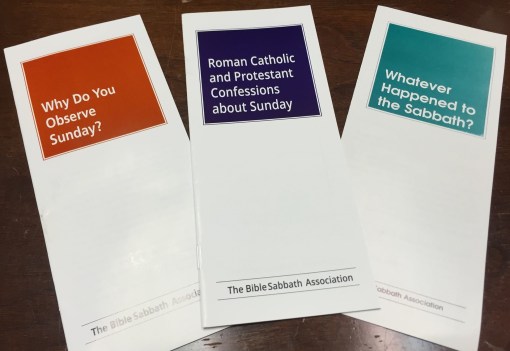
  • Roman Catholic and Protestant Confessions about Sunday – This pamphlet is a series of quotes by Roman Catholic and Protestant ministers confessing that the true Sabbath is Friday sunset to Saturday sunset
  • Whatever Happened to the Sabbath? – This small pamphlet gives a brief overview of the Sabbath. It cites scripture and insightful questions to cause others to consider the importance of the Sabbath.
  • Why Do You Observe Sunday? – This pamphlet is an overview explaining that Sunday is just a common day; it then transitions to show the Apostle’s example of keeping the Sabbath.
  • Other small tracts available:
  • Why the Seventh-Day Sabbath?
  • Why the Protestant Reformation Failed!
  • 100 Facts on the Sabbath Question
  • What Would Jesus Do on the Weekend

To overview these tracts, click the link below!

http://biblesabbath.org/index.php?pr=Leaflets_and_Tracts


In the Beginning Creation According to Genesis

Genesis
In the Beginning Creation According to Genesis
by David Rives

The Holy Bible contains a historical record of the world from the time of creation. That record begins in the book of Genesis, which in the Greek language means “Origins.” In the original Hebrew it is known as “B’reshit” — Beginning — and in the very first sentence, the foundation of the whole Bible, we learn that “In the beginning, God created the heaven and the earth.” So let’s start at the VERY beginning.

To order this informative DVD, click the link below:

https://biblesabbath.org/shopping/pgm-more_information.php?id=97&=SID


Story of Grace

Story of Grace

by Delmar Leger

“Allow me to tell you a story. We can start this story in the winter of 1935. The nation was in the throes of the great depression. It’s hard for us to imagine in today’s affluent society just how desperate those days were. Well do I remember, as a child, people knocking on our back door begging for food. Mom would always feed them. Long lines of hungry people were standing in front of soup kitchens waiting for something to eat. Jobs were virtually non-existent, and money was as precious as it was scarce.

There was a man by the name of Fiorello LaGuardia who was the mayor of New York City during those dark days. LaGuardia seemed to have a genuine, heartfelt love for the common man, especially the downtrodden. One time, during a newspaper strike, he spent his Sunday mornings reading the funny papers over the radio—and with all the appropriate inflections. Why? He didn’t want the children of New York to be deprived of that little bit of enjoyment. He was well known for his blustery outbursts against the “bums” that exploited the poor. He was completely unpredictable and full of surprises….”

(this article is an excerpt from the July-August 2003 edition of the Sabbath Sentinel)

To read the rest of this article, which starts on page 9, click this link: http://biblesabbath.org/tss/502/tss_502.pdf

History of the Sabbath

Andrews History
History of the Sabbath

By J.N. Andrews

This one of the most important books ever written on the Sabbath. Andrews traces the Biblical and secular history of the seventh-day Sabbath, and the origin of first-day observance. It is a vigorous scriptural and historical defense of the Sabbath.

In this book, you will find convincing evidence to settle this long-drawn controversy between Sabbath and Sunday. You will be amazed to see the kinds of arguments and ways in which Sunday defenders tried to make it sacred – and how flawed these arguments are.

A thorough examination is essential for everyone to take a stand on this question. The evidence is here. May God grant you a willing heart, in order that you may stand by His side and His people, regardless of temporal consequences, for it is written, “We ought to obey God rather than men” (Acts 5:29).

To order this thorough and exception book, click the link below!

https://biblesabbath.org/shopping/pgm-more_information.php?id=4&=SID

Sabbath Meditation #12 – An Act of Spiritual Warfare

Sabbath Meditation #12 – An Act of Spiritual Warfare

By Kelly McDonald, Jr.

“And the ten horns out of this kingdom are ten kings that shall arise: and another shall rise after them; and he shall be diverse from the first, and he shall subdue three kings. And he shall speak great words against the most High, and shall wear out [or harass] the saints of the most High, and think to change times and laws: and they shall be given into his hand until a time and times and the dividing of time” (Daniel 7:24-25, KJV).

“And the great dragon was cast out, that old serpent, called the Devil, and Satan, which deceiveth the whole world: he was cast out into the earth, and his angels were cast out with him…And the dragon was wroth with the woman, and went to make war with the remnant of her seed, which keep the commandments of God, and have the testimony of Jesus Christ” (Rev. 12:9, 17).

“Here is the patience of the saints: here are they that keep the commandments of God, and the faith of Jesus” (Rev. 14:12).

Have you ever found yourself fighting to get through the week? Sometimes it may seem like every obstacle is being thrown at you. You may even feel like you are walking through mud. If you ever find yourself thinking this way – do not be troubled.

Daniel is one of the books of the prophetic Bible. Prophetic books foretell the future – either at the time they were given or at a time that has not yet arrived. In Daniel 7:25, we learn about a figure who will attempt to change the times and laws, which includes the Sabbath. He will also attempt to wear out or harass the saints. He also wars against God! While the prophecy refers to the figure known as the Pope, we know that the ultimate enemy of our faith is Satan. He wars against those who keep the commandments of God (Rev. 12:7-17).

While satan fights against you and even uses other people to fight, reject, criticize, or threaten you – realize that one objective is in his mind. He wants you to surrender your Sabbath observance. He wants you to give up the fight to arrive at rest. He knows the strength from Heaven it imparts into your life. We have reviewed the supernatural provision available on the Sabbath in previous meditations.

“Fight the good fight of faith, lay hold on eternal life, whereunto thou art also called, and hast professed a good profession before many witnesses” (I Timothy 6:12).

Continue to resist satan. Fight back by pressing forward into His rest despite hindrances. Resist them even when they come on Sabbath. You will be rewarded with His rest and His presence on His Holy Day.

“But seek ye first the kingdom of God, and his righteousness; and all these things shall be added unto you” (Matthew 6:33).

He rewards those who earnestly seek Him (Hebrews 11:6).

Selah.

Kelly McDonald, Jr; BSA President; www.biblesabbath.org


The Ten Commandments Twice Removed

Ten Commandments
The Ten Commandments Twice Removed

By Danny Shelton and Shelly Quinn

Has the church been guilty of discarding the Decalogue?

A backlash of attention to the Ten Commandments–unleashed by recent U.S. court rulings–rallied Christians in defense of its public display. Amid the cresendo of concern, a lone voice vies for attention, “If you love Me, keep my commandments” (John 14:15).

Is our defense of the Ten Commandments triggered simply by a sentimental interest of Christian culture? Is it posssible the Church stands before God as guilty as our government for discarding the Decalogue? With unflinching conviction, the authors join their voices with great Christian leaders like Billy Graham, D. L. Moody, John Wesley, and Charles Spurgeon, to trumpet the truth– God never revoked His Ten Commandments!

This book answers critical questions with compelling clarity and Bible evidence. Did the Ten Commandment exist before Mt. Sinae? Were they nailed to the cross? How do we de-mystify Paul’s writings about the Law? Does man have authority to change God’s law?

Click the link below to order this book!

https://biblesabbath.org/shopping/pgm-more_information.php?id=28&=SID