Crusade 2000: Christ for the Crisis

Crusade 2000: Christ for the Crisis

Report by Gilford T. Monrose

For the first time ever, the New York area Churches of God 7th Day, came together and held a spiritually explosive tent meeting crusade. The crusade ran for two (2) dynamic weeks in Brooklyn, from August 13-27 under the big red and white tent at Prospect Place and Nostrand Avenue. About 10 churches came together in support of Crusade 2000: “Christ For The Crisis” which was sponsored by the Mt. Zion Church of God 7th Day located 203 East 37 Street, Brooklyn, NY.

Francis DeCaille, host pastor said, “Crusade 2000 did achieved its purpose of propagating the gospel in Brooklyn”.

“The way the churches came together and worked as a team for this crusade, is indicative that God has raised up the church to preach His message before His return”, said Evangelist Lennox Abrigo, Washington, D.C., the main speaker for Crusade 2000. This was truly a sign that God is raising up the Church of God in New York for His purpose.

Some of Evangelist Lennox Abrigo’s sermon titles were, “Why Are the Innocent Dying In Brooklyn”, “New York’s Last Government” and “Big Bang- Big Money: Big Lie!”

A ladies special sermon was preached on how to attract and keep a good man. Another speaker was Evangelist Hector from St. Lucia, West Indies. Wayne Moore, Brooklyn, NY, pastor of Faith Church of God 7th Day, was the moderator. David Taylor, Bronx, NY, pastor of Harvestime Church of God 7th Day was host of “Holy Fun Time.” He was the most generous minister of all. He gave gifts for special reasons to our visitors every night. At the end of each presentation, he would always say, “The greatest gift of all is the man Christ Jesus.”

(this article is an excerpt from the November-December 2001 edition of the Sabbath Sentinel)

To read the rest of this article, which starts on page 11, click this link: http://biblesabbath.org/tss/487/tss_487.pdf


The First Day of the Week (Part 2 of 3)

The First Day of the Week (Part 2 of 3)

by: Ronald L. Dart

Collection for the Saints

One of them is found in first Corinthians 16. Let’s begin in verse 1: “Now concerning the collection for the saints, as I have given order to the churches of Galatia, even so do you. {2} Upon the first day of the week let every one of you lay by him in store, as God hath prospered him, that there be no gatherings when I come. {3} And when I come, whomsoever you shall approve by your letters, them will I send to bring your liberality unto Jerusalem.”

Now there are a couple things about this that you should realize, I have seen this little singular second verse quoted on the back of offering envelopes in church after church after church and the whole idea is that every Sunday morning when you come to church, you should bring an offering with you. This is NOT what this is about; this is about the collection for the saints. In a moment I will explain what the collection for the saints was. The point is that on ‘the first day of the week’ “every one of you” is to “lay by him in store” (verse 2), not bring to the church, and put it in a collection basket, not to give it to somebody else, but to lay by yourself in store. What is this talking about? What Paul is saying is, we are coming down to the time of year when this wave sheaf would normally be offered in Jerusalem on the ‘first day of the weeks’ when the grain harvest is ready, we want each of you to go out on the first day and lay aside a collection of grain for the poor saints in Jerusalem. That’s what this is about. It has nothing whatsoever to do with church offerings and it is emphatically ‘the first day of the week’, because this is the first day they could work! You don’t harvest on a Sabbath Day, this ‘first day of the week’ was the first working day, and oddly enough it confirms the fact that the church was still observing, not merely the feast of weeks, nor the wave sheaf but the Sabbath Day, because it was on the first working day that they were to be out there collecting grain which they were to store up, each of them was to lay by himself in store, so that when Paul got there, they could bring it straight into a gathering point and go away with it. No need to bring it in early, where they would have a storage problem. Do you follow me? So, you “lay it by yourself in store” so there won’t have to be any going out into the fields and getting the grain, harvesting it and preparing it, when Paul came. Paul wanted it all done, all prepared and all stored before he got there.

What is this Collection?

What is this Collection? The roots of it go back to the eleventh chapter of the book of Acts. If you take a look at it, it is rather interesting. The events that are described here took place a long time before the events of 1 Corinthians 16.

Let’s look at Acts 11:25-26: “Then departed Barnabas to Tarsus, for to seek Saul: {26} And when he had found him, he brought him unto Antioch. And it came to pass, that a whole year they assembled themselves with the church and taught many people. And the disciples were called Christians first in Antioch.”

We basically know the theme of the story; this is the first time Paul moves back into the ministry after his exile to Tarsus.

Continuing in verse 27: “And in these days came prophets from Jerusalem unto Antioch. {28} And there stood up one of them named Agabus and signified by the Spirit that there should be great dearth throughout all the world: which came to pass in the days of Claudius Caesar. {29} Then the disciples, every man according to his ability, determined to send relief unto the brethren which dwelt in Judaea: {30} Which also they did, and sent it to the elders by the hands of Barnabas and Saul.”

Now here is what is interesting about this. The way that this reads you would think that there was a famine immediately on the heels of this and indeed there might have been. This may have been the first occasion when a collection was made and sent down to Jerusalem for the saints, but what is fascinating about this is that it was triggered by a prophet in the church who said that this was coming, and we need to make some kind of preparation for it. They believed the man.

Now the Corinthian letters are salted with references to an offering just like this. I think that there are some scholars that think that there is a little confusion of the time involved with it, that Agabus’ prophecy (Acts 11:28) is the prophecy that was fulfilled later when Paul and the others prepared their offering and took it down to Jerusalem. It only sounds like it was an immediate thing in the book of Acts, but that is not extremely important at this time.

Let’s turn back to 2 Corinthians 8. There are numerous references and allusions to this particular offering. I think it is important to establish the fact that we are not talking about taking up a collection in church. That is not what this is about. This is talking about taking up and collecting and preparing grain which is going to be shipped to Jerusalem under supervision for famine relief in a difficult time.

2 Corinthians 8:1: “Moreover, brethren, we make known to you the grace of God bestowed on the churches of Macedonia: {2} that in a great trial of affliction the abundance of their joy and their deep poverty abounded in the riches of their liberality.”

In other words, their gift abounded in the riches of their liberality.

Verses 3: “For I bear witness that according to their ability, yes, and beyond their ability, they were freely willing, {4} imploring us with much urgency that we would receive the gift and the fellowship of the ministering to the saints.”

What is Paul talking about? He is talking about the fact that the churches in Macedonia, Corinth is in Achaia, which is in Greece, Macedonia is to the north where churches like Philippi were located. These people up there were not well-to-do, they were really poor people, but when the prophecy came around, saying that there was going to be a terrible famine in Jerusalem, all of these people, I mean, they just pulled out all the stops and did everything they possibly could to put together a really good package of aid, while they didn’t have any money, they were able to put together grain that could be shipped off to Jerusalem with safety.

Paul continues in verse 4: “Imploring us with much urgency that we would receive the gift and the fellowship of the ministering to the saints. {5} And not only as we had hoped, but they first gave themselves to the Lord, and then to us by the will of God. {6} So we urged Titus, that as he had begun, so he would also complete this grace in you as well.”

In other words, we assigned Titus to get himself down to you people and to make preparation for precisely the same offering that was done up in Philippi.

Verse 7: “Therefore, as you abound in everything, in faith, and utterance, and knowledge, and in all diligence, and in your love to us, see that you abound in this grace also. {8} I speak not by commandment, but by occasion of the forwardness of others, and to prove the sincerity of your love. {9} For you know the grace of our Lord Jesus Christ, that, though he was rich, yet for your sakes he became poor, that you through his poverty might be rich. {10} And herein I give my advice: for this is expedient for you, who have begun before, not only to do, but also to be forward a year ago.”

In other words, you people started last harvest on this. This is interesting all by itself. Isn’t it? The harvest was a year ago, that’s why it was a year ago, that’s when the grain was coming out of the ground, so a year ago on the prophecy, you people started getting ready for this and began to store up grain for this shipment, now we are coming down to the time where we are going to put it together and get it on a boat and send it off to Jerusalem with Titus.

Verse 11: “Now therefore perform the doing of it.” Just do it! “That as there was a readiness to will, so there may be a performance also out of that which you have. {12} For if there be first a willing mind, it is accepted according to that a man hath, and not according to that he hath not. {13} For I mean not that other men be eased, and you burdened: {14} But by an equality, that now at this time your abundance may be a supply for their want, that their abundance also may be a supply for your want: that there may be equality:”

In other words, we are going to help them now, the time may come when they will be helping us, or they have already helped us and so it is that we are able by the movement of grains and supplies back and forth to keep through these very hard and difficult times.

Verse 15: “As it is written, He that had gathered much had nothing over; and he that had gathered little had no lack. {16} But thanks be to God, which put the same earnest care into the heart of Titus for you.”

Paul is saying: “I am so thankful that I have a man who has that same kind of care for you, he will come down there and he will take care of this for you and you can depend on him to actually get this from Corinth to Jerusalem.”

Verse 17: “For indeed he accepted the exhortation; but being more forward, of his own accord he went unto you.”

He didn’t have to be told, he went by himself. Verses 18: “And we have sent with him the brother, whose praise is in the gospel throughout all the churches; {19} And not that only, but who was also chosen of the churches to travel with us with this grace”.

In other words, this guy was selected by the churches up here, to travel with us with this “grace” as he calls it, by that he means the total collection of grain from all that area that they were shipping back to Jerusalem at that time.

He was doing it “to the glory of the same Lord, and declaration of your ready mind: {20} Avoiding this, that no man should blame us in this abundance which is administered by us:” We don’t want any accusations of graft in this, so we have reputable people, people who you know, people approved by the church who are going to carry this grain down to Jerusalem and they are not going to be selling it off on the black market at the docks when they get there, do you understand that, that is what Paul is saying.

Verse 21: “Providing for honest things, not only in the sight of the Lord, but also in the sight of men.” Paul is saying: God knows that we are not going to cheat with this thing, but we’ve got to be seen to be doing it, not to be cheating in the eyes of men as well. Paul says that that is important and you all know that.

Verse 22: “And we have sent with them our brother, whom we have oftentimes proved diligent in many things, but now much more diligent, upon the great confidence which I have in you. {23} Whether any do inquire of Titus, he is my partner and fellow helper concerning you; or our brethren be inquired of, they are the messengers of the churches, and the glory of Christ. {24}

Wherefore show you to them, and before the churches, the proof of your love, and of our boasting on your behalf.”

Paul is saying: “Titus is my man in Corinth. We have told all these people up here, we have told them what kind of people you are, now don’t let us down.”

Good Old-Fashioned Fund Raising

Now you can hear the echoes down through all these generations of just good old-fashioned fund raising, whenever you are trying together, you say, this church over there, they came up with $100,000, now surely, we are a bigger church that they are, you are not going to come up with a mere $50,000. We don’t want to be embarrassed in the sight of our brothers over there, do we?

You hear these same overtones of Paul saying, look I have told these people what kind of people you are, you don’t want to embarrass me with this do you? It is exactly the same old benevolent competition that people often engage in now-a-days in fund raising.

Now, Paul says in 2 Corinthians 9:1: “For as touching the ministering to the saints”, which is what this whole thing is all about, all the way back to 1 Corinthians 16 when he wanted them to get busy and get out there on the first day of the harvest and get the grain put away. That’s what he means when he says, ‘the first day of the weeks’. A better translation would be: ‘the first day of the harvest’ and I will show you why that would be better before I am through.

As the touching and “ministering to the saints, it is superfluous for me to write to you”, well he did too, because if he hadn’t needed to, he wouldn’t have written to them. Paul continues “For I know the forwardness of your mind, for which I boast of you to them of Macedonia, that Achaia was ready a year ago”. I told them, well look, the people down in Achaia was ready a year ago, so I have used you to pump these people up here and I don’t want you to let me down. Your zeal hath provoked a lot of people.

So, I have “sent the brethren, lest our boasting of you should be in vain in this behalf; that, as I said, you may be ready:” Paul is saying, we don’t want any embarrassments, do we?

“Lest haply if they of Macedonia come with me.” When they get down there and you are not ready and there is a lot of chasing around, that you get everything ready when I get there, I am embarrassed, and you are embarrassed, and these guys say I wonder what Paul is talking about?

So “I thought it necessary to exhort the brethren, that they would go before unto you, and make up beforehand your bounty” (Vs. 5.) What he wanted to do was to show up in town, have it ready, and get the guys in the boat and get on the way to Jerusalem, he didn’t want any fooling around, and he wanted to be efficient, just like that.

“Whereof you had notice before, that the same might be ready, as a matter of bounty, and not as of covetousness”. In other words, your generosity, not because we are coming down here coveting or trying to get something out of you….”

This is part two of a three-part series. Stay tuned for the last part.

The above is a transcript of a sermon given by the late Ronald L. Dart.  It was taken from the website of the Ronald L. Dart Evangelistic Association.  You can find more articles and sermons by Ron at RLDEA.com.

The Sabbath Under Crossfire 

Sabbath Under Fire

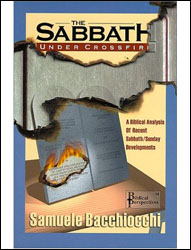
The Sabbath Under Crossfire
Analysis of recent Sabbath/Sunday controversy

Dr. Samuel Bacchiocchi

This work examines the recent attacks against the Sabbath within the larger historical context of the origin and development of the anti-Sabbath theology. An understanding of how the abrogation view of the Sabbath began and developed through the centuries, is essential for comprehending why the Sabbath is still under crossfire today.

The book analyzes in a systematic way the most common arguments used to negate the continuity and validity of the Sabbath for today. With compelling Biblical reasoning, it unmasks the fallacies of the attempts made to reduce the Sabbath to a Mosaic institution, fulfilled by Christ and condemned by Paul.

Most important of all, this book will enrich your understanding of how the Sabbath can enable you to experience the Saviors presence, peace, and rest in your life.

Click the link below to order this powerful work:

https://biblesabbath.org/shopping/pgm-more_information.php?id=17&=SID

Sabbath Keeping in the 300s-400s AD

Sabbath Keeping in the 300s-400s AD

By Kelly McDonald, Jr.

Among the predominant myths about the Sabbath is its practice ceased in early Church history. Interestingly enough, no primary sources in early Church History hint at this. There is actually very little discussion about the Sabbath in the first two centuries after the first Apostles.

As we arrive in the fourth and fifth centuries AD, the Sabbath becomes a more common subject discussed in primary source documents. During these centuries, the Roman Church argued against Sabbath observance while most of the Christian world still honored it. The Roman Church advocated fasting on Sabbath as a way to denigrate it.

In the May-June edition of The Sabbath Sentinel, I discussed that a significant number of Christians during these centuries kept Sabbath in addition to Sunday. I also explained the events that lead to this development. Below, I have listed quotes from these two centuries which clarify that most Christians still honored the seventh-day Sabbath.

337 AD – Eusebius
Eusebius wrote the biography for the emperor Constantine in the late 330s AD. In it, he admitted that Constantine allowed people to have the Sabbath free from work. To learn more about Constantine’s Sabbath protections, CLICK HERE.  We have the quote below:

“The Blessed One urged all men also to do the same, as if by encouraging this he might gently bring all men to piety. He therefore decreed that all those under Roman government should rest on the days named after the Saviour, and similarly that they should honour the days of the Sabbath, in memory, I suppose, of the things recorded as done by the universal Saviour on those days” (Life of Constantine, 4.18.2; Stuart and Hall, p 159; emphasis mine).

363/364 AD – Council of Laodicea
Canon 16: On Sabbath [Saturday], the Gospels and other portions of the Scripture shall be read aloud. Canon 29: Christians shall not Judaize and be idle on Saturday, but shall work on that day; but the Lord’s day they shall especially honour, and, as being Christians, shall if possible, do no work on that day. If, however, they are found Judaizing, they shall be shut out from Christ.  (Quoted from: Hefele, pp 302-319)

This Roman Church Council was held at a time when Arians were a strong political and religious entity in the Eastern Roman Empire. Sabbath observance was condemned, but the Sabbath still retained some significance as the Scriptures were encouraged to be read on it. Despite its canons, the council did not change the strong Sabbath keeping tendencies of the times. To learn more about the Council of Laodicea, click here.

360s AD – Pseudo-Athanasius
“They met on the Sabbath, not that they were infected with Judaism, but to worship Jesus, the Lord of the Sabbath…” (Homilia de Semente, quoted by Bingham, 1138).

360s AD – Epiphanius
He wrote that the Apostles set services for the fourth day of the week, the evening of Sabbath and the Lord’s Day (De fide, sec. 22, 24). It should be noted that no assemblies for teaching or exhortation were commanded by the Apostles for the fourth day and first day of the week. Epiphanius cites no Scriptures to support this view.

“On the apostles’ authority services are set for the fourth day of the week, the eve of the Sabbath, and the Lord’s Day…It continually enjoins prayers to God at the appointed night hours and after the close of the day, with all frequency, fervor, and bowing of the knee. In some places they also hold services on the Sabbaths, but not everywhere” (De Fide, 22.1, 24.6; Translated by Frank Williams, pp 679, 681).

In another work called Panarion, he provided a quote about a group called the Nazoreans. This was the original name given to the followers of Jesus. They still existed in his day; they also observed the Sabbath.
“For these people did not give themselves the name of Christ or Jesus’ own name, but that of  ‘Nazoraeans.’ But at that time all Christians alike were called Nazoraeans. They also came to be called ‘Jessaeans’ for a short while, before the disciples began to be called Christians at Antioch… They are different from Jews, and different from Christians, only in the following ways. They disagree with Jews because of their belief in Christ; but they are not in accord with Christians because they are still fettered by the Law—circumcision, the Sabbath, and the rest” (Panarion, 29.1.2-3, 7.5-6, Translated by Frank Williams, pp 123, 128-129).

Late 300s AD
The Apostolic Constitutions was a series of books written to describe the practices of some Christians. The first several books were composed in the third century AD – you can read an example from it by clicking HERE. The seventh and eighth books were composed in the later part of the fourth century. We have some quotes from it below. The Sabbath was honored as a day of rest and sacred convocation. Fasting on the day was forbidden.

“O Lord Almighty You have created the world by Christ, and hast appointed the Sabbath in memory thereof, because that on that day You have made us rest from our works, for the meditation upon Your laws…On this account He permitted men every Sabbath to rest, that so no one might be willing to send one word out of his mouth in anger on the day of the Sabbath. For the Sabbath is the ceasing of the creation, the completion of the world, the inquiry after laws, and the grateful praise to God for the blessings He has bestowed upon men” (idem, 7.36).

380-390s AD – John Chrysostom
There are many among us now, who fast on the same day as the Jews, and keep the Sabbaths in the same manner…” (Commentary on Galatians, 1:7).

405 AD – Letter from Augustine to Jerome
“For if we say that it is wrong to fast on the seventh day, we shall condemn not only the Church of Rome, but also many other churches, both neighbouring and more remote, in which the same custom continues to be observed. If, on the other hand, we pronounce it wrong not to fast on the seventh day, how great is our presumption in censuring so many churches in the East, and by far the greater part of the Christian world!” (Letter 82, sec. 14)

The greater part of the Christian world still considered the Sabbath a day of rest and enjoyment, whereas some of the Western Churches considered it a fast day.

Sozomen (late 300s-420s AD)
“Likewise some meet both upon the Sabbath and upon the day after the Sabbath, as at Constantinople, and among almost all others. At Rome and Alexandria they do not. Among the Egyptians, likewise, in many cities and villages, there is also a sacred custom among all of meeting on the evening of the Sabbath, when the sacred mysteries are partaken of” (Church History, 7.19).

Socrates Scholasticus (late 300s-430s AD)
“The Arians, as we have said, held their meetings without the city. As often therefore as the festal days occurred — I mean Saturday and Lord’s day—in each week, on which assemblies are usually held in the churches, they congregated within the city gates about the public squares…” (Church History, 6.8)

“For although almost all churches throughout the world celebrate the sacred mysteries on the Sabbath of every week, yet the Christians of Alexandria and at Rome, on account of some ancient tradition, have ceased to do this…” (ibid, 5.22)

Socrates recorded important details. First, nearly all churches honored the Sabbath. Secondly, Rome and Alexandria were the two cities that ceased to gather every Sabbath. He recorded that Rome and Alexandria ceased to honor the Sabbath; this means at one time they honored it. They stopped honoring it because of a tradition, not Scripture. Jesus warned us about the traditions of man that contradict the commandments of God (Matt. 15:1-20).

John Cassian (420-429 AD)

And throughout the whole of the East it has been settled, ever since the time of the preaching of the Apostles, when the Christian faith and religion was founded, that these Vigils should be celebrated as the Sabbath dawns… And so, after the exertion of the Vigil, a dispensation from fasting, appointed in like manner for the Sabbath by apostolic men, is not without reason enjoined in all the churches of the East… …” (Institutes, 3.9)

These primary sources indicate the obvious truth that Sabbath keeping was retained by the greatest portion of Christianity in the fourth and fifth centuries. In the Eastern Churches, some degree of Sabbath keeping would remain the majority practice for hundreds of year into the future. In Western Europe, Sabbath keeping gradually became a minority practice among Christians. Look for more articles in the future on this exciting topic!

Selah.

Kelly McDonald, Jr, BSA President

www.biblesabbath.org

The Sabbath: Its Meaning for Modern Man

Sabbath Meaning for Modern Man
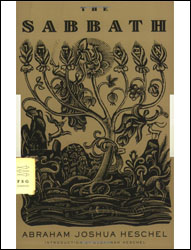
The Sabbath: Its Meaning for Modern Man

by A. J. Heschel

This book is perhaps the premier work on the philosophy of the Sabbath. Each sentence is weighty and worthy of prayerful meditation. He puts forth the idea that the architecture of holiness appears not in space, but in time. Our meaning as humans is found not in material things, but the eternal truth contained in the time period known as the Sabbath.

To order this philosophical examination of the Sabbath, click the link below:

https://biblesabbath.org/shopping/pgm-more_information.php?id=13&=SID


Christian Worship & The Sabbath Day

Christian Worship & The Sabbath Day

by Wayne L. Atchison

Christian belief is manifested in what is practiced: Christianity is not just philosophy or speaking spiritual words, it is also the practice and life-style of good deeds which demonstrate our commitment to Jesus Christ. Being a Christian is a Way of life, based upon what is believed to be true. In order to not be mislead into believing errors, it is important for Christians to always question what is taught to them.

The Scriptures remind Christians that it is not for them to make judgments about another Christian’s Spiritual status: these questions and judgments are to be left to God. However, even without judging the person, it can be agreed that God tells Christians not to practice errors, nor to be unrighteousness (I John 3:7) and to be holy just as God is holy (I Peter 1:15). Therefore, what may be said is that a Christian is not supposed to practice errors, and should therefore earnestly avoid being deceived into doing so.

The Most Widely Accepted Error In Modern Christianity

Doing a little historical research into the Christian Sabbath Day, it becomes obvious that a major deception has been promulgated for multitudinous generations: For over 1,600 years the majority of the Christian world has been taught, and has accepted without question, that Sunday is the Christian’s day of worship. Yet the Scriptures, historical records, and direct quotations from every major Christian denomination, all agree that this commonly taught belief is a blatant error. The truth is that God’s Sabbath day has always been the seventh day of the week—(which today is called) Saturday.

(this article is an excerpt from the November-December 2000 edition of the Sabbath Sentinel)

To read the rest of this article, which starts on page 14, click this link: http://biblesabbath.org/tss/486/tss_486.pdf

Is the Glass Half Full or Half Empty?

Is the Glass Half Full or Half Empty?

By Aimee Zahora

Is the Glass Half Full or Half Empty?

via GIPHY

In the 1980s movie Dead Poet Society, actor Robin Williams played the role of English professor John Keating. One of the memorable scenes involves each of the students taking his turn standing on top of Keating’s desk to view things differently.

The type of mindset you bring to the table on a daily basis shapes your life. Do you lean toward scarcity or abundance in your thinking and actions? Scarcity suggests there is a quantifiable and limited amount of something. Abundance implies that there will always be more.

Your Favorite, Warm Pie Really Matters in Life

Let’s get practical. When you hear pie, what flavor do you gravitate toward? How about a freshly-baked, dark cherry pie? What about a tart key lime slice or peach ala mode? Does pumpkin smothered in whipped cream, or a sugar coma-inducing slice of pecan oozing with rich, sweet gooiness speak to you?

Select which of the two statements below most resonates with you.

  1. There are a defined number of pieces in a pie. When it’s gone, there ain’t no more.

  2. Pies can be sliced in many ways. When each slice has been eaten, another pie can be baked.

Option one denotes practicality but imposes limits. Option two tastes of creativity and provides a solution for increase.

What Kind of Mindset Does God Have?

Consider a smattering of examples from the Word of God.

How God Desired to Powerfully Bless Abraham

In Genesis 12 the Lord spoke to Abram because He had land that He wanted for Abram. In verses 2 and 3 the Lord told Abram He would make him into a great nation, that his name would be great, and that he would be a blessing. The Lord went on to share that those who blessed Abram would be blessed and those who cursed him would be cursed. The Lord also said all people on earth would be blessed through Abram. What a magnitude of blessings and plenty!

In Genesis 26 the Lord declared to Abraham that his descendants would be as numerous as the stars, repeating that all Abraham’s offspring would be blessed. It’s worth noting that God states all. All means every single one, barring no one! Not only is this statement inclusive, but it is also abundant.

You Choose Life for a Rich Existence

My two favorite verses are in Deuteronomy 30 where God shares His desire for each of us to choose life. Not any old mediocre life, but abundant life. A life that includes a personal and intimate relationship with Him. In John 10:10 the concept of abundance is reiterated in the following words, “I have come that they may have life, and have it to the full. (NIV)

Your Free Gifts of Fullness Are Ready Right Now

In Mark 2:27 Jesus Christ explains that the Sabbath was made for man. God gifted us the Sabbath so that we might rest and reconnect with Him to enjoy a quality life.

In Matthew 14 we have the example of Jesus Christ taking very little (five loaves and two fish) and multiplying that small amount to nourish 5000 people. The disciples then collected 12 baskets of leftovers. Again, God believes in abundance.

In the Book of Job, we see where God blessed Job’s latter days more than his early days. We know that Job was extremely wealthy in his early days with thousands of sheep and camels, hundred of oxen and donkeys, and a great many servants. God made a point to bless Job over and above what he had originally. Why? Because God desires abundance for His people.

In Exodus, we have the example of God delivering the Israelites from the Egyptians and preparing land for the Israelites flowing with milk and honey. Flowing means brimming, teeming, and pouring out.

Joshua and Caleb gained entry into the Promised Land where God had prepared a life of fullness for them.

Will You Allow God’s Glorious Mindset to be Yours?

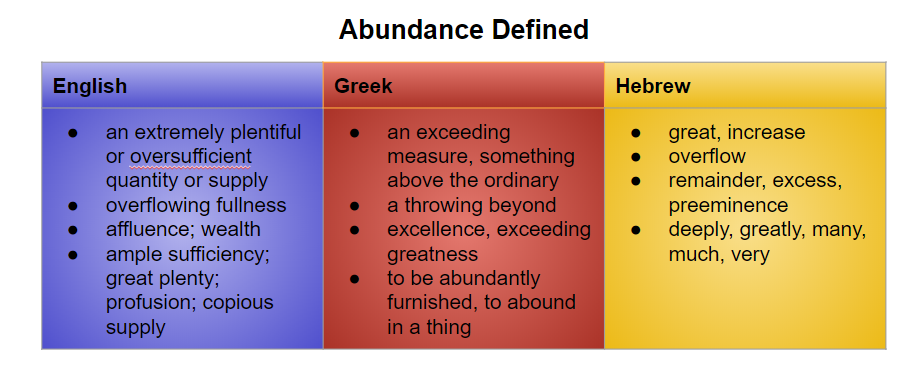
There are many biblical examples that unequivocally show God’s abundance mindset. Ponder some of the definitions shown below for abundance in English, Greek, and Hebrew. Allow the concepts of “copious supply,” “something above the ordinary,” and “overflow” to penetrate your thinking.


Pause and reflect on the powerful abundance God offers His followers in I Corinthians 2:9 and Ephesians 3:20.

“No one’s ever seen or heard anything like this, Never so much as imagined anything quite like it—What God has arranged for those who love him” (MSG).

“God can do anything, you know—far more than you could ever imagine or guess or request in your wildest dreams!” (MSG).

Though God can and does bless His followers with physical abundance, the most important abundance is, of course, spiritual in nature in the form of eternal life.

Actions That Will Bring You a Clearly Abundant Mindset

So, what actions can we claim to ensure the spiritual abundance that He so richly offers?

Immersion in the Word of God holds the power to transform thinking. Language experts agree that immersion wins every time when it comes to language stickiness or retention.

via GIPHY

Surround yourself with friends who think and speak abundantly. It generally takes seven positive statements to counter a single negative comment. Apply that to your friends. You have seven friends whose MO is encouraging, positive and uplifting. Keep them around.

Consider the one friend who might resemble Eeyore. Limit your time with this Eeyore friend. Fill that extra time with someone else who stretches you, believes in you, and supports the growth goals you are working toward.

Be intentional about seeing life differently. As an individual belonging to the Sabbath community, consider whether you operate in a scarcity or abundance mindset. Visualize what you, your family, and your community could look like if you swung the pendulum from scarcity to abundance. After all, such a shift truly draws us closer to the mind and character of God.

By Aimee Zahora, a Sabbath and Holy Day keeping follower of The Way, member of the United Church of God, and blogger on topics that ignite the Spirit.

Tags: scarcity, abundance, pie, God, mindset, immersion, shift


Celtic Church in Britain

Celtic Church
Celtic Church in Britain

by Leslie Hardinge

Shows that Christians in the British Isles almost exclusively kept the seventh day Sabbath for six hundred years after the Messiah. This is an authoritative study of the beliefs and practice of the Celtic Church, which at the same time holds much interest for the non-specialist, containing as it does fascinating descriptions of the life of the early Celtic Christians in their monastic walled villages modeled on the Old Testament cities of refuge.

To learn more about this subject, click on the link below:

https://biblesabbath.org/shopping/pgm-more_information.php?id=6&=SID

The Pre-Existence of the Sabbath

Pre Existence of the Sabbath

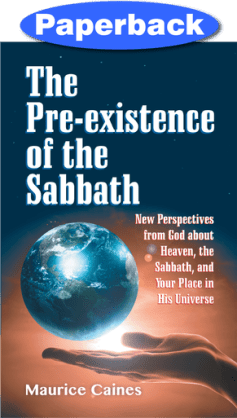
The Pre-Existence of the Sabbath

By Maurice Caines

For whom is the Sabbath designed? What is the nature of the Sabbath? Is it enforced on this planet only, or does its influence have cosmic implications? Why does the Sabbath matter? What does the seventh-day Sabbath have to do with our relationship with God and others?

Whatever your views on the Sabbath, this little book will intrigue and inspire you and make you think in new ways about the day God set apart and sanctified. In Pre-existence of the Sabbath, Maurice Caines presents new perspectives from God about heaven, the Sabbath, and your place in His universe that he found while studying the Word of God. Looking at the nature of the Sabbath through Caines’ eyes might just change the way you view God’s gift of His holy day.

To this short, but informative book, click the link below!

https://biblesabbath.org/shopping/pgm-more_information.php?id=120&=SID

IT’S THE SHOES

IT’S THE SHOES

by Ernest P. Bergmann

“Many of us “come to Jesus” with preconditions for “coming”. We bring to Christianity a load of non-Christian attributes and expect them to be acceptable to God. We are proud of our worldly accomplishments and expect God to be joyful in receiving such a worthy citizen into His kingdom.

Such is simply not the case with God. We are saved solely on the basis of God’s grace, but to live as Christians we have to get rid of some baggage before we are mature in God. God does not force changes on us. If changes are to be made, the Holy Spirit works within us, aiding us in getting rid of worldly baggage, but without direct force. God may place us into situations, and give us trials, that let us know we are doing something that needs changing, but we can “out-stubborn” God to continue life as we chose to live it.

Yet, if we choose to go God’s Way, there will be many growth changes along the way. We will make those changes because God will make it clear to us changes are needed, and because we love God. At that point in our Christian walk we begin to see the spirituality of God’s laws and place them into our lives to let the Way become a path illuminated by  God’s light…”

(this article is an excerpt from the January-February 2000 edition of the Sabbath Sentinel)

To read the rest of this article, which starts on page 12, click this link: http://biblesabbath.org/tss/481/tss_481.pdf