March 7, 321 AD – Constantine’s Sunday Law

March 7, 321 AD – Constantine’s Sunday Law

by Kelly McDonald, Jr.

On March 7 321 AD, Constantine approved the “day of the sun” as a day of rest for the Western Roman Empire. It was a law enacted to honor the sun god by requiring rest for those who lived in the city. Those in the country were exempt from it. Below I have provided an English translation of this law:

“All judges and city people and the craftsmen shall rest upon the venerable day of the sun. Country people, however, may freely attend to the cultivation of the fields, because it frequently happens that no other days are better adapted for planting the grain in the furrows or the vines in trenches. So that the advantage given by heavenly providence may not for the occasion of a short time perish.” (Codex Justinian 3.12.2 [some list as 3.12.3]; English: Ayers, pp 284-285; Latin: Krueger, p 127)

As we look at this first law, there are no references to the God of the Bible or Jesus. It did not force anyone to worship anything. Moreover, it contains no references to the seventh-day Sabbath of the Bible. At that time, the Roman Church emphasized the use of the phrase “Lord’s Day” to refer to Sunday; it is missing from the law because the Roman Church did not emphasize Sunday rest yet.

Notice in Constantine’s decree that farmers were not allowed this day off of work. It applied to those in the cities, not the country. The Biblical Sabbath (Friday sunset to Saturday sunset) was a day of freedom for all people, regardless of their occupation. This extends even to farmers in their busiest seasons (Ex. 34:21).

In Latin, the phrase translated as “venerable day of the sun” is venerabili die solis. Constantine’s law was based upon honoring and esteeming the celestial body we call the sun. The Mithras cult was a favorite for Roman Emperors, especially Constantine. He minted coins as late as the 320s AD honoring Sol Invictus, the invincible sun god (Encyclopedia Britannica “Mithras”, Cath. Encycl. “Constantine the Great”). On some of these coins, he was crowned by Sol (see Sear, pp 363-491). We have an example of a coin below:
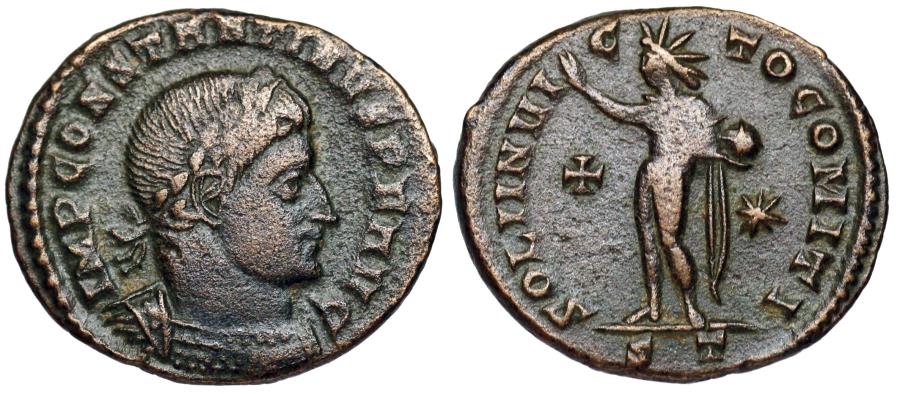
Const coin

On one side of the coin, you see Constantine’s face. The inscription reads IMP (short for Imperator) Constatantius PF (short for Pius and Felix, or Pious and Happy) AVG or Augustus. On the other side is the sun deity, Sol Invictus, with the inscription: SOL INVICTO COMITI, which means “Sol Invictus, my companion.” There is also a cross symbol beside the sun deity. This coin was minted in 316, which was several years before his famous Sunday law. He struck coins with Jupiter’s likeness on them as late as the mid-320s.

While Constantine’s decree did not change the Sabbath, it created a civil day of rest beside it. CLICK HERE to learn more about how Constantine protected Sabbath observance. His first Sunday law also did not force any sort of worship on his subjects, though the law itself was dedicated to the sun. 

The Catholic Encyclopedia states: “…many of the emperors yielded to the delusion that they could unite all their subjects in the adoration of the one sun-god who combined in himself the Father-God of the Christians and the much-worshipped Mithras; thus the empire could be founded anew on unity of religion. Even Constantine, as will be shown farther on, for a time cherished this mistaken belief…. Many other actions of his also have the appearance of half-measures, as if he-himself had wavered and had always held in reality to some form of syncretistic religion…” (Article: Constantine the Great).

Long Term Outlook

While this law did not affect the Sabbath, it did set a precedent with long-term implications. About 50 years after his death, Theodosius I and later emperors enacted Sunday rest laws with added Christian meaning. As the Roman Catholic Church gained political influence in the Dark Ages and Middle Ages, their leaders pressured temporal rulers to force Sunday rest. In modern times, some regions and countries still have Sunday rest laws that exist in some form or fashion.

One could argue that his Sunday rest laws were among the most impactful rulings made by emperors in ancient times – as the effects are seen even today. 

For more commentary on Constantine and the effects of this March 7, 321 law, please click HERE – Did Constantine Change the Sabbath?

To read Constantine’s second Sunday law, click HERE – Constantine’s Second Sunday Law

Kelly McDonald, Jr.

Bible Sabbath Association (BSA) www.biblesabbath.org

Bibliography
Ayer, Joseph Cullen. A Source Book For Ancient Church History. New York: Charles Scribner’s Sons, 1913. pp 284-285.
Catholic Encyclopedia: Constantine the Great; Mithras
Codex Justinian, Latin. Edited by Paulus Krueger. Corpus Iuris Civilis. Codex Iustinianus. Vol 2. Berlin, 1892. p 127.
Sear, David. Roman Coins and their Values, Volume IV. Spink, London, 2011. Pp 233-264,  363-491.

A Glorious Day

A Glorious Day

By Dianne D. McDonnell

Is your Sabbath joyful? Do you look forward to it all week long? When you are in the middle of hard work—do you think, “Not much longer and it will be the Sabbath!”

When I first began to keep the seventh day as a holy Sabbath, I thought I was giving up the world. It seemed impossible to me to change that much. I described keeping the Sabbath as “swimming upstream” to the worried ministers counseling me. And since I was the only one in my family being called, I wondered how I could ever do it. I finally decided, “I know this is right. I have proven it to myself. I won’t think of all the Saturdays ahead of me. I’ll just take it one Sabbath at a time. I’ll try, with God’s help, to keep one Sabbath at a time the best way I possibly can.”

That was a very long time ago! I now have been keeping the Sabbath longer than I was alive before accepting it! Now I laugh at myself for beginning with such a negative view of keeping such a glorious day! At sunset on Friday night I thank God for His Sabbath day. On Sabbath morning I wake up happy to rest up, draw closer to God, and just be joyful in the plans God has for me and for each of my brothers and sisters in Christ. He plans to give us Eternal Life! And on that Sabbath day I am one week closer to being inside God’s own Kingdom! And so I rest, as God did, finally understanding why we are told, “There remains, then, a Sabbath-rest for the people of God; for anyone who enters God’s rest also rests from his own work, just as God did from his.”  (Refer to Hebrews 3:16-4:11, NIV.) On that day I glory in the blessings He has provided and still provides, and I am grateful for all the times He has helped me through hard trials. The Sabbath stands as weekly proof that we will finally be in the Messiah’s Kingdom, in His own glorious Rest. Yes, it is a glorious day!

A note to those who use only the King James Bible: Hebrews 4:9 is not accurately translated in the KJV. The word “rest” is from the Greek sabbatismós meaning “a keeping of the Sabbath or Sabbath rest”, and is correctly translated in the NASU, NIV, ASV, and RSV Bibles, as well as most Interlinears.

Dianne McDonnell is the founder of Freedom Ministry.

http://www.freedom-ministry.com/

Conscience Taken Captive: A Short History of the Seventh Day Baptists

ConscienceTakenCaptive

Conscience Taken Captive: A Short History of the Seventh Day Baptists

By Don Sanford

This book is a tremendous piece of history showing how Sabbath keepers took a foothold and extended the Kingdom of God into America. Here is an excerpt from page 8:

“The First Seventh-day Baptist Church in America was organized in December 1671 from members of a Baptist Church who had come to the conviction of the Sabbath of the Bible. Stephen and Anne Mumford were Sabbath keeping members of the Tewksbury Baptist Church in England when they migrated to American in 1664 during a period of dissenter persecution. About the same time, according to Samuel Hubbard’s journal, his wife Tracy, “took up keeping the Lord’s holy 7th day Sabbath the 10th day of March 1665…”

“Within 20 years about 76 names were added to the covenant relationship which spread out to places such as Westerly, Rhode Island, and New London, Connecticut. The membership included American Indians as well as English colonists…”

“In 1709 it was constituted as the First Hoplinton Seventh Day Baptist Church, now located at Ashaway, Rhode Island. This is the oldest existing Seventh Day Baptist Church in America”.

To learn more from this powerful book of history, click here: https://biblesabbath.org/shopping/pgm-more_information.php?id=86

Abortion and the Sabbath

Abortion and the Sabbath

by Kenneth Westby


(This article is an excerpt from the Nov-Dec 2004 edition of the Sabbath Sentinel)

“Looking for a fight? Just bring up the subject of abortion in mixed company. Strongly state your opinion and soon there will be “blood.” Abortion is one of those incendiary topics that sit at the intersection of religion and politics like a lit match between two open cans of gasoline. But why has the subject of abortion become so charged with emotion, vitriol, and even, at times, violence? For most of history the right and wrong of abortion was not a polarizing issue. Most cultures regarded it as an evil. In modern, more civilized times, it was a shameful practice and against the law. People who did speak out in favor of abortion, such as the Marquis de Sade, were universally condemned as deviant reprobates.

In 1973 with the famous Roe v Wade case all that began to change in America. The U.S. Supreme Court declared “open season” on the unborn. The court had somehow conjured a “privacy” principle from the U.S. Constitution, and from that phantom constructed a “woman’s right to choose”—to choose to kill her yetto-be-born baby. From ’73 to now the death toll stands at 40 million (and counting) helpless innocents slaughtered in the name of “a right to choose.” A third of American women have had their sons and daughters snuffed out. A quarter of unborn children will die this way. Those promoting abortion (prochoice) and those abortionists making money on its thriving business are treated as noble pioneers in the emancipation of women from the drudgery of motherhood or the consequences of sexual promiscuity…”


To read the rest of this article, which starts on page 4, click this link:

http://biblesabbath.org/tss/510/tss_510.pdf


What is the meaning of Galatians 4:8-11?

What is the meaning of Galatians 4:8-11?

By Kelly McDonald, Jr.

In Galatians 4:8-11, Paul wrote: “8 Formerly, when you did not know God, you were slaves to those who by nature (by the order of things) are not gods. 9 But now that you know God – or rather are known by (under) God – how is it that you are turning back to those weak and miserable (lacking) principles? Do you wish to be enslaved by them all over again? 10 You are observing days and months and seasons and years! 11 I fear for you, that somehow I have wasted my efforts on you.”

Some have used this passage to suggest that Paul is condemning the celebration of the Sabbaths. Many people assume that Paul’s letter to the Galatians is written to a group of Jews who are ‘going back’ to law keeping. What is the truth?

First of all, Paul affirmed that he was the Apostle to the Gentiles (Galatians 1:15-16). A second detail of importance is that one of the main issues in Galatia was adult circumcision. If he was speaking solely to a group of Jews ‘going back’ to law-keeping, then the issue of circumcision would not have arisen because they would have already been circumcised.

Third, Paul begins this passage in verse 8 by saying, “Formerly, when you did not know God, you served those gods (plural) who were by nature not gods.” Paul is addressing a group of people who at one time worshiped other gods. The Sabbaths were given for us to worship the one and only True God (not more than one). This fact alone disqualifies any application to any practice in the Torah – but there is even more evidence to affirm this fact.

Lastly, the language used in the passage does not support any claim that Paul is preaching against the Sabbath. The phrase Paul uses – “days and months and seasons and years” – does not contain any of the Greek words used in the New Testament for the Sabbath (sabbaton), New Moon celebrations (neumenea), or Feast Days (heorte). The Galatian churches had a group of Gentiles going back to paganism and the worship of other gods.

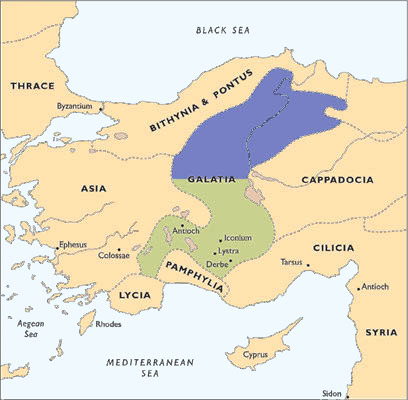
What are the “days and months and seasons and years” to which Paul refers? To understand this phrase, one must understand some of the history of this region. Galatia was located in what is now called modern-day Turkey. Below, we have a map highlighting this area:

Galatia 1

For hundreds of years, the peoples of Galatia were influenced by their own traditions of pagan worship as well as Greek mythology. The region was first subdued by the Romans around 189 B.C. By the time Paul wrote to these churches in approximately 53 A.D., this region was dominated culturally and politically by the Roman Empire. The days, months, seasons, and years to which Paul refers are the Greek and Roman worship practices that permeated Galatian culture hundreds of years before Paul’s visit to Galatia (see Acts 14:8-20).

For an illustration of this, take into consideration the “days” that Paul mentions. In the first century AD, every day was dedicated to a specific god or goddess in Roman culture. The practice of naming every day of the week comes from this custom. The day we call the first day of the week (Sunday) was dedicated to the sun god (Solis or Apollo); the second day of the week (Monday) was dedicated to the moon god (Selenas or Lunas) (days).

In addition to these days, the Romans also dedicated each month to a specific god or goddess. They held ceremonies during the month to commemorate that particular deity. Here are two examples. The month we call January was dedicated to the god Janus, who was said to have two faces. The month of March derives its name from the Roman god Mars (months).

The Romans also kept certain seasons or times of celebrations to their gods that coincided with events in nature. The Saturnalia was a seasonal festival held in December to commemorate the god Saturn just before the Winter Solstice (seasons). The combination of observing all these events makes up years; sometimes years were dedicated to certain deities (years – Colson, pp 47-49). These ancient celebrations involved worship practices such as making sacrifices, prayers, vows, and/or superstitions to these gods, which are the “weak and miserable principles” Paul mentions in Galatians 4:9.

Paul links these days, months, seasons, and years to a time when the Galatians served or worshiped other gods. The Sabbaths were set apart and ordained by the one True God , which is why it is called holy. God gave everything to show mankind how to serve and worship Him. Paul kept the Sabbath with Galatian churches in Acts chapter 13:13-48 (CLICK HERE to read about his Sabbath keeping in this region). Therefore, he would never condemn observances of them.

In these verses, Paul is clearly warning Gentiles in the region of Galatia not to return to pagan practices they engaged in prior to conversion.

Kelly McDonald, Jr.
BSA President www.biblesabbath.org

Works Cited:

Colson, F. H. The Week. Cambridge, 1926. pp 47-49.

The Sabbath and Family Time

The Sabbath and Family Time

By Kelly McDonald, Jr.

Throughout the week, the kids are running around and the parents are tending to business. People are going “to and fro” in pursuit of various activities. Friday night is a great way to wind down the week by getting the family together and spend some time focusing on God. It is a time to slow everything down.

When we look at the Sabbath commandment in Exodus 20, we find that the members of our family are supposed to have this special freedom to rest as well. It is a time for us to come together and honor God as a family unit.

There is a short ceremony called an Erev Shabbat ceremony. It literally means “the evening of the Sabbath.” In this ceremony, you spend time blessing your children, spouse, and enter into God’s Sabbath rest. Too many times, we curse our children in America. The Jewish people have more Nobel peace prize winners than any other people on earth. Why is this? Could it be because they bless their children every Sabbath? They take the time to rest. They honor what they know. Here is a link to a sample Erev Shabbat Service: https://kellymcdonaldjr.com/erev-shabbat-ceremony/

This Erev Shabbat service is just one example of how to honor the Sabbath as a family. You can always create your own family tradition that brings the family together. Another way to spruce up Friday night is to make it the best meal of the week. This gives us just another reason to look forward to this day.

God gave us this day to slow down and enjoy His blessings in our lives. Some blessings are spiritual, some are material, and others are mental or emotional. A deep revelation from God is a spiritual breakthrough. A passing score on a test is material, but it also lifts mental and emotional stress off of us. The Sabbath is a time of reflection on the blessings we received from our Creator in the past week. After all, we live in HIS creation!

You could spend some time with your family reflecting on the blessings of God in your life. Think about how He came through for you this week and share it with one another. One problem in our culture is that we do not spend enough time in effective one-on-one communication. So many things are done through email, facebook, texting, and even phone calls. Use this time to sit down and talk to each other face to face.

Another idea is to get together and have a family Bible study or prayer time. Some people even bring in the Sabbath by worshiping together!  In Exodus 31:16, the Lord said, “The Israelites are to observe the Sabbath, celebrating it for the generations to come as a lasting covenant.” The Hebrew word translated as celebrate is shamar, and it means to guard, protect, or celebrate. One of the ways we guard our minds from wandering away from God on the Sabbath is to celebrate Him! Satan the devil will send all sorts of things your way to distract you from the Sabbath—anxious thoughts about situations in your life, calls from your job, and attitudes. When we celebrate, we are so focused on Him that those things are drowned out! They become less important.

Wouldn’t it be nice to spend more time with your family?  These are just some sample ways to help bring the family together on the Sabbath.  The family unit was given to us by God to teach us more about Him. Let’s bring in this special day as one while we affirm our oneness with Him!

God Bless!

Kelly McDonald, Jr.

BSA President www.biblesabbath.org

35 Reasons Why I Keep the Bible Sabbath

Products-35ReasonsWhy125

35 Reasons Why I Keep the Bible Sabbath

by Robert Franklin Correia

This book will give you 35 reasons why it is important for us to keep the Sabbath. This book will build your faith and give you confidence in your walk with God. Here is Reason #8, taken from page 17:

  1. Because the Sabbath is God’s flag.

God has a flag:

  • “I [God] will set up my ensign” (Isa.49:@2, RV).
  • A flag is a sign:
  • They set up their ensigns for sins (Ps. 74:4)
  • God’s sign is His Sabbath:
    • “I have them my Sabbaths, to be a sign” (Eze. 20:12; see also verse 20).
    • “It [my Sabbath] is a sign (Ex. 31:13).
    • “It [my Sabbath] is a sign… forever” (Ex. 31:17)

Since God has a flag (Isa. 49:22, RV), and a flag is a sign (Ps. 74:4), and God’s sign is His Sabbath (Eze. 20:12, 20), therefore, God’s flag is His Sabbath, because things equal to the same things are equal to each other.


God took of the fabric of time and made Himself an ensign for eternity. He made a unit of time by rolling of a globe, and He called that unit day. He took a handful of days – seven-and made them a week. And of that week He took the last day, the seventh, and made it the Sabbath. That Sabbath is His sign, His emblem, His flag.


To learn all 35 great reasons to honor the Sabbath, order this book at the following link:


https://biblesabbath.org/shopping/pgm-more_information.php?id=94&=SID


Choice Stories For Children

Choice Stories for Children


Choice Stories For Children

by Ernest Lloyd

This book contains nearly 40 short stories written during the late 1800s. Every story has an important lesson to build good character. The stories were selected from four out of print books; Scrap Book Stories; Golden Grains vol. 1 and vol. 3 and Lost Jewels.

Stories will convey character traits such as how to avoid temptation and respecting property rights. They are great reads to children and grandchildren!

You can use these stories as a template to come up with more to teach your children.


To order this book, just click the link below:

https://biblesabbath.org/shopping/pgm-more_information.php?id=46&=SID

Torah, the Law, and Legalism

Torah, the Law, and Legalism

by Ken Ryland

(This article is an excerpt from the Sept-Oct 2003 edition of the Sabbath Sentinel)

“To many Protestants the idea that Christians should “keep the Law” is equal to suggesting that they should become Pharisees. The theology of most Protestant denominations is based on the rejection of any obligation derived from the Hebrew Scriptures—the Old Testament. That view, of course, paints us who have a high regard for all the laws of God as legalistic in the eyes of those who believe that grace has supplanted the law. Many Sabbatarians, on the other hand, fall into the ditch on the opposite side of the same road with the belief that after accepting Christ as Savior, Christianity consists of living by God’s code of conduct, His law, and nothing else matters. To such people, all matters of life and love are ultimately judged by the question, “Does it conform to God’s law?”

Both of these points of view are based on a misunderstanding of the meaning of “Torah,” the Hebrew word most often translated as “law” in English and “nomos” in Greek. Years ago a Hebrew scholar friend of mine impressed upon me the fact that “Torah” has a much broader meaning than the word “law.” Neither “law” nor “nomos” comes close to conveying the depth and breadth of meaning carried by the word “Torah.” My friend always admonished me to think of Torah as “instruction” rather than law, and this definition has served me well over the years in helping me understand the mind of God and the meaning of His Word. “Instruction” has many connotations and nuances, similar to the word “Torah.” Besides conveying the idea of teaching, it also implies an obligation to obey the instruction, but the meaning is much deeper than that. Torah instruction also brings into play the “relationship” between the instructor and the one instructed (shall we say, between teacher and disciple)…”


To read the rest of this article, which starts on page 3, click this link:

http://biblesabbath.org/tss/503/tss_503.pdf